
- All
- Product Name
- Product Keyword
- Product Model
- Product Summary
- Product Description
- Multi Field Search
Views: 0 Author: Site Editor Publish Time: 2026-10-17 Origin: Site


An open frame power supply is a bare PCB assembly with exposed components and screw terminals, while an enclosed power supply mounts the same conversion circuitry inside a metal or perforated cover. The choice between them is not about which one performs better — it is about which one your enclosure, your wiring practice and your safety review can accept. If your equipment already has a tool-accessible metal cabinet with proper creepage distances and airflow, an open frame unit gives you more power per dollar and more design freedom. If the supply is customer-accessible, installed in a dusty workshop, or shipped as a standalone box, an enclosed unit costs more but removes an entire category of approval and field-failure risk. This guide compares the two formats on the dimensions that actually decide a build.
The enclosure you already have decides the format. An open frame unit borrows protection from the host cabinet; an enclosed unit brings its own.
Creepage and clearance are an assembly requirement, not a component one. Exposed terminals must satisfy the distances the applicable safety standard demands once installed.
Enclosed housings trade thermal headroom for protection. The cover that keeps dust out also keeps heat in, so the derating curve matters more.
PFC changes the input current profile, not just the efficiency figure. Harmonic current limits apply to the end equipment, and a PFC front end often simplifies compliance.
Plan the certification path before you fix the format. The applicable standard, the enclosure, and the wiring method are decided together.
Match the format to the maintenance model. Field-replaceable units favour enclosed modules; factory-integrated assemblies favour open frame.
An open frame supply is supplied as a populated board with a mounting base and terminal blocks, with no cover over the live parts. The published open frame power supply range sits at the top of the wattage ladder where chassis-mounted assemblies are common.
Because it removes everything between the heat source and the ambient air. There is no cover to obstruct convection, no perforation pattern to design, and no additional metal to source. For a chassis-integrated product the host cabinet already provides the barrier, the airflow path and the mounting structure, so a second enclosure adds cost, volume and thermal resistance without adding protection the user can perceive.
The designer inherits the spatial distances, the finger-safety question and the wiring discipline. Screw terminals are exposed, so the assembly must be arranged so that a tool or a finger cannot reach a live conductor in normal service. Heat-generating components sit directly in the airflow, which is an advantage only if that airflow is actually specified.
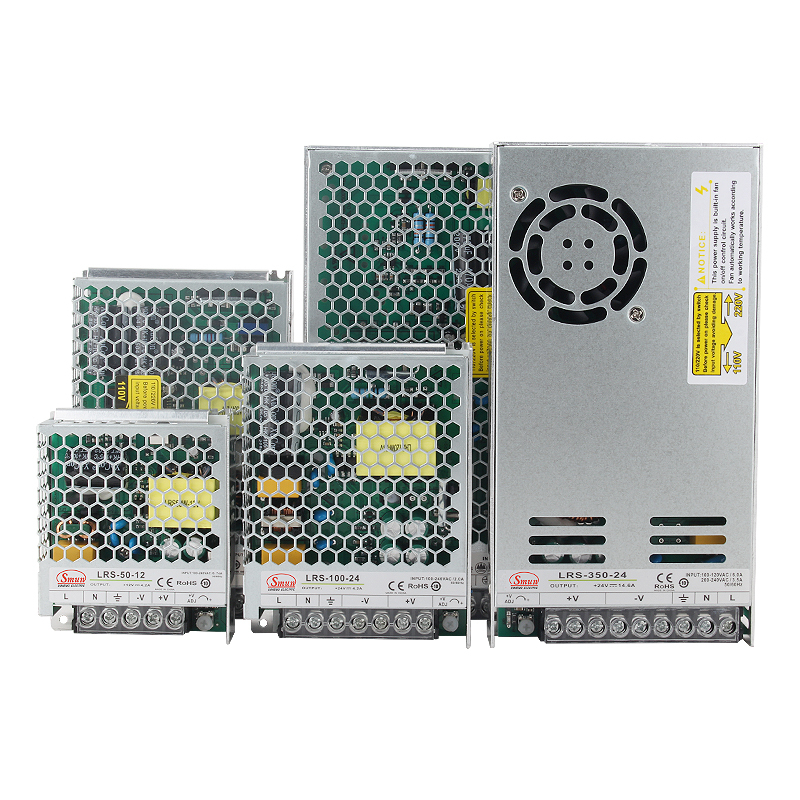
An enclosed supply wraps the conversion stage in a metal case, frequently perforated for convection. The published enclosed type power supplies include thin, low-profile formats designed for tight panels and higher-power chassis formats with an internal fan.
Because the barrier now belongs to the component rather than to the assembly. The user cannot touch a live part through a closed case, so the assembly-level creepage question reduces to the input and output wiring entries. That is the single largest reason enclosed units dominate products installed in the field by end users rather than by a trained panel builder.
Panel builders who must fit a supply into a shallow DIN-rail cabinet, machine builders shipping a sealed control box, and any product where the supply is visible to the end user. A thin enclosed format such as the LRS Series 35W–600W thin enclosed PSU exists precisely to reconcile the protection of a case with the depth limits of a modern control panel.
Table 1: Open frame vs enclosed switching power supply
Dimension | Open frame | Enclosed |
|---|---|---|
Mechanical form | Populated board, exposed parts | Case or perforated cover |
Thermal path | Direct convection from components | Convection through the cover |
Creepage and clearance | Must be engineered at assembly level | Largely resolved by the case |
Finger-safe terminals | Achieved by the host enclosure | Achieved by the case |
EMI shielding | None from the supply itself | Partial, from the metal cover |
Safety standard pathway | Assembly-level assessment | Component-level assessment plus wiring entries |
Maintenance model | Factory-integrated replacement | Field-replaceable module |
Typical application | Chassis-integrated OEM equipment | Panel builds, standalone and field-served products |
Relative cost at equal power | Lower | Higher |
Cooling options | Natural convection or forced air | Natural convection; fan on high-power formats |
Creepage is the distance along a surface between two conductive parts; clearance is the distance through air. Both are measured in the assembly as installed, not on the bare board. An open frame supply that looks compliant on the bench can fail once wiring enters the terminals at an angle, so route conductors so that a loose strand or slipped wire cannot bridge primary and secondary.
A finger-safe terminal is one whose live parts cannot be contacted by a standard test finger in the installed position. Recessed screws, hinged covers and shroud plates achieve this; exposed screw heads do not. Where the format is open frame, the surrounding cabinet or an add-on terminal cover meets the requirement.
Forced airflow is needed when the ambient inside the cabinet exceeds what the convection path can reject at the required load. Read the derating curve at the real internal ambient and mounting orientation, then decide whether a fan is cheaper than a larger supply. A fan also brings a moving part, a dust path and a maintenance item, so make it a deliberate decision.
The chassis becomes part of the thermal path and, to some degree, of the EMI structure. That is usually favourable, but the chassis temperature also rises. Bonding the frame to the chassis is standard practice; verify the effect on nearby components rather than assuming the metal carries the heat away.
The applicable standard follows the end product, not the power supply. IEC/EN 62368-1 covers audio/video, information and communication technology equipment and has largely replaced the older 60950-1 and 60065 for that family. IEC/EN 60601-1 applies to medical electrical equipment and adds requirements such as leakage current limits that constrain the choice of supply. Read the standard that governs your end product, then select the format that lets the assembly satisfy it — and obtain the supplier's own declaration rather than assuming compliance from a datasheet summary.
IEC 61000-3-2 sets limits on harmonic current emissions for equipment connected to the public low-voltage supply, with applicability depending on equipment class and input current. Because those limits apply to the end equipment rather than to a module in isolation, a supply with power factor correction at the front end simplifies the argument considerably. Confirm the applicable edition and scope with your compliance partner.
A power-factor-corrected front end draws current in a shape closer to the supply voltage waveform, which raises the power factor and lowers harmonic content. Published figures illustrate the difference: the RSP-320 320W PFC power supply is specified with power factor greater than 0.95 at 230 VAC and greater than 0.98 at 115 VAC full load, input current of 4A at 115 VAC and 2A at 230 VAC, surge current of 20A and 40A respectively, input efficiency of 88–90% depending on model, and leakage current below 1.5 mA at 240 VAC. The trade is a higher component count and unit price against a simpler compliance path.
Table 2: Power and output ranges available across series
Series | Published wattage | Published output voltages | Format note |
|---|---|---|---|
S Series | 15W to 1200W (series designation); datasheet models S-25 to S-600 | 5V, 12V, 15V, 24V, 48V, 60V | Universal-input convection-cooled formats |
LRS Series | 35W to 600W | 3.3V, 5V, 12V, 15V, 24V, 36V, 48V | Thin enclosed, low-profile panel format |
RSP-200 | 200W | 12V, 24V, 27.3V | PFC front end, multi-application |
RSP-320 | 320W | 12V, 15V, 24V | PFC front end, single output |
RSP-2000 | 2000W | Adjustable 24V–150V | Chassis format, panel or DIN-rail adapter |
RSP-3000 | 3000W at 220 VAC input | Adjustable 17–25V (24V model), 25–36.5V (36V model) | Chassis format with fan |
Series ranges above are quoted from the published product designations and specification tables. Confirm the exact model, input range and adjustment window on the datasheet before ordering.
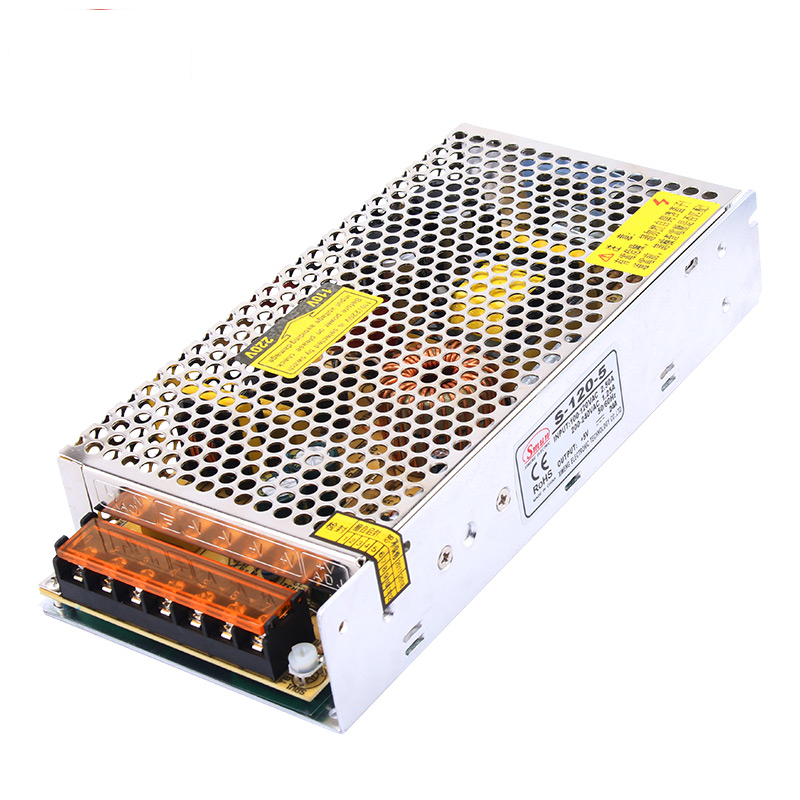
The AC/DC switching power supply series spans a wide enough wattage range that format choice and thermal headroom interact directly. Consider a panel that needs 200W of continuous output.
Step 1 — Establish the internal ambient. Measure the air temperature inside the closed cabinet at the mounting position, not the room temperature. Assume for this example 50 °C.
Step 2 — Take the load requirement. The load draws 200W continuously. On a 200W-rated unit that is a 100% load with no margin — acceptable only if the derating curve permits it at 50 °C.
Step 3 — Read the derating curve at the real ambient. Manufacturer curves typically allow full rated power to a defined temperature and reduce it above that point. If the curve permits full power only to 45 °C and derates above it, a 200W unit does not deliver 200W at 50 °C. Select a higher rating or improve the airflow.
Step 4 — Check the enclosure effect. An enclosed unit adds thermal resistance between the components and the cabinet air. Compare the derating curves of the open frame and enclosed candidates at the same ambient rather than assuming they are equal.
Step 5 — Decide between more watts and more airflow. The cheaper route in unit cost is usually to increase the wattage; the cheaper route in enclosure volume is usually to improve the airflow path. Both must be evaluated against the derating curve.
Illustrative method only; not a SMUN product specification.
Who can touch the supply in service? If anyone other than a trained panel builder, start with an enclosed format.
What is the internal ambient at the mounting position? This number, not the room temperature, selects the wattage.
What is the deepest space available? Thin enclosed and open frame formats differ substantially in mounting depth.
Which standard governs the end product? That standard, not a preference, decides the leakage and spacing requirements.
How will the unit be replaced? Field replacement favours an enclosed module; factory integration favours open frame.
Answer those five and the shortlist typically collapses to two or three series.
Open frame and enclosed power supplies are not competing products — they are two mounting philosophies for the same conversion circuitry. Open frame wins when the host cabinet already supplies the barrier, the airflow and the mounting structure, and when the assembly is built by a trained integrator. Enclosed wins whenever the supply must protect itself, whether because the end user can reach it, the environment is contaminated, or the unit ships and is serviced as a module.
The decision is therefore made in the mechanical design, not the electrical specification. Fix the internal ambient, the available depth, the finger-safety requirement and the applicable standard first; the wattage and the series then follow. Reversing that order is the most common reason a supply selection has to be repeated late in a project.
Before requesting a quotation, confirm three things in writing: the internal ambient at the mounting position, the derating curve at that ambient, and the supplier's declaration for the standard your end product must satisfy.
A: Only if the assembly as a whole prevents contact with live parts and satisfies the spacing requirements of the standard governing the end product. The open frame format transfers those obligations to your enclosure design.
A: The cover adds thermal resistance between the components and the surrounding air, so the same output power usually means a higher internal temperature rise. Compare the derating curves of both formats at your real internal ambient.
A: That depends on the equipment class, the input current and the applicable edition of the harmonic current limits. IEC 61000-3-2 governs harmonic current emissions for equipment connected to the public low-voltage supply. Confirm the scope with your compliance partner; a PFC front end is a common route to satisfying the limits.
A: Enough that the derating curve at your measured internal ambient still covers the load, including start-up inrush and expected ageing. Reading the curve at the real ambient, not the nominal rating, is what turns the calculation into a decision.
A: Thin enclosed formats are designed for shallow DIN-rail enclosures, and dedicated DIN-rail series exist for cabinet builds. Open frame units need a host enclosure to provide the barrier and airflow path, which a DIN-rail cabinet does not always offer.