
- All
- Product Name
- Product Keyword
- Product Model
- Product Summary
- Product Description
- Multi Field Search
Views: 0 Author: Site Editor Publish Time: 2026-10-19 Origin: Site


In industrial control cabinet design, selecting the right power supply form factor directly impacts assembly time. It also influences thermal management and long-term maintenance costs. Engineers often focus heavily on electrical requirements. However, the physical packaging holds equal importance. Getting this physical choice right prevents expensive panel redesigns later on. A bad choice leads to cramped wiring. While electrical specifications narrow down your initial list, the physical mounting method dictates true integration. It determines your layout strategy. This guide provides a direct, technical comparison of these two popular mounting styles. We help electrical engineers and system integrators finalize their Bill of Materials (BOM). We remove the guesswork from your component selection process. You will understand how to evaluate spatial limitations. You will also learn to assess thermal dynamics and maintenance requirements properly. We aim to help you select the perfect power unit for your next industrial project.
Understanding industrial power supplies starts with their mechanical foundations. We categorize these devices primarily by how they mount inside a control panel. You must understand the core philosophy behind each design. They serve fundamentally different integration strategies.
The DIN Rail Approach: Manufacturers build these units specifically for industry standardization. They design them to clip directly onto 35mm TS35 standard rails (often referred to as top-hat rails conforming to IEC 60715). You mount them right alongside programmable logic controllers (PLCs), relays, and circuit breakers. This method focuses heavily on modularity. It allows you to organize automation components neatly in horizontal rows. The design philosophy emphasizes rapid deployment. It creates a unified, organized visual layout inside the enclosure. You can shift components left or right easily during assembly.
The Enclosed (Chassis-Mount) Approach: This represents a highly traditional metal-framed unit. It often features a perforated aluminum or steel casing for passive airflow. You bolt this unit directly to the cabinet’s metal backplate. You can also mount it directly to a machine chassis. It provides a highly secure, permanent mounting solution. Engineers have used this robust method for decades in heavy manufacturing equipment.
When framing the central debate of an enclosed vs DIN rail power supply, view it as a matter of mechanical integration. It rarely comes down to electrical performance differences. Both styles can deliver highly stable DC power. Your physical layout dictates the winner. Your assembly workflow also plays a massive role in this final choice.
We must evaluate these devices across several strict physical parameters. You cannot rely on electrical specifications alone. Let us break down the core dimensions that affect cabinet builders daily.
How quickly can you mount the unit? This question directly affects your production budget. Skilled labor remains expensive.
DIN Rail: The built-in snap-on mechanism reduces installation to mere seconds. You need zero drilling. You require zero tapping. Panel builders highly favor this style for rapid assembly. They simply hook the top lip over the metal rail. They then snap the bottom spring clip into place. A satisfying click tells you it is secure. This tool-less approach removes human error. It speeds up line production immensely.
Enclosed: This style demands significantly more manual effort. It requires precise measuring on the backplate. You must mark the holes, center-punch them, and drill into the metal. Then, you tap the threads. Finally, you clean up the metal shavings. Metal shavings can cause catastrophic electrical shorts if left behind. You then screw the unit down manually. This process increases labor time per unit dramatically. Such a workflow scales poorly in high-volume cabinet production. You pay substantially more for assembly labor over time.
You must evaluate how each unit occupies three-dimensional physical space. Engineers often forget the depth dimension when planning layouts.
Footprint vs. Volume: Enclosed units generally have a wider two-dimensional footprint. However, they maintain a much lower profile. They hug the backplate closely. Conversely, rail-mounted units are narrower horizontally. They save valuable rail space for other automated components. However, they possess a higher depth profile. They protrude much further out into the cabinet space. You must ensure they do not hit the cabinet door when closed.
Clearance Rules: You must follow mandatory spacing requirements for both styles. Proper spacing prevents dangerous thermal bottlenecks. Manufacturers typically recommend 20 to 50 millimeters of clearance above and below standard convection units. Ignoring these rules causes internal temperatures to spike. High heat leads to premature capacitor failure. Always consult the specific datasheet for clearance limits before finalizing your CAD drawings.
Heat remains the ultimate enemy of electronic components. You must manage it effectively to ensure longevity.
Convection Dynamics: A well-designed DIN rail power supply leverages natural vertical convection. Heat rises upward through internal cooling chimneys. This vertical airflow cools the internal components naturally. The upright orientation aids this chimney effect perfectly. The design inherently promotes better passive cooling without external assistance.
Conduction & Forced Air: Enclosed units often rely heavily on conduction. They transfer heat directly to the cold metal backplate. Sometimes, high-wattage enclosed units require built-in DC cooling fans. Fans introduce moving parts into your system. Moving parts eventually fail. Dust clogs fan bearings over time. You must use fans to maintain operating temperatures under heavy loads, but they introduce new maintenance risks.
Mechanical stress plays a huge role in harsh environments. You must plan for physical movement.
Compare mounting stability carefully in high-vibration environments. Think of heavy stamping machinery or maritime shipboard applications. Securely bolted enclosed units often edge out standard spring clips here. Four rigid steel screws simply will not shake loose easily. They withstand severe G-forces. You might need to specify ruggedized metal rail brackets if you choose the modular method in these settings. Cheap plastic clips can snap under extreme mechanical shock.
Pay close attention to industrial compliance. Familiarize yourself with UL508, UL61010-1, and UL62368-1 standard requirements. Both form factors offer fully compliant models. You must verify the specific safety certifications required for your intended market region.
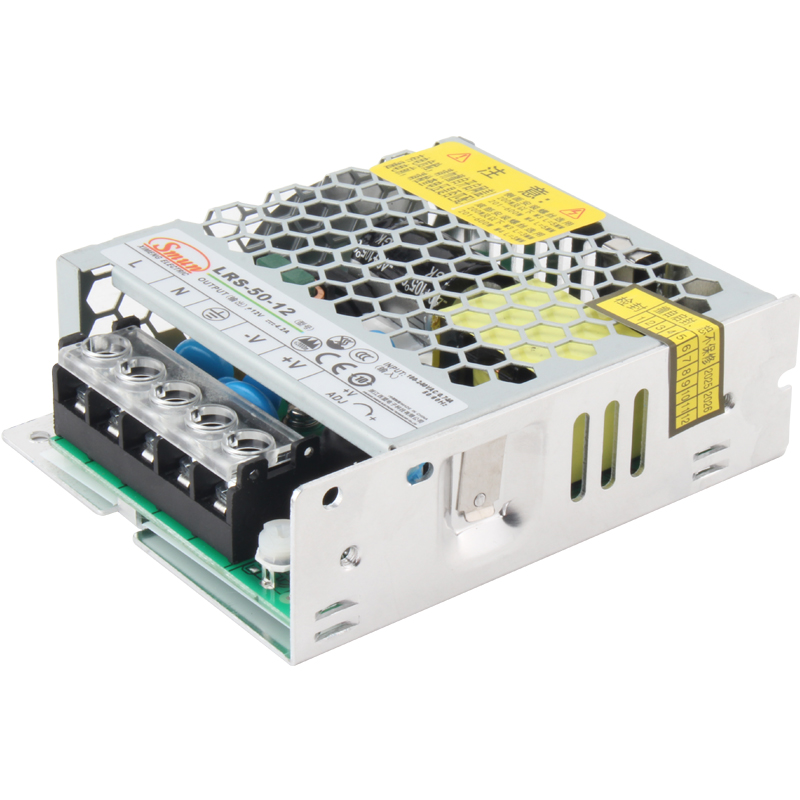
Sometimes, traditional chassis mounting makes the most strategic sense. Let us examine a specific industry standard to understand why.
Strategic Fit: These units prove ideal for cost-sensitive, high-volume OEM equipment. Engineers often integrate the power supply directly into the machine chassis itself. They skip the standardized, separate control panel entirely. This direct machine mounting saves valuable space. It eliminates the need for an external electrical box. You see this often in 3D printers, CNC routers, and automated vending machines.
Keyword Focus: We must analyze the LRS enclosed power supply series. It stands as an absolute standard industry benchmark. It delivers low-profile, economical power reliably. Engineers trust this series globally for general automation tasks.
Advantages: You get an extremely competitive price-per-watt ratio. You also benefit from an exceptionally low profile. Many models measure under 30 millimeters thick. This 1U form factor helps tremendously in tight vertical spaces. You can hide them easily behind interactive displays. You can tuck them inside shallow operator panels where traditional blocks fail to fit.
Limitations: You will find them much slower to replace in the field. Maintenance technicians must remove mounting screws manually in cramped spaces. They also offer less native integration with standard industrial control loops. They lack the modular bridging features found on rail-mounted counterparts. You cannot daisy-chain them as cleanly.
We must analyze the financial implications of your choice over time. Do not just look at the initial purchase order. Look at the operational lifecycle.
Upfront Hardware Cost: We must acknowledge the initial pricing reality frankly. Enclosed units are generally 20% to 40% cheaper at the hardware level. This significant price gap makes them highly attractive. Strict budget projects often default to this style. When you build ten thousand machines, saving twenty dollars per unit matters immensely to the bottom line.
Downtime and Replacement: You need to calculate MTTR (Mean Time To Repair). Replacing a bolted-in enclosed PSU takes significant time. You must shut down the machine completely. A technician must unscrew the chassis safely. They must carefully rewire the terminal blocks. Replacing a rail-mounted unit requires mere minutes. You just un-clip the broken unit. You re-clip the new one. Some premium rail units even feature pluggable terminal blocks. You transfer the pluggable block instantly without touching bare wires. This speed saves hundreds of dollars in factory downtime.
Scalability: Rail setups allow for incredibly easy future expansion. You can add redundancy modules seamlessly later on. You can attach DC UPS battery backups on the exact same rail. This flexibility future-proofs your cabinet design. Bolted setups lock you into a rigid physical footprint. If you need more power later, you must drill new holes.
Make your final choice using clear criteria. We have structured a practical breakdown to guide you.
Choose DIN Rail When:
Choose Enclosed (Chassis-Mount) When:
Mounting Style Comparison Summary
| Evaluation Criteria | Rail Mounted Approach | Chassis Mounted Approach |
|---|---|---|
| Installation Speed | Very Fast (Tool-less snap) | Slow (Requires drilling/screwing) |
| Upfront Cost | Higher initial investment | Lower (Highly economical) |
| Space Profile | Narrow footprint, high depth | Wide footprint, low depth |
| Vibration Tolerance | Moderate (Requires metal clips for high shock) | Excellent (Bolted directly to metal chassis) |
| Thermal Management | Excellent natural vertical convection | Relies on backplate conduction or built-in fans |
| System Modularity | High (Easily scalable) | Low (Fixed physical footprint) |
Let us review the steps to verify physical fitment before purchasing. Follow these strictly to avoid costly assembly errors.
The choice between these two styles fundamentally remains a choice of mechanical architecture. It represents your lifecycle strategy, not just power delivery. Both types deliver stable voltage. However, they integrate into your workflow differently. You are designing a physical ecosystem. A cohesive layout saves time during both assembly and future maintenance.
We remind engineers to verify thermal derating curves meticulously. Always check physical dimension limits before final procurement. Heat will destroy your electrical components if ignored. Ensure your cabinet provides adequate breathing room for whichever style you select. Do not pack units too tightly.
We prompt buyers to review specific datasheet parameters carefully. Request a sample unit for physical fit-testing inside your prototype cabinet. Consult with your technical sales team for accurate bulk quoting and lead time information. Make your choice based on solid engineering data, not just industry habit.
A: Yes, you can adapt them using aftermarket mounting brackets. However, this approach adds extra cost and increases the physical depth of the unit. It may also negatively impact thermal dissipation compared to a native unit designed specifically for rail mounting. We recommend buying a native unit whenever possible.
A: Typically, no. Most industrial models are engineered specifically for fanless natural convection cooling. This design greatly improves the Mean Time Between Failures (MTBF) by eliminating moving parts. Fans frequently break down in dusty industrial environments, so avoiding them increases reliability.
A: Yes, they are perfectly safe provided they meet the required safety certifications for your specific region. You must install them with proper terminal protection covers to prevent accidental contact with live wires. Standard rail units often shroud these terminals by design, so enclosed units require a bit more attention to touch-safety during installation.