Statistically, the driver remains the most common point of failure in outdoor LED systems. These components routinely compromise massive commercial installations prematurely. When failures occur, you face staggering labor and equipment expenses. Replacing a broken unit on a streetlight or stadium mast drains project budgets quickly. This high cost of failure highlights a critical procurement reality. Sourcing from partners prioritizing component resilience is absolutely non-negotiable. This guide provides a rigorous framework for vetting your manufacturing partners. We will help you select a reliable led driver factory oem capable of delivering long-term stability. You will learn how to evaluate technical capabilities properly. We also explore ways to verify certifications and implement effective shortlisting strategies. Armed against harsh environments, you can confidently secure robust components for your next major installation.
Key Takeaways
Reliability Trumps Initial Cost: Component-level quality (capacitors, potting) dictates the true long-term financial viability for commercial lighting projects.
Verification is Mandatory: A legitimate LED driver factory OEM provides verifiable MTBF (Mean Time Between Failures) data and open component BOMs (Bill of Materials).
Environmental Specialization: Standard indoor drivers cannot be retrofitted; true outdoor commercial lighting drivers require specific surge protection, thermal management, and validated ingress protection.
Compliance Mitigates Risk: Selecting partners with robust local and international certifications prevents project delays and liability issues.
The Business Impact of Driver Selection in Commercial Outdoor Projects
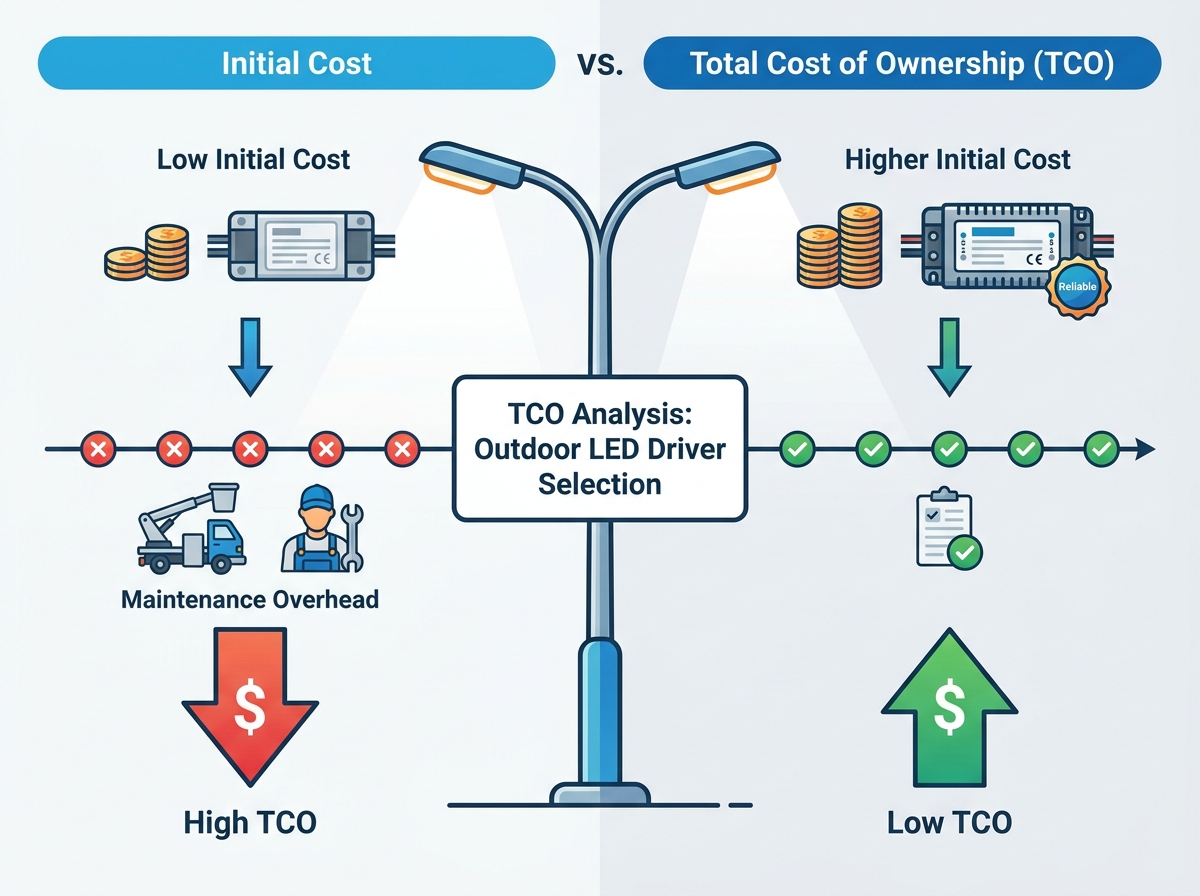
Choosing an inexpensive power supply often feels like a quick financial win. However, initial unit savings vanish rapidly during post-installation maintenance. We must contrast the minimal savings of a cheap unit against massive maintenance overhead. Replacing components on high-mast installations requires specialized equipment. You often need bucket trucks, road closure permits, and multiple certified technicians. A ten-dollar saving upfront easily transforms into a thousand-dollar maintenance ticket later.
Premature failures also inflict severe damage upon brand reputation. When a newly installed municipal lighting project goes dark, stakeholders notice immediately. Such failures damage the system integrator's credibility significantly. They also jeopardize warranty escrow payouts tied to performance milestones. Clients hold integrators fully accountable when systems fail before expected lifespans end. To protect your brand, you must source a highly durable outdoor led driver designed specifically for rigorous deployments.
Commercial outdoor environments subject electronics to extreme physical stress. Manufacturers must design products to survive these harsh realities continuously. We categorize these environmental extremes into four primary threats:
Wide Temperature Swings: Units must endure freezing winters and blistering summer heat without thermal degradation.
High Humidity: Moisture causes internal corrosion if enclosures lack proper sealing.
Lightning Strikes: Atmospheric electrical discharges can instantly destroy unprotected circuitry.
Grid Voltage Fluctuations: Industrial zones frequently experience unstable AC inputs requiring robust internal regulation.
Essential Technical Capabilities for an Outdoor LED Driver Factory
Evaluating technical competence separates genuine manufacturers from mere assemblers. You must look beyond marketing brochures to understand actual engineering capabilities. Ingress protection ratings often cause significant confusion during procurement. We must differentiate between theoretical design ratings and actual physical testing.
A true waterproof led driver requires extensive validation. Manufacturers should submerge test batches to verify enclosure integrity over time. High-quality factories utilize premium thermal potting compounds inside their units. This specialized epoxy or silicone serves a dual purpose. It prevents moisture ingress entirely and transfers internal heat to the outer shell. You absolutely need a verified ip67 led power supply to guarantee long-term outdoor survival.
Matching the correct topology to your specific application is equally critical. Projects require different electrical delivery methods based on fixture design. A constant current setup works best for high-power street and area lighting. In contrast, you specify a constant voltage led driver for parallel loads. These include architectural lighting, outdoor signage, and long strip lighting runs.
Surge protection represents another non-negotiable technical capability. Outdoor lighting grids experience frequent transient voltage spikes. A competent factory integrates robust transient voltage surge suppression directly into the circuit. Minimum requirements dictate 6kV line-to-line and 10kV line-to-ground protection ratings. These built-in safeguards allow the unit to survive grid anomalies safely.
Thermal management architecture ultimately dictates component lifespan. We must carefully evaluate how the factory approaches internal heat dissipation. Aluminum enclosures perform significantly better than plastic alternatives outdoors. Internal component spacing also prevents localized heat islands from forming on the PCB. Proper thermal paste application between active components and the chassis is vital.
Below is a quick reference chart outlining topology applications.
Topology Type
Primary Application
Common Output Ranges
Key Benefit
Constant Current (CC)
Streetlights, High-bay, Area Lights
350mA - 2100mA+
Prevents thermal runaway in high-power LEDs
Constant Voltage (CV)
Architectural, Signage, Strip Lights
12V, 24V, 48V
Allows flexible parallel wiring of multiple modules
Manufacturing Standards and Quality Control Vetting
Reliability originates from transparent component sourcing and rigorous quality control. You must assess the factory’s supply chain practices deeply. The longevity of any power supply heavily depends on its internal capacitors. Electrolytic capacitors typically degrade first under high thermal stress. Premium longevity hinges entirely on utilizing Tier-1 electrolytic capacitors. Sourcing components from brands like Rubycon or Nippon Chemi-Con indicates strong manufacturing integrity.
Burn-in testing protocols reveal a factory's commitment to quality assurance. Top-tier facilities never skip this crucial manufacturing phase. They subject 100% of their output to full-load burn-in testing. These tests occur inside specialized rooms maintained at elevated temperatures. Units typically run between 40°C and 50°C for 12 to 24 hours continuously. This rigorous process forces weak internal components to fail before shipping. Skipping this step pushes infant mortality failures onto the end customer.
Modern factories utilize advanced automated production to ensure batch-to-batch consistency. Manual assembly introduces human error into highly sensitive electronic circuits. You should look for specific automated technologies on the production floor:
Surface-Mount Technology (SMT) machines for precise component placement.
Automated Optical Inspection (AOI) systems to catch soldering defects instantly.
Automated potting machines to ensure uniform thermal compound distribution.
Computerized wave soldering for strong, reliable through-hole connections.
Defect rate tolerances provide a clear window into factory standards. We must establish acceptable failure rate benchmarks for commercial projects. The industry standard for premium drivers falls below 0.5%. Elite manufacturers consistently achieve defect rates under 0.2%. If a factory considers a 2% failure rate acceptable, they are unsuitable for major outdoor projects.
Certifications, Compliance, and OEM Warranty Realities
Navigating global electrical standards protects your project from severe liability issues. Every region mandates specific safety and performance benchmarks. A reputable factory maps out necessary certifications clearly. They should readily provide UL Class P or Class 2 documentation for North America. European markets demand valid ENEC, CE, and CB certifications. Australian deployments strictly require SAA approvals. You must verify actual certificate numbers through official databases. Relying on unverified claims or fake logos invites disastrous project delays.
Warranties require careful deconstruction before signing any purchase agreements. Factories frequently advertise a standard "5-Year Warranty" in bold lettering. However, the fine print often contains restrictive operational clauses. We must analyze warranty conditions tied to the maximum case temperature. This measurement is universally known as the Tc point. If a commercial lighting driver exceeds its rated Tc point, the warranty voids immediately. Operating hours also factor heavily into these agreements. A five-year warranty might only cover 20,000 actual operating hours.
Your project might require specific custom OEM or ODM modifications. Standard off-the-shelf units rarely meet complex municipal bidding requirements perfectly. Assess the factory's capability to provide custom tooling quickly. They should offer customized output programming via NFC or DALI protocols. Minor software modifications should not trigger complete re-certification cycles. A capable partner can apply private labeling while maintaining existing safety approvals seamlessly.
Shortlisting Logic: Next Steps for Vetting Your Manufacturing Partner
Transitioning from initial research to factory shortlisting demands a systematic approach. You must request the right documentation immediately during negotiations. Ask the factory for third-party LM-79 and LM-80 reports regarding the paired luminaire systems. Crucially, demand detailed driver life-cycle test reports. These documents prove longevity claims through accelerated thermal testing data.
Establishing a sample evaluation protocol prevents costly bulk-order mistakes. Never purchase thousands of units based purely on a specification sheet. You should order a small sample batch for rigorous independent testing. Define clear steps for this evaluation process. Perform a teardown analysis to verify internal component brands. Subject the samples to extreme temperature cycling chambers. Finally, conduct hipot testing to ensure robust dielectric strength.
Assessing supply chain resilience ensures your project stays on schedule. Global component shortages can paralyze poorly managed manufacturing facilities. Evaluate the factory's total monthly production capacity accurately. Discuss typical lead times during peak manufacturing seasons transparently. You also need to determine their Minimum Order Quantity (MOQ) flexibility. A good partner accommodates smaller pilot runs before demanding massive commitments.
A final factory audit remains the ultimate verification step. If traveling is impossible, mandate a comprehensive live video tour. We highly recommend hiring a third-party auditing firm like SGS or TÜV. These professionals will verify production lines and testing equipment objectively. They ensure the facility actually exists and operates to stated standards.
Review this checklist before authorizing any bulk manufacturing orders.
Verification Category
Specific Action Required
Acceptance Criteria
Component Quality
Request open BOM (Bill of Materials)
Presence of Tier-1 capacitors and ICs
Testing Protocols
Review burn-in room logs
100% testing at 40°C+ for min 12 hours
Certification Validity
Check UL/CE databases
Active certificates matching factory name
Production Capacity
Third-party facility audit
Verified SMT lines and automated potting
Conclusion
Finding the best factory partner requires balancing upfront unit economics against verifiable engineering practices. You cannot afford to prioritize slight unit discounts over proven component resilience. Rigorous testing protocols ensure your outdoor installations survive harsh environmental realities. Verification of certifications prevents legal liabilities and installation delays.
We encourage project decision-makers to prioritize highly transparent manufacturers. Demand open component lists and verifiable life-cycle data. Seek out suppliers who act as dedicated technical partners rather than mere order-takers. By demanding excellence during the procurement phase, you guarantee stability for your entire commercial lighting network.
FAQ
Q: What is the standard MOQ for a custom outdoor LED driver?
A: The standard Minimum Order Quantity usually ranges between 500 and 1000 units. For fully customized units requiring new tooling or unique enclosure designs, factories may charge upfront setup fees. Some manufacturers waive these setup costs if your annual volume commitment exceeds 5,000 units.
Q: How does a constant voltage LED driver differ from constant current in outdoor applications?
A: A constant voltage unit maintains a steady electrical pressure (like 12V or 24V) for parallel architectural runs or strip lights. Constant current units maintain steady electrical flow (amperage) regardless of load voltage changes. We use constant current exclusively for high-power series arrays like streetlights to prevent thermal runaway.
Q: Can an IP67 LED power supply be completely submerged in water?
A: No. An IP67 rating only protects against temporary immersion in water up to 1 meter deep for 30 minutes. It handles heavy rain and splashing perfectly. For continuous underwater submersion, like pool or fountain lighting, you must specify an IP68-rated driver.
Q: Why is the Tc (Case Temperature) point critical for commercial lighting driver warranties?
A: The Tc point designates the maximum allowable temperature on the driver's outer casing. Operating a unit above this specific temperature drastically accelerates the degradation of internal electrolytic capacitors. Exceeding the Tc limit voids the manufacturer warranty because it predictably cuts the expected lifespan in half.