A CCTV system is only as reliable as the power behind it. Many buyers spend most of their time comparing cameras, lenses, storage capacity, or software features, yet the power supply often receives far less attention than it deserves. From our perspective, this is one of the most common reasons why otherwise good security monitoring systems later suffer from unstable performance, image loss, camera rebooting, nighttime failure, or shortened equipment life. A proper Power supply does much more than simply turn a camera on. It helps maintain voltage stability, supports long cable runs, protects devices from electrical issues, and contributes directly to the long-term reliability of the full monitoring system.
Why the CCTV Power Supply Matters More Than Many Buyers Think
In many projects, the power supply is treated as a supporting accessory rather than a core system component. That approach often leads to avoidable problems. Cameras may work normally during testing, but once the system is installed and exposed to real conditions, power-related issues begin to appear.
A poor power supply selection can lead to voltage drop, especially in larger systems or longer cable runs. It can also create inconsistent startup behavior when multiple cameras power on at the same time. In outdoor or industrial environments, unstable power may cause repeated device resets, poor infrared performance at night, or even permanent damage.
Start With the Basic Electrical Requirements
Before comparing product types, the first step is to understand the actual electrical needs of the cameras and related devices.
Check the rated voltage
Most CCTV cameras commonly use 12V DC, 24V AC, or PoE-based power standards. The first rule is simple: the power supply output must match the camera’s required input voltage. A mismatch can result in unstable operation or hardware damage.
If a camera is designed for 12V DC, using the wrong type of supply is a serious risk. The same applies to accessories such as video baluns, transmission equipment, or IR illuminators that may have their own power requirements.
Calculate the current draw
Every camera consumes a certain amount of current, usually listed in amperes or milliamps. The total current requirement of the system should be calculated carefully, especially when one power supply is used for multiple cameras.
For example, if each camera requires 1A and there are 8 cameras on one central power unit, the theoretical requirement is 8A. In practice, extra margin should be reserved to avoid operating the power supply at full load continuously.
Leave a safety margin
A good rule is to leave additional capacity beyond the calculated load. This helps the system handle peak demand, startup surges, environmental variation, and future expansion. A supply that constantly runs near its maximum rating may age faster and become less stable over time.
Understand the Main Types of CCTV Power Supply
Different projects require different power supply structures. Choosing the right type depends on how the system is installed and maintained.
Individual plug-in power adapters
These are common in small systems with one or a few cameras. They are easy to install and replace, making them suitable for simple indoor projects or temporary systems.
However, if the number of cameras grows, using separate adapters for each one can become messy and harder to manage. Maintenance also becomes less convenient because each adapter is a separate point of failure.
Centralized power supply boxes
Centralized CCTV power boxes are popular in larger monitoring projects. One unit can provide power to multiple cameras from a single location, often with individual fused outputs.
This approach helps simplify maintenance and cable organization. It also allows technicians to inspect and manage the power system more efficiently. For commercial buildings, schools, stores, and medium-sized facilities, centralized power distribution is often a practical choice.
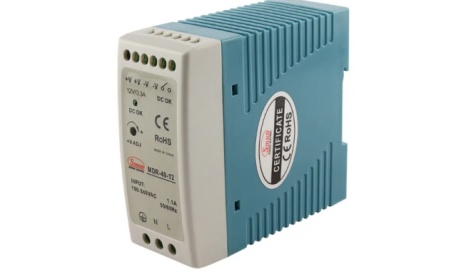
DIN rail or industrial power supplies
For industrial, transportation, or control-cabinet applications, DIN rail mounted power supplies may be preferred. These are often chosen for more demanding environments where stable output, compact structure, and integration into electrical cabinets are important.
PoE switches and PoE injectors
In IP surveillance systems, Power over Ethernet can simplify installation by transmitting power and data through the same cable. This can reduce wiring complexity and speed up deployment.
Match the Power Supply to the Size of the Monitoring System
The right selection depends heavily on project scale.
Small residential or shop systems
For a system with a few indoor cameras, a small plug-in adapter or compact multi-output power supply may be enough. The priorities here are usually ease of installation, stable operation, and reasonable cost.
Medium-sized commercial systems
For offices, schools, apartment buildings, or retail chains, centralized power supplies often make more sense. They improve wiring management and simplify maintenance when multiple cameras are involved.
Large or complex monitoring networks
For large properties, industrial zones, transportation facilities, or integrated security systems, the power solution must be planned more carefully. Output stability, surge protection, expansion capacity, and long-distance distribution all become more important.
In these cases, the CCTV power supply is not just a simple accessory. It becomes a critical part of the monitoring infrastructure.
Cable Distance and Voltage Drop Should Never Be Ignored
One of the most overlooked issues in CCTV projects is voltage drop. Even if the power supply output is correct at the source, the camera may receive less voltage after power travels through a long cable.
This is especially important in larger sites where cameras are mounted far from the control room or power cabinet. When voltage drops too much, the camera may show unstable video, weak infrared function, or intermittent rebooting.
Several factors affect voltage drop:
Cable length
Cable thickness
Current draw of the camera
Environmental temperature
Whether multiple devices share the same route
For longer distances, it may be necessary to use thicker cable, choose a different voltage architecture, shorten the run, or redesign the distribution method.
The lesson is simple: power supply selection cannot be separated from wiring design. A high-quality power supply still needs a suitable transmission plan.
Key Features to Look for in a Reliable CCTV Power Supply
When comparing products, it is helpful to look beyond the basic voltage and current figures. Several features can make a real difference in long-term performance.
Stable output
Stable voltage and current output are essential for camera reliability. The better the stability, the lower the risk of image problems or system resets.
Overload protection
A power supply should include protection against overload. This helps reduce the chance of damage if the connected load exceeds normal limits.
Short-circuit protection
Short-circuit protection is important for installation safety and ongoing operation. If wiring faults occur, the power supply should respond quickly to limit damage.
Overvoltage protection
Cameras and related devices can be sensitive to electrical abnormalities. Overvoltage protection helps reduce risk in unstable power environments.
Good heat dissipation
Heat affects lifespan. A well-designed product should manage heat efficiently, especially in enclosed spaces or high-temperature areas.
Build quality and component quality
Internal component quality matters. A well-manufactured power supply usually performs more consistently over time and offers better reliability in continuous-use monitoring systems.
Practical Comparison Table for CCTV Power Supply Selection
Project Type | Common Camera Quantity | Recommended Power Supply Type | Main Consideration | Typical Advantage |
Small home or shop | 1–4 | Individual adapter or small multi-output unit | Simple installation | Low complexity |
Office or retail site | 4–16 | Centralized CCTV power supply box | Easier maintenance | Better cable management |
Apartment or school | 8–32 | Centralized multi-channel power supply | Stable distribution | Organized servicing |
Industrial facility | 8+ | DIN rail or industrial-grade power supply | Harsh environment | Higher durability |
IP surveillance network | Varies | PoE switch or injector | Power and data integration | Reduced wiring |
Conclusion
A dependable CCTV system begins with dependable power. While cameras and recorders are the visible parts of a monitoring project, the power system is what keeps everything working consistently day after day. From our experience, the best Power supply choice is the one that fits the real operating conditions of the site, provides enough capacity for stable performance, and leaves room for safe long-term use. Zhejiang Ximeng Electronic Technology Co., Ltd. focuses on practical power solutions for security monitoring applications, helping customers match product performance with actual project needs rather than short-term assumptions. If you are evaluating power options for a new or existing CCTV system, we welcome you to learn more about Zhejiang Ximeng Electronic Technology Co., Ltd. and contact us for further product information and application support.
FAQ
What is the most common voltage for a CCTV power supply?
Many CCTV cameras use 12V DC, but some systems use 24V AC or PoE. The correct choice depends on the camera specification and system design.
How do I know how much current my CCTV power supply needs?
Add together the current requirements of all connected cameras and leave extra margin for stable operation, startup demand, and future expansion.
Why does my CCTV camera fail at night even though it works during the day?
A common reason is insufficient power when infrared functions activate at night. Voltage drop or lack of current margin can cause rebooting or image failure.
Is a centralized CCTV power supply better than separate adapters?
For multi-camera systems, a centralized power supply often improves cable management, maintenance efficiency, and overall system organization.