Sourcing power electronics from overseas carries high stakes. A compromised power supply unit (PSU) can easily trigger catastrophic system failures. It often leads to harsh compliance rejections or widespread product recalls. You cannot afford to guess when safety and brand reputation are on the line.
China offers a vast ecosystem for power electronics manufacturing. However, quality variance remains massive. Component sourcing reliability and engineering capabilities differ greatly across regions. Navigating this landscape requires careful due diligence and a trained eye.
This guide equips engineering and procurement teams with a strict, evidence-based framework. You will learn how to properly evaluate, audit, and shortlist a trustworthy manufacturing partner. We will bypass standard marketing claims. Instead, we focus directly on verifiable quality, supply chain transparency, and international compliance.
Key Takeaways
Verification over claims: Prioritize manufacturers who provide transparent Bill of Materials (BOMs) and verifiable global safety certifications (UL, TUV, CE) over those simply offering the lowest unit price.
Facility capabilities: A true OEM/ODM partner will demonstrate rigorous in-house quality control, including 100% full-load burn-in testing and Automated Optical Inspection (AOI).
Technical alignment: Ensure the supplier specializes in your exact product architecture, whether that is a standard ac dc power supply, a specialized industrial switching power supply, or a highly regulated medical-grade unit.
Supply chain resilience: Evaluate the manufacturer's component sourcing networks (e.g., capacitor brands, transformer quality) to prevent silent downgrades during mass production.
The High Stakes of PSU Sourcing: Defining Success Criteria
The PSU serves as the heartbeat of any electronic device. If it fails, the entire product fails. Poor vendor selection leads directly to high Return Merchandise Authorization (RMA) rates. You might face failed EMI/EMC compliance tests at crucial launch windows. Ultimately, these failures inflict permanent brand damage.
Procurement teams often chase the lowest initial unit price. This approach carries severe hidden risks. Saving a fraction of a dollar on cheap components frequently results in massive post-sale support burdens. Poorly constructed units cause field failures. They force expensive recalls. They damage client trust permanently. You must look beyond simple unit costs.
A truly successful partnership delivers concrete, verifiable results. First, you should expect a zero-defect arrival rate. Every unit must function correctly out of the box. Second, valid certifications must ensure seamless customs clearance. Shipments held at borders kill product timelines. Finally, reliable partners maintain stable lead times. They buffer against raw material fluctuations through smart supply chain management.
Aim for zero-defect production batches.
Demand current, verifiable safety certificates.
Insist on transparent supply chain buffers.
Decoding the Vendor Landscape: Factories vs. Trading Companies
The vendor landscape presents a confusing mix of entities. You will encounter true manufacturers, basic assemblers, and trading companies. Platforms like Alibaba blur these lines intentionally. You must differentiate them early in your sourcing process.
Dealing directly with a factory is non-negotiable for custom OEM/ODM projects. This direct relationship is vital when sourcing a complex industrial switching power supply. Technical adjustments happen frequently during development. You need direct access to the actual engineers making those changes. Middlemen slow this communication down. They often mistranslate technical requirements entirely.
Spotting trading companies requires attention to specific red flags. First, look at their product catalogs. Trading companies often sell everything from simple chargers to heavy industrial machinery. True factories maintain narrow, specialized product lines. Next, ask for deep technical documentation. Traders usually delay sending datasheets because they must request them from the actual factory. Finally, demand a live video audit of their Surface-Mount Technology (SMT) lines. Traders will invent excuses to avoid this simple request.
Evaluating Technical Breadth and Product Architectures
You must assess if a vendor's primary R&D aligns with your specific needs. A manufacturer might excel at building millions of cheap smartphone adapters. However, they likely lack the thermal management expertise required for a high-wattage enclosed power supply. High-power units demand entirely different design philosophies. Heat dissipation and component spacing become critical survival factors.
Evaluate their capabilities across standard and specialized architectures. Producing a basic single output psu is relatively simple. Complex multi-output configurations challenge a factory's engineering depth. You should also assess their competency for a universal switching psu. Handling 90-264VAC inputs reliably across diverse global power grids requires robust transformer design and precise voltage regulation.
Look for evidence of advanced design thresholds. Does the R&D team utilize LLC resonant topologies? Do they integrate modern Gallium Nitride (GaN) components? GaN integration proves a mature engineering department. It requires complex PCB layouts and advanced thermal planning. Legacy assemblers cannot manage these modern architectures. They stick to outdated, bulky designs.
Compliance, Certifications, and Global Standards
Buyers frequently fall into the certification trap. A manufacturer might proudly claim they are "CE compliant." This phrase holds zero legal or technical weight. You need vendors holding verifiable, current certificates from recognized testing laboratories. Look for marks from TUV, SGS, Intertek, or UL.
You must mandate the review of actual documentation. Request CB test reports during the initial vetting phase. Demand complete EMI/EMC lab results. Check the dates. Expired certificates indicate a factory cutting operational costs. Do not skip this crucial verification step.
Evaluate the factory through market-specific lenses. Different regions demand strict adherence to local regulations. Your supplier must understand these regional hurdles deeply.
Target Market
Required Standard/Mark
Primary Focus Area
North America
UL / FCC
Fire safety, electrical shock, electromagnetic interference.
Compulsory product safety and national quality standards.
Always practice assumption transparency. Never assume a certification for a 50W model automatically covers the 100W model in the same series. Wattage changes alter thermal and electrical profiles completely. Always verify the exact model number against the official lab database.
Auditing Quality Control and Component Traceability
Component sourcing carries immense hidden risks. The most common trap is the "golden sample" maneuver. A factory hand-builds a perfect prototype. They use premium Japanese capacitors from Rubycon or Nippon Chemi-Con. It passes all your tests perfectly. However, during mass production, they quietly substitute these with subpar, unbranded alternatives. This silent downgrade ruins field reliability.
You must audit their in-process Quality Control (QC) steps rigorously. Effective factories employ strong Incoming Quality Control (IQC) for all raw materials. They test components before assembly begins. Watch their Surface-Mount Technology (SMT) precision. Inspect their wave soldering quality. Poor wave soldering leaves cold joints. These joints crack under vibration, causing intermittent failures.
Mandatory burn-in testing separates true manufacturers from risky assemblers. A proper facility conducts 100% full-load burn-in testing on every unit. Ask for their specific duration and temperature parameters. Standard acceptable practices require 4-8 hours at 40-50°C. If they test for only 30 minutes, walk away immediately.
Finally, interrogate their Mean Time Between Failures (MTBF) claims. Do not just accept a printed number. Ask how the manufacturer calculates it. Do they use MIL-HDBK-217F standards? Can they prove it with actual accelerated life testing data? Real engineers welcome these technical questions.
The Shortlisting Framework: From Initial Contact to Final Audit
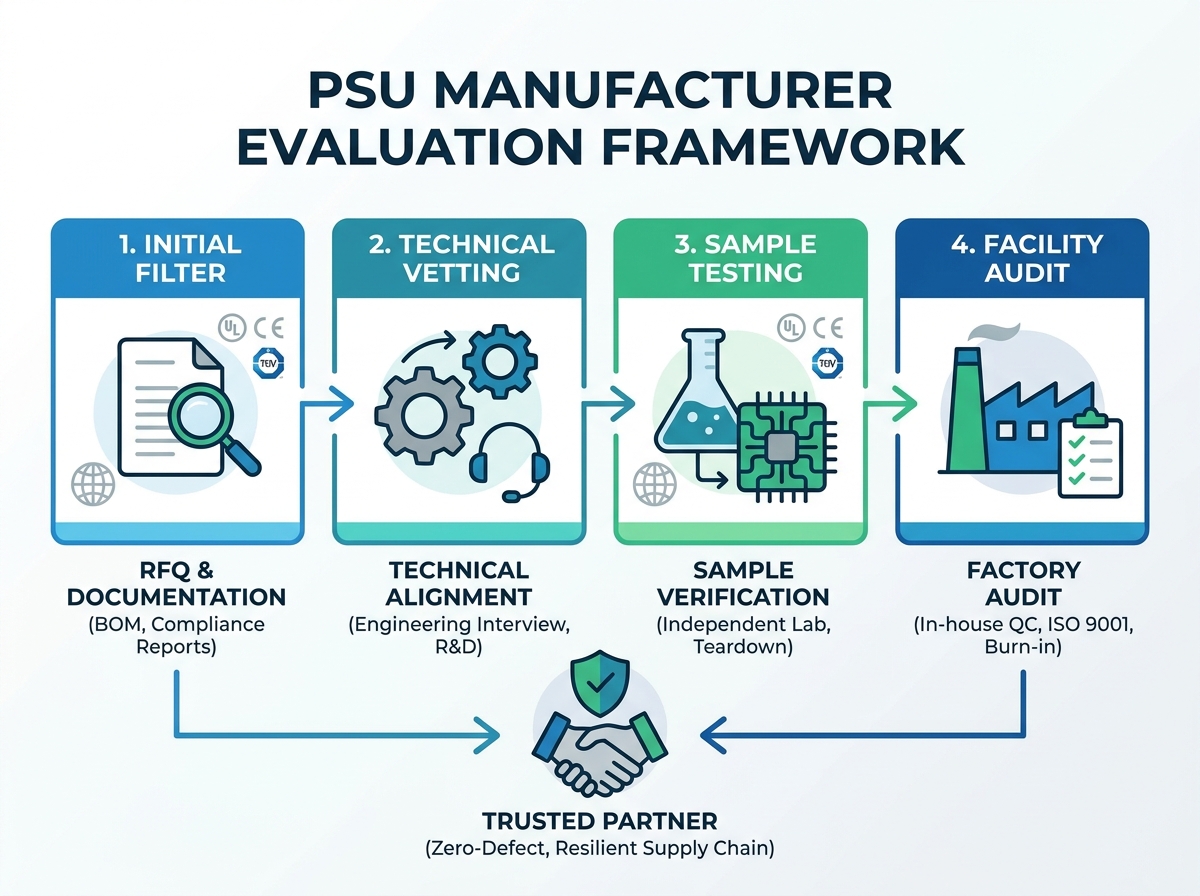
Finding the right partner requires a structured approach. You must filter out weak candidates systematically. Follow this proven four-step framework to secure a reliable manufacturing relationship.
The Initial Filter: Send a highly specific Request for Quote (RFQ). Do not just ask for prices. Require MTBF data, BOM transparency, and current compliance reports upfront. Discard any vendors who cannot provide technical datasheets promptly. Slow responses indicate they are likely traders, not factories.
The Engineering Interview: Bypass the sales representatives entirely. Schedule a video call with their lead engineers. Discuss specific thermal derating curves for your application. Ask how they plan to mitigate EMI for your device. If the engineers cannot answer directly, the factory lacks R&D depth.
Sample Evaluation & Independent Testing: Order production samples. Do not rely solely on the factory's internal testing. Send these units to a third-party lab. Alternatively, use your in-house engineering team. Conduct aggressive teardowns. Perform stress testing. Verify their efficiency claims against real-world loads.
Facility Audits: Never sign a massive contract without a physical or proxy audit. Utilize third-party auditors like VDE or independent QA firms based in China. Verify their ISO 9001/14001 compliance natively. Check the factory footprint. Ensure worker conditions meet ethical standards. This is how you identify a top-tier switching power supply manufacturer china reliably.
Following these strict steps removes emotion from the purchasing decision. It forces vendors to prove their worth through data, transparency, and engineered performance.
Conclusion
Selecting a switching power supply partner represents a technical marriage. It is never a simple transactional purchase. Your vendor's quality directly dictates your product's survival in the market. A rigorous evaluation protects your brand from disastrous failures and compliance lawsuits.
Your next step is to formalize your technical requirements. Create a strict, uncompromising spec sheet. Begin mapping out a shortlist of three to five audited factories based on the criteria discussed above. Ignore flashy B2B marketplace rankings entirely. Rely only on hard engineering data, transparent BOMs, and verifiable certifications to make your final choice.
FAQ
Q: What is the typical Minimum Order Quantity (MOQ) for a custom switching power supply in China?
A: For custom ODM designs, MOQs typically range from 1,000 to 3,000 units to cover R&D and tooling costs. For off-the-shelf standard models, MOQs can be as low as 100-500 units.
Q: How can I verify if an ac dc power supply actually meets the advertised safety standards?
A: Request the official test report and the certificate number. Go directly to the issuing laboratory's website (e.g., UL Product iQ) and input the certificate number to ensure it is active and matches the exact manufacturer and model.
Q: Why do some suppliers quote significantly lower prices for identical specifications?
A: Price discrepancies usually stem from downgraded internal components (e.g., using cheaper capacitors with shorter lifespans), omitting EMI filters, or skipping rigorous burn-in testing. Always compare the internal BOMs, not just the external spec sheet.