
- All
- Product Name
- Product Keyword
- Product Model
- Product Summary
- Product Description
- Multi Field Search
Views: 0 Author: Site Editor Publish Time: 2026-07-04 Origin: Site


Buyers routinely face a difficult dilemma when designing reliable power systems. They must balance the lower upfront cost of modified sine wave technology against the severe risk of equipment degradation and electrical inefficiency. This decision represents much more than a simple technical specification. It stands as a vital risk-management choice for critical household appliances, remote off-grid systems, and heavy-duty commercial fleets.
Connecting sensitive electronics to an incompatible power source can cause catastrophic failures. You risk destroying expensive equipment and losing power during critical moments. Our goal is to provide a clear, evidence-based framework to evaluate both waveform technologies. We will explore exactly how these signals interact with modern internal components.
You will discover how to match each inverter type precisely to your specific load profiles. We will walk you through essential performance metrics and compatibility guidelines. By the end, you will have the practical knowledge required to confidently select the correct hardware for your unique electrical demands.
Waveform quality dictates compatibility: Pure sine wave (PSW) matches grid power smoothly; modified sine wave (MSW) uses a "stair-step" output that causes high Total Harmonic Distortion (THD).
Hidden costs of MSW: While cheaper upfront, modified sine waves run AC motors up to 20% less efficiently, generating excess heat and potentially reducing equipment lifespan.
Modern reliance on PSW: Sensitive electronics, modern compressors, and medical devices strictly require pure sine wave inverters to function safely.
Supplier vetting is critical: Partnering with a vetted pure sine wave inverter manufacturer ensures accurate continuous power ratings and robust safety certifications.
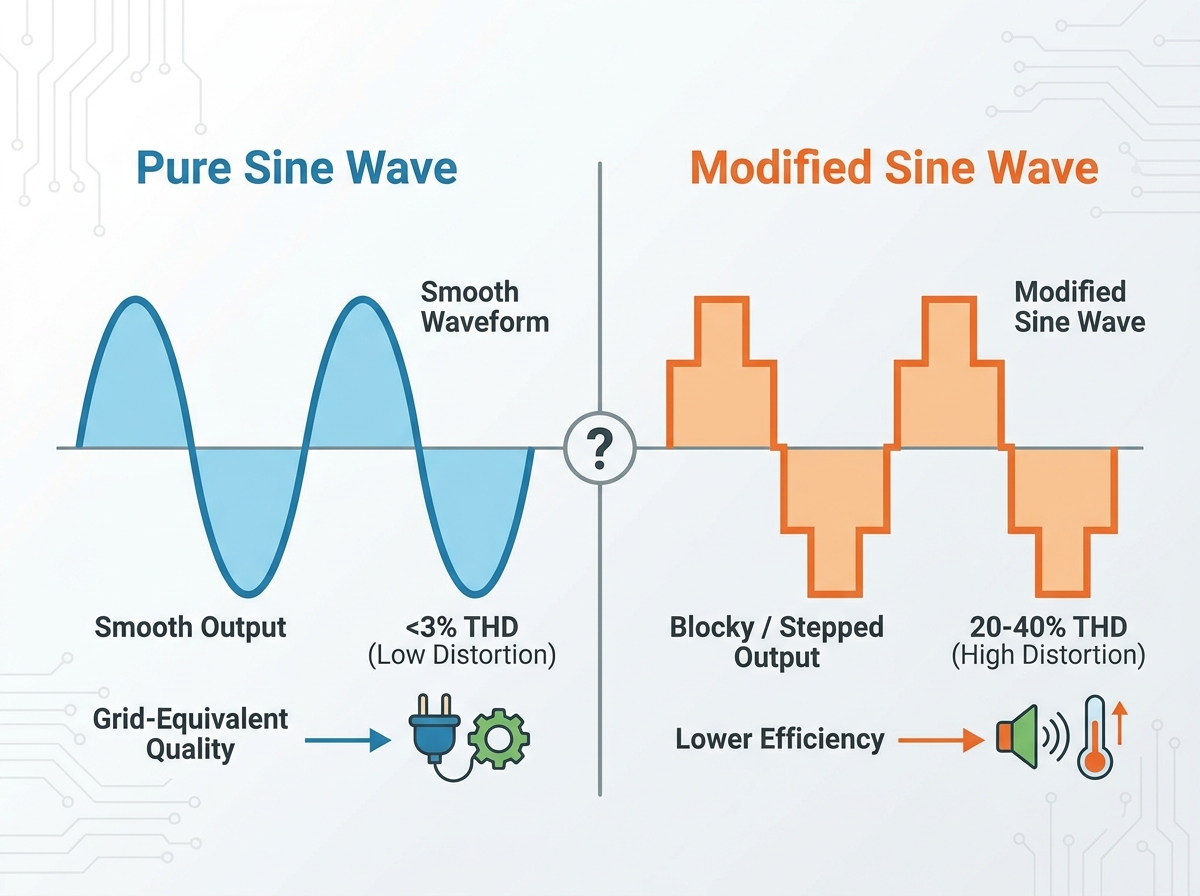
Let us first visualize the electrical output. A pure sine wave inverter produces a smooth, rolling oscillation. It perfectly mimics the clean electricity supplied by municipal utility grids. The voltage transitions seamlessly over time. It rises and falls in a perfectly rounded, continuous curve. We achieve this smooth curve through advanced Pulse Width Modulation (PWM) and complex filtering capacitors.
Conversely, modified sine waves use blocky, stepped voltage shifts. They rapidly switch polarity in harsh, sudden increments. This creates a jagged, staircase-like waveform. It poorly imitates true grid power. The abrupt voltage changes shock sensitive electronic components.
We measure this signal clarity using Total Harmonic Distortion (THD). THD quantifies the unwanted frequencies present in the electrical signal. Standard utility grid power typically features a THD below 3%. High-quality pure sine wave models replicate this precision flawlessly. However, modified sine waves often produce 20% to 40% THD. This high distortion creates immense electrical noise across your circuits.
You will frequently notice a distinct "buzzing" symptom when using modified waves. The stepped wave delivers power inefficiently to your devices. This causes loud, audible buzzing in audio equipment and televisions. It also triggers intense physical vibrations in induction motors. Your appliances struggle to process the jagged electrical signal. Over time, these micro-vibrations cause severe physical wear on internal bearings and coils.
Common Mistake: Many beginners assume modified sine waves are "close enough" to grid power. You must never make this assumption when dealing with modern electronics.
What needs pure versus modified power? We developed a practical load compatibility framework. It categorizes your daily appliances by their electrical risk level. You must audit your specific devices before finalizing any hardware purchase.
These devices strictly require pure sine wave power. If you use a stepped wave, they will overheat, malfunction, or fail completely.
Motor-driven appliances: Variable-speed motors, modern refrigerators, and HVAC compressors rely on smooth magnetic induction.
Microprocessor-controlled units: Smart TVs, induction cooktops, and modern washing machines require precise voltage timing to operate.
Medical equipment: CPAP machines and oxygen concentrators demand absolute electrical stability for patient safety.
Specialty electronics: Laser printers and equipment containing thyristors or solid-state relays will crash instantly on a modified wave.
These devices tolerate modified sine wave power without immediate failure. They typically lack complex microchips or sensitive inductive coils.
Simple resistive loads: Traditional incandescent bulbs, basic electric heaters, and simple coffee makers.
Older motorized tools: Brush-type universal motors found in basic power tools. However, they may run slower and hotter than usual.
Appliance Type | Pure Sine Wave Required? | Expected Reaction on Modified Wave |
|---|---|---|
Smart Refrigerator | Yes | Compressor overheats; digital board failure. |
Incandescent Lighting | No | Functions normally. |
CPAP Machine | Yes | Motor damage; potential safety hazard. |
Electric Space Heater | No | Functions normally. |
Microwave Oven | Yes | Loud buzzing; cooks food unevenly. |
Decision Rule: If the equipment relies on precise timing, electronic controls, or magnetic induction, it requires a pure sine wave signal to prevent critical failure. A quality household inverter should always output a pure sine wave to protect mixed domestic loads.
You must weigh initial capital expenses against long-term operational efficiency. Modified inverters look highly attractive initially. They often carry a significantly lower sticker price. However, you must consider the severe thermal degradation of connected appliances.
A modified sine wave inverter runs AC motors up to 20% less efficiently. This technical inefficiency generates massive excess heat inside the appliance. Heat slowly destroys internal appliance components over months of use. Early equipment replacement quickly negates any initial hardware savings.
Energy waste poses a massive threat in remote systems. Modified waves cause appliances to draw much higher amperage. They consume significantly more power to perform the exact same work. This drains expensive battery banks much faster than necessary. Lithium and lead-acid batteries suffer from shortened lifespans when subjected to constant heavy draws.
Excessive battery drain creates a critical failure point. It ruins the reliability of any off grid inverter system. It also compromises complex solar power inverter installations. Solar arrays must work harder to replace the wasted energy. This forces you to buy larger solar panels to compensate for the inefficiency.
Best Practice: Always prioritize electrical efficiency over initial hardware costs. Pure sine wave technology offers vastly superior long-term performance. It protects your primary appliance investments. It preserves your battery bank cycles efficiently.
Proper sizing ensures long-term system stability and safety. Different applications demand unique power conversion strategies.
Off-grid systems demand highly precise AC conversion. Modern charge controllers integrate closely with your battery banks. They require stable electrical environments to regulate voltage properly. A pure sine wave provides the necessary stability for these sensitive charge controllers to function without fault.
RV and mobile fleets face unique power challenges on the road. Users frequently start microwaves or air conditioning units simultaneously. These appliances create massive transient loads. They demand huge spikes of temporary electricity called Locked Rotor Amps (LRA). Peak surge ratings matter just as much as continuous output. Your system must handle these sudden power spikes gracefully without tripping internal breakers.
We highly recommend building a robust sizing buffer into your system design. You should size your inverter 20% to 25% above your anticipated continuous load. For example, if your devices require 1,000 continuous watts, you need a 1,250-watt unit minimum.
Calculate the total wattage of all devices running simultaneously.
Add the highest single surge wattage from your largest motor.
Multiply the total continuous load by 1.25.
Select an inverter that meets or exceeds this final number.
An inverter running at maximum capacity generates extreme internal heat. This sizing buffer manages thermal output safely. It ensures hardware longevity. It entirely prevents sudden shutdowns during unexpected load spikes.
Supplier vetting remains absolutely critical for safety and performance. You must evaluate a pure sine wave inverter manufacturer carefully before purchasing fleet hardware.
First, you must verify the true pure sine wave output. Cheap, unbranded models often advertise falsely low THD numbers. They label themselves as pure sine but deliver modified performance. You should request actual oscilloscope testing data from the supplier. Reputable manufacturers gladly provide independent lab validations to prove their waveform clarity.
Next, scrutinize the continuous power integrity. Many brands use deceptive "peak surge" marketing numbers on their packaging. They print 4,000W in huge letters, but the unit only delivers 2,000W continuously. Furthermore, you must check the continuous power rating at high temperatures. Evaluate how it performs at 40°C (104°F). High heat derates electrical output significantly. A cheap unit might lose 30% of its capacity on a hot summer day.
Examine compliance and safety certifications closely. These standards remain non-negotiable for serious installations.
UL 458: Essential for mobile applications like RVs and commercial fleets.
UL 1741: Mandatory for grid-tied solar setups to prevent back-feeding.
CE and FCC: Indicate compliance with strict European and American electronic interference standards.
These marks indicate high-quality internal components. They prove the presence of reliable MOSFETs. They guarantee the manufacturer used heavy-duty copper transformers instead of cheap aluminum wiring.
Finally, assess the warranty and technical support structure. Multi-year warranties signal intense product confidence from the engineering team. Localized technical support proves invaluable during complex installations. You need responsive OEM partners to troubleshoot issues effectively. Avoid manufacturers who hide their contact information or rely solely on automated chatbots.
Modified sine wave inverters still hold a minor niche in legacy setups or strictly resistive applications. However, pure sine wave technology stands as the definitive standard for modern electrical demands. The complex microprocessors inside today's appliances simply cannot survive on jagged, distorted power.
Protecting your expensive end-user equipment easily justifies the slight premium of a pure sine wave model. You eliminate the risk of random device failures. You maximize battery efficiency. You ensure your sensitive tools operate precisely as the original manufacturer intended.
We encourage you to audit your specific device loads today. Document your continuous wattage and peak surge requirements. Then, contact a certified manufacturer to scope your exact power conversion needs. Making the right choice now secures your power independence for years to come.
A: Yes. The jagged waveform creates high Total Harmonic Distortion (THD). This distortion forces devices to run inefficiently. The resulting excess heat can quickly degrade internal capacitors. It will eventually fry sensitive power supplies and digital logic boards over time.
A: We highly recommend it. Most modern solar setups power mixed household or commercial loads. These loads include smart refrigerators, computers, and LED drivers. They strictly require stable, grid-equivalent power to function safely without overheating.
A: We advise using a portable oscilloscope. It lets you visually inspect the waveform for smooth curves. Alternatively, plug in a simple digital clock. A modified sine wave will cause the clock's timer to run noticeably fast or behave erratically.
A: They contain highly sophisticated internal components. Manufacturers must use complex microcontrollers to generate the precise PWM signal. They also require heavier copper coils and advanced filtering capacitors to successfully smooth the DC-to-AC conversion.