
- All
- Product Name
- Product Keyword
- Product Model
- Product Summary
- Product Description
- Multi Field Search
Views: 0 Author: Site Editor Publish Time: 2026-07-02 Origin: Site


Industrial automation, railway systems, and heavy-duty robotics face relentless physical demands. They require power architectures capable of tolerating extreme thermal and electrical stress. Traditional off-the-shelf power modules often fail under these harsh conditions.
Selecting the right dc-dc converter supplier oem involves much more than comparing unit costs. It centers around mitigating the risk of catastrophic field failures. You must ensure strict regulatory compliance, specifically meeting safety standards like EN 50155 and UL 62368-1. Furthermore, securing supply chain longevity protects your manufacturing lines from sudden component obsolescence.
This guide evaluates the top industrial suppliers in the market today. It breaks down the technical criteria necessary for effective supplier shortlisting. You will gain an objective decision framework tailored specifically for OEM engineering and procurement teams.
Evaluating a supplier requires looking beyond peak efficiency; thermal derating curves, MTBF (Mean Time Between Failures), and EMI/EMC compliance are the true markers of industrial viability.
The choice between an isolated dc converter and a non isolated buck converter dictates both safety compliance and thermal footprint.
Top-tier suppliers differentiate themselves through robust BOM (Bill of Materials) lifecycle management, reducing the risk of premature component obsolescence.
Selecting a ready-to-deploy dc dc converter module often accelerates time-to-market compared to discrete component designs, provided the supplier offers reliable technical support and lead times.
Engineers often face overwhelming choices when specifying industrial power architectures. You must apply strict selection criteria to filter out inadequate suppliers. Evaluating a vendor on technical merit alone is no longer sufficient for modern manufacturing.
Assess testing transparency early in the evaluation process. Reliable suppliers publish extensive environmental data freely. Look closely for thermal shock and vibration resistance results. EMI and EMC test reports also indicate robust internal design. Industrial applications demand proof of survival. Requesting documentation regarding specific MIL-STD or EN certifications helps verify these claims.
Industrial OEMs typically demand long product lifecycles spanning 7 to 15 years. You must evaluate end-of-life (EOL) notification policies carefully. Leading suppliers maintain deep component sourcing redundancy. They protect you from sudden manufacturing halts. Ask potential vendors how they manage older component revisions. A strong lifecycle program prevents expensive system recertification down the road.
Project requirements often expand over time. Evaluate the supplier's overall product roadmap. Do they offer a logical upgrade path? Moving from low-power board-level components to high-power, chassis-mount modules should feel seamless. A broad portfolio prevents you from qualifying multiple new vendors later. Standardizing on one deep-portfolio supplier drastically reduces procurement friction.
Complex PCB layouts inevitably generate integration challenges. Check the availability of Field Application Engineers (FAEs) in your region. Expert FAEs provide invaluable assistance during critical design phases. They guide thermal management strategies effectively. They also conduct detailed PCB layout reviews. Fast technical support answers can save weeks of product development time.
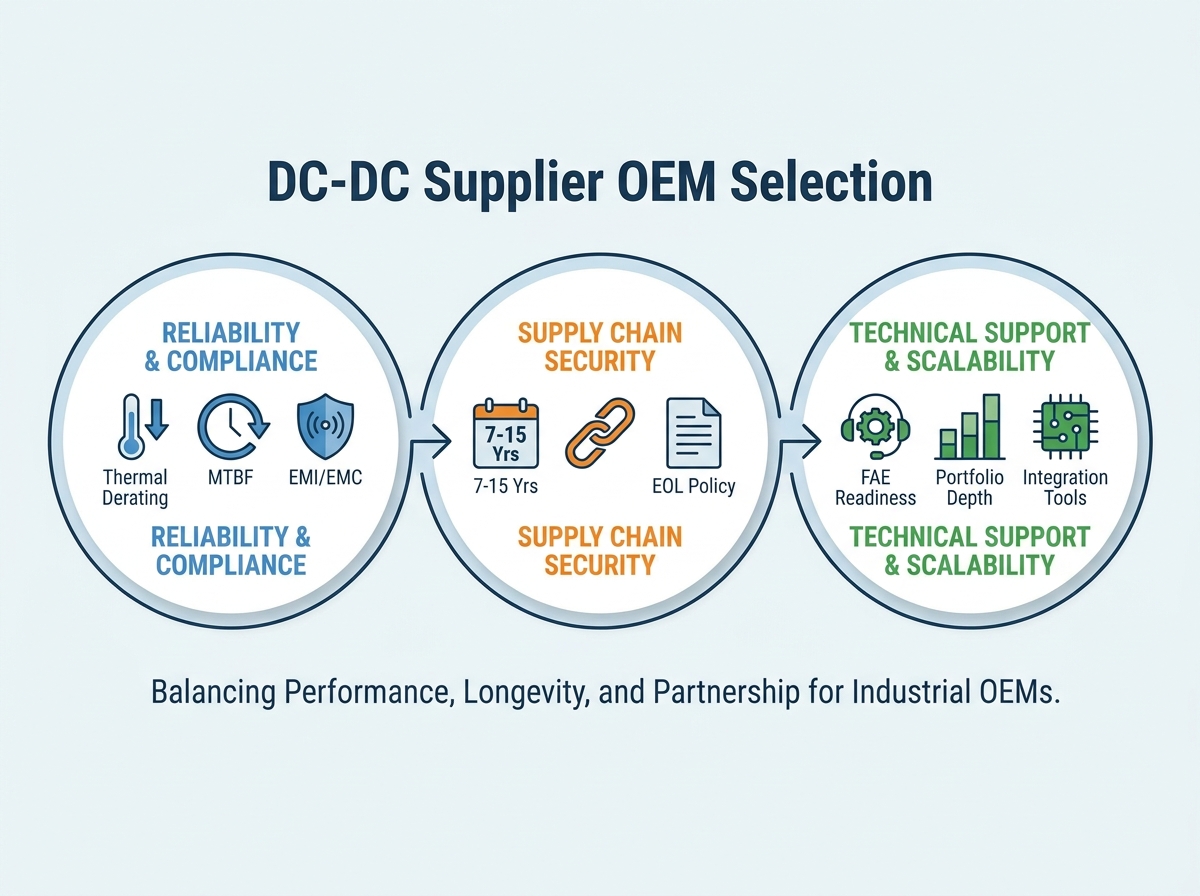
Choosing a manufacturing partner requires balancing performance, pricing, and specific industry specialization. The market features several dominant players globally. We detail their specific industrial strengths and transparent limitations below.
Supplier Capability Comparison Chart
Supplier | Primary Strength | Ideal Application Focus | Notable Limitation |
|---|---|---|---|
Traco Power | Ruggedized & Isolated Design | Railway (EN 50155), Medical | Premium price point |
MEAN WELL | Cost-to-Performance Ratio | DIN-Rail, Factory Automation | Fewer micro-module options |
Murata | High-Density Miniaturization | Compact Drones, Portable Tech | Strict layout requirements |
Vicor | Advanced Power Topologies | Heavy Robotics, Edge Computing | Proprietary integration needed |
Texas Instruments | Custom Silicon Components | Bespoke Power Boards | High engineering overhead |
Traco Power operates as a recognized industry leader in ruggedized power solutions. They specialize deeply in medically isolated designs. You will find an extensive portfolio of railway-certified modules meeting EN 50155 standards. Their units tolerate massive voltage fluctuations seamlessly.
Limitations: They employ a premium pricing model. Their highly protected solutions might be over-engineered for standard, climate-controlled indoor applications. Buying Traco for simple office hardware often inflates project budgets unnecessarily.
MEAN WELL boasts massive global availability and deep inventory channels. They offer a highly competitive cost-to-performance ratio. Their units perform exceptionally well for enclosed and DIN-rail cabinet systems. Plant managers favor them for easy retrofitting.
Limitations: They place less focus on ultra-compact, high-density board-level micro-modules. Specialized semiconductor brands often outpace them in extreme miniaturization tasks.
Murata delivers exceptional high-density dc dc converter module designs. They serve highly compact applications perfectly. Choose them when board space and payload weight face strict constraints. Their low-profile components enable sleeker end-product form factors.
Limitations: Thermal management in tight enclosures proves highly demanding. You must strictly adhere to their specific layout and airflow guidelines. Ignoring their copper plane recommendations often triggers thermal throttling.
Vicor utilizes proprietary switching topologies. These advanced designs enable massive power delivery within extremely small packages. They fit perfectly into heavy robotics, EV test benches, and edge computing server racks. They handle transient power spikes effortlessly.
Limitations: Integration remains highly specialized. OEM engineers must often adapt to proprietary packaging formats. Unique cooling methodologies are frequently required to maximize their performance.
Texas Instruments provides an unmatched portfolio of discrete controllers. They offer excellent bare-metal power components for custom designs. They suit OEMs designing bespoke power boards from scratch perfectly. Their WEbench design tool remains an industry standard.
Limitations: This route demands high internal engineering expertise. Designing, laying out, and certifying the final power stage takes massive effort. Buying pre-packaged modules is usually much faster for smaller engineering teams.
System architecture dictates your foundational power topology. You must align component capabilities directly against your specific application demands. A mismatched topology creates systemic vulnerabilities.
Selecting between isolated and non-isolated designs represents a critical engineering junction.
An isolated dc converter proves essential for heavy industrial control systems. It provides crucial ground loop elimination across long communication cables. It also guarantees high noise immunity and operator safety against dangerous high voltage faults. Galvanic isolation physically separates the input and output circuits. However, isolation introduces higher component costs. It also demands a larger physical footprint on the circuit board.
Alternatively, cost-sensitive projects benefit from much simpler topologies. A non isolated buck converter excels at step-down logic level regulation. You should deploy them for stepping down internal rail voltages. They work perfectly when input and output isolation is not a strict safety requirement. They offer higher efficiency and consume significantly less board space.
Many legacy industrial systems still operate exclusively on standard 12V rails. Newer sensors and heavy-duty actuators often demand higher operating voltages. Upgrading the entire main power supply is rarely practical.
Incorporating a dedicated boost converter 12v solves this dilemma easily. It efficiently steps up legacy 12V inputs to 24V or 48V. This enables the seamless integration of modern high-power components into older infrastructure architectures. Backup battery systems also utilize these converters frequently. They maintain stable system bus voltages even as the underlying battery cells discharge and drop voltage.
Deploying any industrial dc converter introduces unique implementation risks. Proactive mitigation strategies prevent costly redesigns later. Engineers must look past marketing numbers.
Assuming continuous high-load operation in unventilated enclosures inevitably leads to field failures. Heat destroys electronics faster than any other factor. You must review the supplier's thermal derating curves meticulously. Never rely solely on "headline" power ratings.
Components behave very differently at 70°C ambient compared to 25°C laboratory conditions. A module rated for 100 watts might only deliver 60 watts safely inside a hot electrical cabinet. Adequate heat sinking remains non-negotiable. Designing large PCB copper planes to wick away heat is equally critical.
Electromagnetic interference often delays final product certification significantly. Investigate internal module design elements early.
Look for shielded inductors integrated inside the module.
Verify the presence of robust internal input filtering.
Ensure your layout minimizes large high-frequency current loops.
These features directly impact your OEM final system-level emissions testing. Choosing a pre-compliant, low-noise module saves weeks of frustrating laboratory debugging. It keeps your product launch schedule safely on track.
De-risking the prototyping phase accelerates your entire project timeline. Check the availability of comprehensive integration tooling from the manufacturer. Evaluation boards allow immediate bench testing before you print a custom PCB. Accurate 3D CAD models streamline mechanical enclosure design. SPICE simulation models enable your engineers to verify transient load responses accurately.
Procurement teams must follow structured logic when finalizing vendor selections. Emotional or purely price-driven decisions often lead to long-term reliability penalties.
Establish hard technical parameters before requesting any quotes. Document your exact input and output voltage ranges clearly. Determine the required isolation rating definitively based on safety standards. Clearly outline ambient temperature limits based on real-world deployment environments. Giving suppliers strict boundaries prevents them from pitching unsuitable products.
Never approve a high-volume purchase order based entirely on datasheet promises. Always request Proof of Concept units first. Test these modules rigorously under maximum load conditions. Apply peak ambient temperatures simultaneously. Observe their performance under combined stress factors. Monitor thermal imaging to identify unexpected hot spots.
Balance the upfront module cost against warranty terms and historical failure rates. Cheaper modules often incur hidden maintenance penalties later. Factor in the engineering time saved by utilizing pre-certified, ruggedized components. Reduced testing cycles directly improve overall project profitability. Calculating mean time between failures (MTBF) provides a realistic view of long-term viability.
Engage the top two shortlisted suppliers directly today. Request detailed MTBF documentation. Demand firm lead-time guarantees for upcoming pilot production runs. Secure written commitments regarding raw component availability to avoid future shortages.
Selecting the right industrial power architecture represents a highly strategic business decision. You must carefully balance thermal reliability, regulatory compliance, and supply chain security. Taking a holistic view prevents severe manufacturing bottlenecks down the road.
Over-specifying your power needs adds unnecessary weight and inflates project budgets. Conversely, under-specifying directly risks catastrophic system failure in the field. Finding the optimal middle ground defines engineering success.
We highly advise OEM teams to consult closely with vendor field application engineers. Always cross-reference datasheet specifications against your real-world enclosure constraints. Start engaging your shortlisted partners today to secure evaluation boards for your next design cycle. Proactive testing remains your best defense against product delays.
A: You should specify an isolated converter to meet strict safety regulations protecting human operators from high voltages. They are also essential for breaking ground loops in long communication lines, such as RS-485 or CAN bus. Finally, they protect sensitive analog signal lines in heavy industrial noise environments.
A: Common pitfalls include ignoring the manufacturer's derating curves at high ambient temperatures. Engineers often lack adequate PCB copper planes required for proper heat sinking. Many mistakenly rely on maximum power ratings without accounting for zero-airflow environments inside sealed mechanical enclosures.
A: Long lead times can halt your entire assembly line. It is crucial to select suppliers with diversified manufacturing bases. Look for partners maintaining robust, multi-region inventory channels. This protects your production schedule during global component shortages and unexpected logistics disruptions.