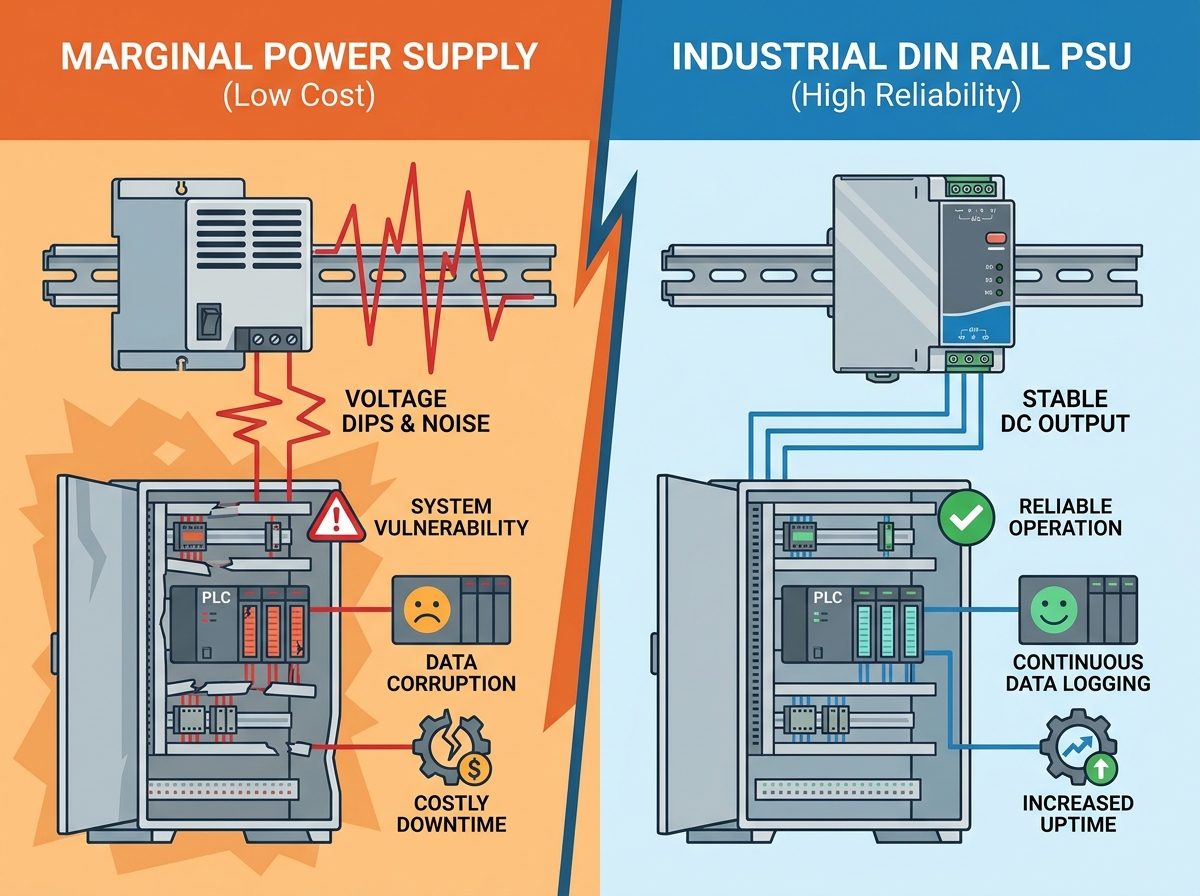
The control cabinet functions as the central nervous system of modern automation. Unstable power directly harms these critical setups. It triggers cascading system failures, random PLC resets, and costly unplanned downtime. Decision-makers must look past basic product definitions and initial price tags. You must evaluate power solutions based on thermal performance, lifecycle predictability, and cabinet density. Today's connected factory floors leave no room for unreliable voltage drops. This article provides system integrators and engineers with a rigorous framework. You will learn how to evaluate power units against strict Industry 4.0 infrastructure demands. We will guide you through thermal derating, environmental resiliency, and proper manufacturer vetting.
Key Takeaways
Prioritizing thermal derating curves over nominal wattage prevents premature failures in unventilated control cabinets.
Compact, slim DIN rail power supply units reduce panel footprint but require stricter efficiency evaluations to manage heat dissipation.
Selecting the right din rail power supply manufacturer (industrial focus vs. commercial crossover) dictates regulatory compliance (e.g., UL 61010) and supply chain reliability.
Implementing redundancy and advanced diagnostics reduces Mean Time to Recovery (MTTR) for mission-critical automation modules.
The Hidden Costs of Marginal Power in Control Cabinets
Voltage dips, transients, and electrical noise easily disrupt sensitive logic controllers (PLCs). They also confuse I/O blocks and blind intricate sensor networks. A momentary voltage sag might seem minor on the surface. However, it often forces connected industrial computers to reboot. This single interruption breaks automated production sequences. It ruins active chemical batches and misaligns robotic tool paths.
Let us look at financial impacts versus upfront expenses. You might save $50 by choosing a commercial-grade power module initially. Yet, this minor saving pales in comparison to operational reality. A tripped or degraded unit can easily cause a $10,000-per-hour line stoppage. The factory loses massive revenue while maintenance crews hunt down the electrical fault. Procurement teams must weigh these intense downtime risks carefully. Premium power components act as cheap, highly effective insurance for expensive automation machinery.
Smart manufacturing introduces even higher functional demands. Industry 4.0 environments feature immense sensor density and continuous data logging protocols. These advanced tracking networks require an exceptionally stable automation power module. Clean power prevents subtle data corruption during high-speed network transmissions. We rely on this continuous data flow to train predictive maintenance algorithms. If the baseline power fluctuates randomly, the entire factory data model degrades quickly.
Sizing and Sourcing: Core Evaluation Criteria for an Industrial DIN Rail PSU
Selecting the right unit goes far beyond simply reading the nameplate wattage. Engineers must scrutinize deeper electrical characteristics and thermal specifications.
First, evaluate continuous output current versus peak load capacity. We commonly call this peak capacity the "power boost" function. Inductive loads, like heavy conveyor motors or large contactor relays, draw massive current during startup. A standard power unit might enter overload protection and shut down abruptly. A properly sized industrial din rail psu delivers up to 150% of its rated current for several seconds. This capability handles sudden inrush demands without resetting the entire cabinet.
Next, you must fully understand thermal derating and electrical efficiency. Always check the manufacturer's official derating curve before purchasing. A nominal 240W power supply might only deliver 180W at 60°C. If you ignore this crucial curve, you risk premature component failure. Furthermore, aim for energy efficiencies well above 90%. High efficiency definitely saves factory electricity, but that is merely a secondary benefit. The primary goal is reducing ambient heat inside sealed electrical enclosures. Less wasted energy means less destructive internal heat generation.
Finally, inspect the exact ripple and noise specifications. Analog sensors and communication gateways require remarkably clean DC output to function properly. Set your baseline expectation to less than 50mV peak-to-peak. Higher electrical noise levels easily distort sensitive analog signals. This unseen distortion causes erratic robotic movements or completely false temperature readings.
Here is a standard evaluation chart for quick engineering reference:
Evaluation Metric
Standard Commercial Specification
Industrial Target Value
Why It Matters for Automation
Power Boost
None / 100% maximum
120% - 150% for 3+ seconds
Prevents complete shutdown during heavy motor startup.
Ensures system stability in unventilated outdoor panels.
Ripple and Noise
> 100mV pk-pk
< 50mV pk-pk
Protects sensitive analog data signals from distortion.
Designing for Harsh Environments: Thermal, Shock, and Vibration Resiliency
Industrial manufacturing settings severely test electronic hardware on a daily basis. Constant mechanical stress rapidly exposes weak manufacturing and assembly techniques.
Vibration mitigation remains a top priority for system designers. Heavy machinery, industrial robotics, and continuous metal stamping presses generate intense mechanical shocks. A highly secure rail mount power supply features reinforced metal mounting brackets and vibration-resistant internal connectors. This distinct mechanical advantage prevents sudden power losses. It secures the system against loose internal wiring or dislodged heavy transformers.
Extreme temperatures also constantly plague remote manufacturing facilities. Automation cabinets often sit dangerously close to blast furnaces or inside deep-freeze storage facilities. Outdoor solar arrays present similar thermal challenges. These harsh applications necessitate incredibly wide operating temperature ranges. You need robust units capable of running reliably from -40°C up to +70°C. Crucially, they must achieve this impressive feat without any forced-air cooling. Mechanical cooling fans introduce fragile moving parts into the system. Moving parts eventually fail and constantly draw in conductive factory dust.
Environmental protections extend far beyond simple temperature resilience. Evaluate specific factory site conditions before finalizing your bill of materials. You should actively specify conformal-coated printed circuit boards (PCBs) for specialized industrial settings. These difficult environments include wastewater treatment plants, chemical processing facilities, and damp maritime ports. Conformal coating effectively protects delicate copper traces against morning condensation. It also shields components from conductive carbon dust and highly corrosive hydrogen sulfide gases.
Managing Panel Density with a Slim DIN Rail Power Supply
Physical space commands an absolute premium inside modern factories. The persistent industry trend of shrinking control cabinets creates significant real estate challenges. Engineers must somehow fit more automation nodes, safety relays, and edge gateways into increasingly confined physical spaces.
To directly meet this complex challenge, many designers adopt a slim din rail power supply. These highly compact footprints effectively reduce the overall panel size. However, aggressive miniaturization carries distinct physical trade-offs.
Internal Crowding: Packing identical electrical wattage into a narrower chassis heavily limits internal component spacing.
Heat Dissipation: Smaller physical surface areas struggle to shed thermal energy effectively into the surrounding air.
Clearance Requirements: Many narrow units still require strict ventilation gaps on either side to survive safely.
You must carefully review the internal layout and airflow requirements specified by the hardware manufacturer. Selecting an ultra-slim form factor usually requires high-efficiency internal topologies like synchronous rectification. This advanced circuitry drastically lowers wasted heat. It prevents destructive internal heat buildup within the narrow metal casing.
Panel density constraints also directly impact system modularity. Automation setups often require supplemental backup power modules for ultimate safety. Consider exactly how you will integrate DC UPS units, buffer modules, or redundancy modules. Advanced slim units allow these critical add-ons to snap directly alongside the main supply. This smart modular approach builds highly robust power grids. Best of all, it achieves this without needlessly expanding the overall cabinet footprint.
Vetting Your DIN Rail Power Supply Manufacturer: Industrial Compliance and Reliability
Finding excellent physical hardware represents only half the engineering battle. Your chosen vendor plays a massive role in your long-term system success.
First, strictly prioritize the verification of crucial industrial certifications. A truly credible din rail power supply manufacturer industrial must provide highly transparent safety documentation. Look specifically for UL 61010-1 and UL 61010-2-201 compliances. You should also rigorously verify CE marks and ATEX certifications for hazardous location deployments. These formal documents verify rigorous EMC (Electromagnetic Compatibility) immunity. They also guarantee strict physical fire safety standards.
Next, deeply investigate component provenance and published reliability metrics. Procurement teams often confuse these distinct statistical numbers. You must differentiate between Mean Time Between Failures (MTBF) and actual expected electrolytic capacitor lifetime.
MTBF: This is merely a statistical probability of random failures across a very large production batch. It does not indicate exactly how long a single isolated unit will last.
Capacitor Lifetime: This represents the true limiting physical factor of any standard din rail power supply. High ambient enclosure heat rapidly dries out internal electrolytic capacitors.
Advise your corporate procurement teams to demand completely transparent component sourcing. Premium-grade Japanese capacitors generally offer significantly longer operational lifespans under severe thermal stress.
Finally, thoroughly discuss product lifecycle and strict revision control. Automation designs represent incredibly heavy initial engineering investments. Partnering with a dedicated industrial manufacturer directly ensures product availability for ten years or more. Commercial consumer brands frequently discontinue basic models. They also alter internal circuitry without providing advance notice. Strict revision control policies successfully avoid forced panel redesigns caused by sudden product obsolescence.
Conclusion
The control cabinet's internal power supply acts as a critical insurance policy for your entire automation infrastructure. When we treat essential power modules as cheap commodities, we invite catastrophic system failures and extensive factory downtime. By understanding strict thermal derating, environmental resilience, and spatial constraints, you build fundamentally stronger industrial networks.
Take these actionable next steps before finalizing your upcoming bill of materials:
Audit your current or proposed panel designs against true peak load startup requirements.
Analyze internal cabinet thermal realities and map out expected ambient peak temperatures.
Request comprehensive laboratory test reports and exact derating curves from shortlisted vendors.
Verify the exact internal capacitor lifespans and necessary regulatory certifications for your target installation region.
FAQ
Q: What is the difference between an industrial DIN rail power supply and a commercial-grade unit?
A: Industrial units endure harsh operational conditions natively. They feature incredibly wide temperature ratings (-40°C to +70°C) and robust EMC immunity against heavy factory electrical noise. Commercial units mostly use cheaper internal components. They completely lack strict MTBF transparency and rarely survive high physical vibration or extreme ambient cabinet heat.
Q: How much headroom should I calculate when sizing a rail mount power supply?
A: Engineers generally apply a standard 20% to 30% protective buffer rule safely above the maximum continuous load. This extra electrical headroom successfully handles unexpected inrush currents. It also easily accommodates future sensor network expansions and perfectly compensates for natural electrolytic capacitor aging over the entire equipment's lifespan.
Q: Can I connect two DIN rail power supplies in parallel for more power?
A: You cannot parallel standard hardware units directly. Connecting them without proper internal load sharing quickly causes one single unit to shoulder the entire burden. You must select units specifically designed with internal current-sharing circuitry. Alternatively, actively use external redundancy modules to safely and evenly balance the load across both connected devices.
Q: Does a slim DIN rail power supply compromise lifespan due to heat?
A: It absolutely can, unless the hardware manufacturer uses advanced internal circuit designs. High-efficiency topologies, such as synchronous rectification, dramatically reduce wasted energy generation. This intelligent design allows ultra-slim footprints to operate surprisingly coolly. Always review the specific thermal derating curves and spacing requirements to firmly guarantee maximum component lifespan.