Current rating is a thermal number. The continuous current a module can hold depends on its derating curve, not on the model name.
Apply the 80% rule. A 15A module is sized for roughly 12A continuous, leaving margin for heat and ageing.
Inrush decides the next size up. Motors and capacitive banks draw three to five times running current at startup.
Price steps track the thermal build. Above 10A, housings become ribbed aluminium with potting, and that is the cost jump.
Lead time depends on standardisation. Stock ratings ship in days; custom output tuning adds a prototype phase first.
Ask for the test report, not the label. Current, isolation and protection claims should be backed by documents.
Introduction
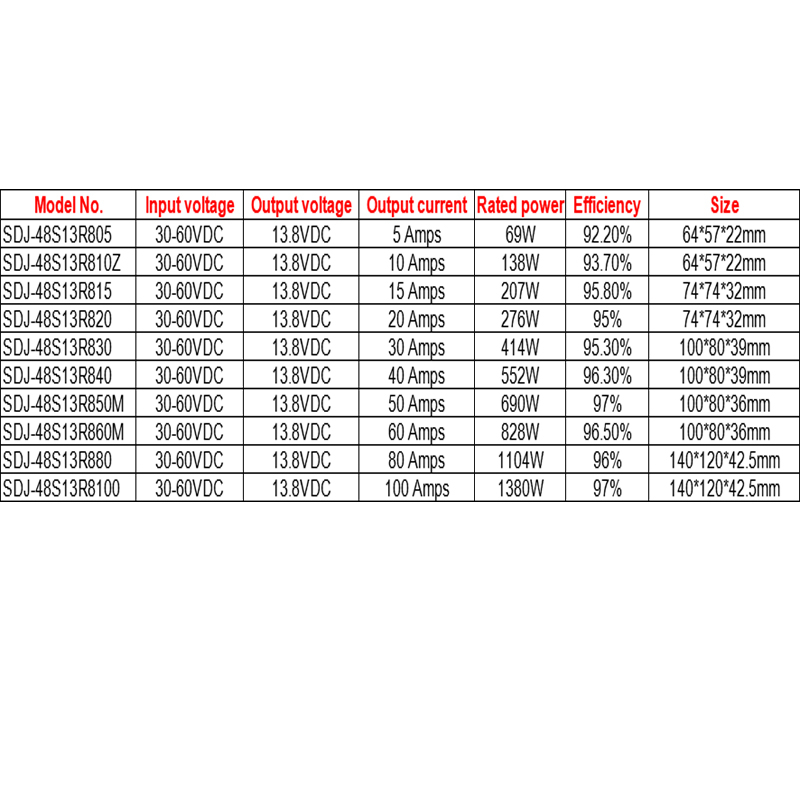
Sourcing a china 36v 15a converter, or any specific industrial voltage regulator, requires navigating a vast landscape of manufacturing capabilities and pricing structures. Chinese power supply manufacturers dominate the global supply chain, offering highly competitive DC-DC converters for 12V, 24V, 36V, and 48V bus architectures. However, procuring reliable hardware necessitates a strict understanding of how output current dictates physical size, thermal management, and overall cost. For procurement engineers and system integrators, mastering these scaling rules is essential for securing cost-effective, high-reliability power modules without falling victim to under-spec'd components. A 48V to 13.8V step-down unit rated 5A to 100A shows how one platform can cover a whole current band.
How to Size DC-DC Converters by Current (5A, 10A, 15A, 30A)
Properly matching the current capacity of a module, such as a china 12v 15a converter, to your specific application prevents both thermal failure from under-sizing and budget bloat from over-engineering.
The 80% Continuous Load Rule
A fundamental principle of power system design is never to run a DC-DC converter at 100% of its rated capacity continuously. If your industrial control panel requires a constant 12 Amps to operate, selecting a 12A converter will lead to excessive heat generation and a drastically shortened lifespan. Instead, apply the 80% rule: size the converter so your continuous load represents approximately 75% to 80% of its maximum rating. In this scenario, a 15A converter provides the necessary thermal headroom, ensuring the internal MOSFETs and capacitors operate well within their safe temperature margins, vastly improving Mean Time Between Failures (MTBF).
Managing High-Current Inrush and Transients
High current models (e.g., 20A to 30A capacities) are often necessary not because the continuous load demands it, but to survive startup transients. Heavy inductive loads like DC motors, solenoids, or large capacitive banks in networking equipment can draw a surge current three to five times higher than their steady-state operation. If a 10A motor briefly demands 30A upon startup, a tightly rated 15A converter will trigger its Over-Current Protection (OCP) and shut down. Always cross-reference the converter’s specified peak surge capacity (e.g., 150% for 3 seconds) with the inrush profile of your specific load.
Physical Footprint and Heat Dissipation
As output current increases, the physical volume of the converter must scale proportionally. A 5A module might fit in a compact plastic enclosure suitable for standard PCB mounting. Conversely, a 15A or 30A converter must house larger magnetic cores, thicker copper traces, and heavy-duty switching transistors. Consequently, these high-current units are typically encased in large extruded aluminum chassis with deep cooling fins and full silicone potting to maximize thermal transfer away from the dense internal circuitry.
Table 1: Current Tiers Under the 80% Continuous Rule
Rated output
Continuous at 80%
Housing and cooling
Typical load
Check before ordering
5A
About 4A
Compact plastic or thin aluminium
Sensors, small IoT nodes
Derating at cabinet ambient
15A
About 12A
Ribbed aluminium, potted
Control panel, radio, camera bank
Peak surge against motor inrush
30A
About 24A
Extruded aluminium with deep fins
Motor drives, large capacitor banks
Cable gauge and terminal rating
40A and above
About 32A and above
Heavy chassis, forced air often needed
Vehicle systems, telecom racks
Thermal test inside the real enclosure
Illustrative sizing at 80% of rated current; not a product specification.
Price Bands vs Output Capacity: What to Expect
Understanding the cost structure of different current capacities, from a low-power china 48v 3a converter to heavy-duty industrial units, helps in accurate project budgeting.
Low-Current Economy Tier (1A to 5A)
Converters operating in the 1A to 5A range are heavily commoditized. Because they generate minimal heat, they utilize standard FR4 printed circuit boards, smaller passive components, and basic plastic or thin aluminum housings. These units are highly cost-effective, typically priced in the lower tiers, making them ideal for high-volume consumer electronics, basic sensor networks, or IoT device deployments where power demands are strictly limited.
Mid-Range Industrial Tier (10A to 15A)
When stepping up to the 10A to 15A bracket, prices increase non-linearly. This price jump is driven by the necessity for upgraded thermal architectures. Components must feature lower Equivalent Series Resistance (ESR) capacitors and higher-grade silicon to handle the increased current without melting. Furthermore, the enclosures transition to heavy-duty, ribbed aluminum with high-quality thermal potting compounds. These converters are the workhorses of factory automation and vehicular auxiliary power, balancing rugged reliability with moderate cost.
High-Current Heavy-Duty Tier (20A to 40A+)
High-current converters demand premium pricing due to the immense engineering challenges of switching massive power in a compact footprint. They often employ advanced synchronous rectification, planar transformers, and multiphase switching architectures to keep efficiency high and heat manageable. The heavy copper weight required on the PCBs and the sheer volume of raw aluminum for the heatsinks heavily influence the bill of materials (BOM) cost. These are specialized investments for electric vehicle systems, heavy telecommunications infrastructure, and heavy machinery.
Table 2: What Moves the Price Between Current Tiers
Cost factor
1A to 5A
10A to 15A
20A to 40A+
Passive components
Standard grade
Low-ESR capacitors, higher-grade silicon
Premium parts, multiphase control
PCB copper weight
Light
Heavier traces
Heavy copper, planar magnetics
Housing
Plastic or thin aluminium
Ribbed aluminium with potting
Extruded chassis with deep fins
Thermal design effort
Minimal
Derating study needed
Thermal modelling and test
Main cost driver
Component count
Thermal architecture
Silicon area and aluminium volume
Across the 10A to 15A band, a 24V to 13.8V unit rated 5A to 100A is priced by the same three cost factors in Table 2, not by the voltage label alone.
Standard Lead Times for Chinese Power Supply Manufacturers
When planning a bulk deployment requiring units like a china 36v 10a converter, factoring in the manufacturing and logistical lead times is critical for maintaining project schedules.
Off-the-Shelf Availability
For standard voltages and common current ratings (e.g., 12V to 24V step-ups at 5A or 10A), many established Chinese manufacturers maintain rolling stock. Sample quantities or small pilot runs of 50 to 100 units can often be dispatched within 3 to 7 working days. Relying on standard, non-customized configurations is the fastest way to accelerate your prototyping phase.
Standard Production Runs (MOQ)
For larger commercial orders—typically ranging from 500 to 5,000 units—the standard production lead time averages between 3 to 5 weeks. This timeline accounts for PCB fabrication, component procurement, surface mount technology (SMT) assembly, potting, curing, and rigorous burn-in testing. It is crucial to coordinate closely with the factory, as global semiconductor shortages or regional holiday schedules (such as the Chinese New Year) can dramatically extend these standard windows.
Customization and NRE Timelines
If your application demands modified cable lengths, specific ruggedized connectors, custom output voltage tuning, or unique firmware for battery charging profiles, the timeline shifts. Customization requires an initial engineering review and prototype approval phase, which can take 2 to 4 weeks. Once prototypes are signed off, the standard 3 to 5 week mass production clock begins. Proper supply chain planning must account for this extended ramp-up period.
Selecting the appropriate DC-DC converter from China requires balancing precise load requirements against thermal constraints and budget realities. Whether you require a robust china 36v 15a converter for heavy industrial automation or a compact module for sensor networks, applying the 80% continuous load rule and understanding the cost implications of output current ensures a successful deployment.
Partnering with a manufacturer that documents its process supports quality and predictable lead times. Before the RFQ, fix the continuous load, the inrush profile and the cabinet ambient, then ask each supplier for the same three figures so the quotes can be compared like for like.
Ready to source reliable, competitively priced power modules for your next project? Explore our DC-DC Converter Modules to find the perfect capacity and price point for your system architecture, or compare the step-down buck range where the 36V input is fixed.
FAQ
Q: How do I size a converter for a 12A continuous load?
A: Divide the load by 0.8 and round up, which gives roughly 15A. That headroom keeps the module below its thermal ceiling in a closed cabinet and leaves room for capacitor ageing, and it also gives the inrush of any motor on the same rail somewhere to go.
Q: Why do 15A converters cost more than three 5A units?
A: Because the price step is driven by thermal architecture rather than by silicon alone. Above 10A the housing becomes ribbed aluminium with potting, the capacitors must be low-ESR types and the copper weight rises, so three small modules do not add up to one large one.
Q: Can a 36V 15A converter run from a 24V battery bank?
A: Only if the module accepts that input range. A step-down part needs the input above the output, while a wide-input or boost-buck part can hold 36V from a lower battery. Check the input range on the datasheet before matching the output current.
Q: What lead time should I expect for 1,000 units?
A: For a standard rating, plan on 3 to 5 weeks of production after the order is confirmed, on top of any component waiting time. Orders in the 500 to 5,000 unit band usually fall inside that window unless a shortage or a holiday shutdown intervenes.
Q: Is a lower price per unit always the cheaper choice?
A: No. A module sized at 100% of the load runs hotter and derates sooner, so the replacement cost can exceed the saving. Compare the derating curve, the protection list and the test documents, then judge price against the current the unit can hold continuously.