We audit the line, not the brochure. Machine age, paste inspection and AOI placement tell you more about consistency than any datasheet.
Every unit goes through burn-in on our floor. Sampling hides infant mortality; we run each supply at full load in a temperature-controlled chamber.
ATE coverage is what makes a batch repeatable. We log output accuracy, regulation, ripple, OVP, OCP and short-circuit recovery against the serial number.
Traceability is how we contain a defect. Batch-level component records let us limit a recall to the units that carry the suspect part.
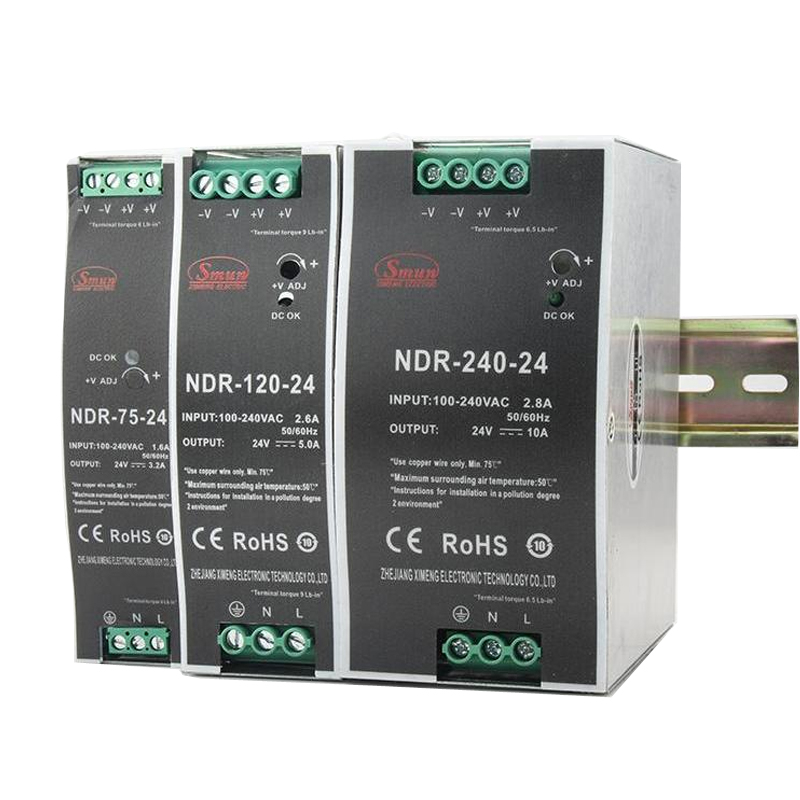
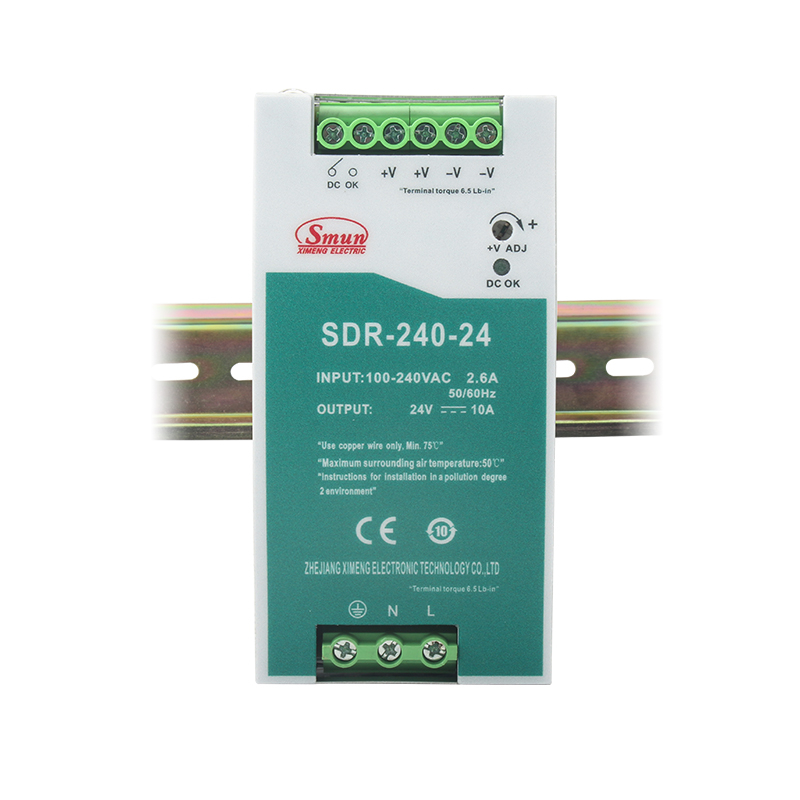
Four families cover most cabinets. We build MDR, HDR, EDR and NDR for a 35 mm rail; TDR takes over above 480 W on three-phase panels.
We confirm the mains before we quote. 230 V ±10% in the EU, 120 V in North America, 100 V in Japan and 240 V in Australia do not share one input design.
Introduction
When a buyer asks us for din rail power supply manufacturers, the question behind the question is almost always the same: will this factory build the same unit next year, and will it behave identically inside the same cabinet two years after that. We have exported power supplies for 16 years. We run two production lines in a 1,143 m² plant with 77 people, and our repeat order rate sits between 30% and 50%. That last number is the only audit result we genuinely trust, because it is the one our customers write themselves.
A DIN rail supply is the least glamorous component in an industrial cabinet and the one that stops a line. When it fails, the operator does not lose a channel; the machine stops. That is why we treat a DIN rail order as a manufacturing audit rather than a catalogue pick, and why we are willing to walk a buyer through our own floor before the first order is placed.
What follows is the audit we run on ourselves, the twelve points we would want any competing supplier to answer, and the mistakes we see most often when a project is shortlisted on price alone.
How We Audit a DIN Rail Line, Step by Step
Where Defects Actually Start: SMT, AOI and Wave Soldering
Every DIN rail supply we build begins as a bare board that goes through solder paste printing, pick-and-place and reflow. The failures that reach a customer are almost never design failures; they are process drift. A placement machine that has lost calibration puts a 0402 resistor half a pad off centre, the joint still looks soldered to the eye, and the unit passes a visual check. That is why we inspect paste after printing and place AOI immediately after reflow rather than at the end of the line. A defect caught at AOI costs us a rework; the same defect caught in the field costs the customer a truck roll.
Through-hole parts are the opposite problem. Transformers, bulk electrolytic capacitors and the switching MOSFETs carry real thermal mass, so wave soldering has to be profiled per board instead of run at one global setting. We keep a profile printout for every product and re-verify it after any change of solder alloy or conveyor speed, because a cold joint on a transformer pin behaves like a resistor that gets worse with each thermal cycle.
Why We Burn In 100% Instead of Sampling
The bathtub curve has a steep left wall, and the units that fall off it are the ones built with a marginal MOSFET or a dry capacitor. Sampling does not find them, because the defect rate in that window can be one unit in two hundred and a sample of five has almost no chance of catching it.
So we burn in every unit. Each supply runs at 100% of rated load in a chamber held at 45 °C to 50 °C ambient, typically for four hours on the standard families and longer on the higher-power models. During that window we cycle the mains input on and off, which stresses the inrush limiting circuit and the primary-side switching devices in a way a steady-state run never does. A unit that is going to fail early almost always fails inside that window, on our bench, where the fix is a rework rather than a warranty claim.
What a Burn-In Log Should Show You
Ask for the chamber load sheet, not a certificate. A credible sheet lists the serial numbers loaded, the ambient setpoint, the load percentage and the start and stop times. If a supplier can only show a procedure document, the process is probably sampled. We keep the load sheets because they are also our internal containment tool: when a batch of electrolytic capacitors turns out to be from a suspect lot, the sheet tells us which serial numbers were built with it.
ATE, EMC and Traceability: What We Test Before a Unit Ships
The Six Measurements We Log Against Every Serial Number
Automated test equipment is what turns a one-off good unit into a repeatable product. On our line each DIN rail supply goes through a functional test that records six values against the serial: output voltage at no load and at full load, load regulation, output ripple, over-voltage protection trip point, over-current protection trip point and short-circuit recovery.
The six matter because they fail differently in the field. Ripple that drifts upward means an output capacitor is degrading. An OVP point that has moved down means the feedback divider has drifted, and the unit will nuisance-trip a customer's load long before it dies. Logging them per serial is also what makes a complaint answerable: we can pull the record for the exact unit and see whether it left the plant inside its window.
In-House EMC Pre-Scan and the Standards Your Market Asks For
We size and label our DIN rail stock around the mains the cabinet will actually see, not around a single "universal" figure. In the EU and the UK the nominal is 230 V at 50 Hz with a tolerance band of ±10%, so a 264 V upper limit is not a marketing number, it is simply the arithmetic. North America runs 120 V at 60 Hz, with 208 V and 240 V delta in the same buildings. Japan is 100 V and splits 50 Hz in the east from 60 Hz in the west, which is why a unit sold into both Tokyo and Osaka has to survive either. Australia runs 240 V at 50 Hz. When a buyer says "Europe" we ask which of those they mean before we quote, because the answer changes the input derating and often the varistor.
The file your market expects is different as well. In the EU the safety reference for a switch mode supply is EN 61558-2-16, and emissions sit under EN 55032 with industrial immunity under EN 61000-6-2. In the United States industrial control equipment is assessed to UL 508, while equipment that falls under IT or AV scope goes to IEC 62368-1. The rail itself is fixed by IEC 60715, the 35 mm profile that every one of our DIN housings clips onto.
That is why we run an in-house pre-scan before a model goes to a third-party lab. A pre-scan on conducted emissions, surge, EFT and ESD tells us whether a design is drifting before we spend money on an external test. It is cheaper to change a common-mode choke in our own shielded room than to discover the problem in a lab report three weeks later.
Component Traceability and First Article Inspection
Traceability sounds bureaucratic until the first recall. We record the incoming lot for the critical parts on a DIN rail supply: the bulk capacitors, the PWM controller, the switching devices, the optocoupler and the transformer. When a supplier issues a lot alert, those records tell us the range of serials affected in minutes. Without them, the honest answer is "every unit we ever shipped", which is how a small defect becomes an expensive one.
First article inspection closes the gap between drawing and volume. We measure the first unit of a run against the drawing and the bill of materials, photograph the internals, record the component revision and sign it off before the line is released. A customer who holds our FAI report knows what the second thousand units are supposed to look like.
The 12-Point Checklist We Run on Our Own Floor
This is the list we would hand an auditor, and the list we suggest a buyer uses on any supplier. Each line has a piece of evidence attached, because a checkpoint without evidence is just a promise.
#
Checkpoint
What to look at
Evidence we hand over
1
SMT line
Machine age, feeder setup, nozzle condition
Calibration records and first boards off the run
2
Solder paste
Printer settings and paste inspection results
SPI log per shift
3
Reflow profile
Zone temperatures against the paste datasheet
Profile printout per product
4
Wave soldering and AOI
Preheat, flux, dwell, AOI after wave
Daily profile log and defect Pareto
5
Functional test
ATE coverage and the six logged values
ATE record per serial number
6
Burn-in
Every unit at full load, 45 °C to 50 °C ambient
Chamber load sheet with serials
7
Input cycling
Inrush and primary stress during burn-in
Burn-in program with on/off cycles
8
Dielectric strength
Hi-pot level and insulation resistance
Hi-pot log per unit
9
EMC pre-scan
Conducted emissions, surge, EFT, ESD benches
Pre-scan report before external testing
10
Incoming quality
Capacitor, controller, MOSFET and opto lots
IQC record tied to the production lot
11
First article
Unit measured against drawing and BOM
Signed FAI report with photos
12
Packing and label
Carton drop, label, serial and manual
Packing spec and a sealed sample carton
Which of Our DIN Rail Families Fits Which Cabinet
Most panel builders do not need a catalogue, they need to know which family lands in which slot. We build four AC-input families onto the same 35 mm rail, plus a DC-input pair and a three-phase range, and the choice usually comes down to width and whether the panel needs power factor correction. The current line-up sits under our DIN rail power supply range, and the table below is how we talk about it with a buyer who has a drawing rather than a part number.
Family
Power range
Input
Outputs
Width on rail
Active PFC
MDR-10 to MDR-100
10 W to 100 W
85-264 VAC or 124-370 VDC
5, 12, 15, 24, 48 V
22.5, 40, 55 mm
No
HDR-15 to HDR-150
15 W to 150 W
85-264 VAC
12, 15, 24, 48 V
17.5 to 105 mm
No
EDR-75 to EDR-150
75 W to 150 W
90-264 VAC
12, 24, 48 V
32, 40 mm
No
NDR-75 to NDR-480
75 W to 480 W
100-260 VAC
12, 24, 48 V
32 to 85.5 mm
NDR-240 and NDR-480 only
TDR-480 and TDR-960
480 W to 960 W
400 VAC three phase
24, 48 V
85.5 mm and wider
Yes
DDR-15 and DRD-15
15 W
DC input
5, 12, 15, 24 V
90 mm class
Not applicable
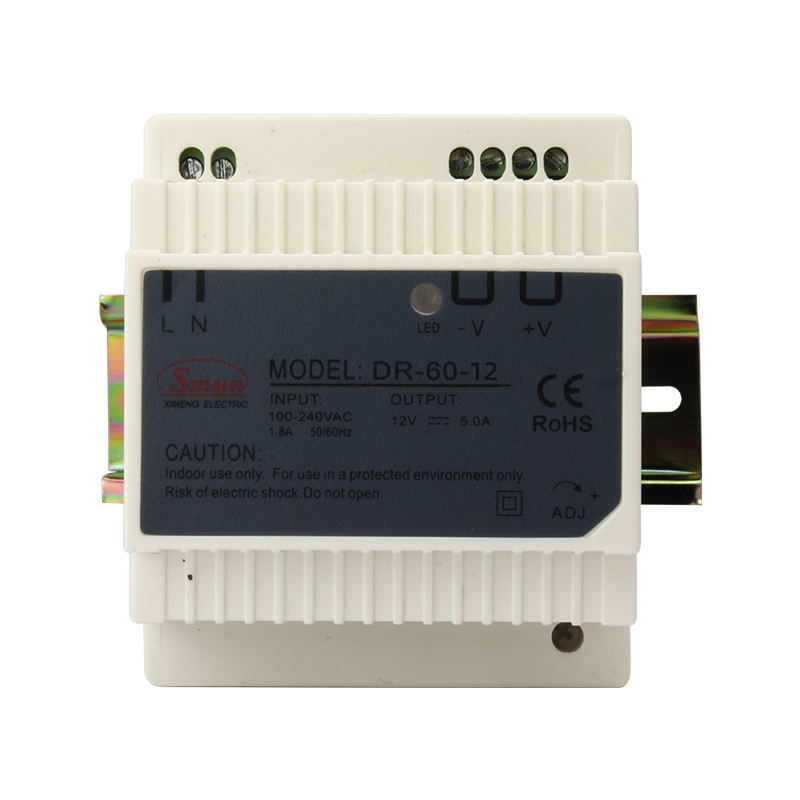
The practical rule we give customers is simple. Under 100 W in a depth-limited enclosure, use MDR, because 22.5 mm of rail is often the whole budget. Between 75 W and 150 W with a fan-free requirement, HDR and EDR are interchangeable on price and differ mostly on width. Above 240 W in a single-phase panel, the NDR series carries active power factor correction from NDR-240 upward, which matters when a site has a harmonic limit to meet. Above 480 W, or wherever the panel already has 400 V three phase, we move the customer to TDR rather than parallel two single-phase units. And when the whole cabinet only needs 30 W to 60 W for relays and indicator lamps, the DR series is the lowest-cost way onto the rail.
How We Accept a Production Lot
A checklist is only an audit if there is a pass line. We accept a lot only when the ATE log for every serial shows load regulation inside ±1% and output ripple below 1% of the rated output voltage at full load, and we reject the lot if more than one unit in a hundred falls outside either band. On the burn-in side we accept when zero units fail during the chamber window, because a single infant failure is a signal about the component lot rather than about that one board.
Mistakes We See Most Often in DIN Rail Sourcing
These are the five we end up correcting most often after a customer has already bought somewhere else. We list them with the symptom, because the symptom is what the buyer notices first and the cause is usually two steps upstream.
Common mistake
What you see in the field
What we do about it
Derating ignored above 50 °C
Supply shuts down at 55 °C cabinet temperature
We publish a derating curve and re-rate to 80% load at 60 °C
Neutral missing on a 380 V panel
Unit appears dead on a three-phase feed
We specify two-phase plus neutral input, or move to TDR
Parallel operation without ORing
One supply hogs the load and trips OCP
We size a single larger unit or add a redundancy module with diode ORing
Ripple budget taken from the datasheet only
Sensitive analogue front end picks up 100 Hz noise
We measure ripple at the load, not at the terminals
Rail depth not checked
Supply fouls the enclosure door or the wire duct
We quote width and depth from the drawing before the order
The first one is the most expensive because it is invisible at the sample stage. A 24 V supply rated 150 W may be rated at 25 °C ambient or at 50 °C depending on the family, and a cabinet in a steel mill in summer is not a laboratory. That is why we ask for the cabinet ambient before we recommend a model, and why we would rather sell a larger frame than defend a shutdown.
The other recurring mistake is not a DIN rail mistake at all: some panels never needed a rail. When a cabinet has the floor area and only one or two outputs, an enclosed power supply is cheaper and easier to service than a rail-mounted unit with a separate enclosure. We would rather lose the DIN rail sale than see a customer fight a mounting bracket for a year.
What We Need From You to Quote and Build
We try to keep the commercial side as concrete as the technical side, because vague terms are where a first order goes wrong.
Our minimum order quantity is 100 pcs per model, which is one production run on our line. Our standard lead time is 25 working days after deposit for models we build regularly, and we confirm the exact date on the proforma invoice because a non-standard output voltage or a customer label adds a separate set-up. We quote FOB Ningbo by default and can work EXW or CIF when the buyer's forwarder prefers it. Samples ship in 5 working days, and we charge for them rather than sending stock at no cost, because an unpaid unit is usually pulled from the shelf and never goes through the same burn-in window as a real order.
We warrant our DIN rail families for 3 years from shipment against defects in material and workmanship. Claims come back to us with the serial number, and the ATE and burn-in records for that serial are what we use to decide between a repair, a replacement and a process change. That is also why the repeat order rate is the number we quote in the introduction: 30% to 50% of our customers come back, and they come back because the record exists when something goes wrong.
If you send us the cabinet drawing, the mains, the ambient and the load profile, we will come back with a specific model, a derating note and a price rather than a catalogue page.
Conclusion
A DIN rail power supply is bought on a datasheet and judged on a production line. The twelve points above are the ones that separate a factory from an assembler: paste inspection and AOI catch process drift, 100% burn-in catches infant mortality, per-serial ATE records make a batch repeatable, and component traceability makes a recall survivable. None of them appear in a price list, and all of them appear two years later.
If you are shortlisting din power supply manufacturer options and want the audit evidence behind any of the twelve points, send us the cabinet specification and we will answer point by point with the records we hold. If you already know the wattage and only need the rail data, the 75-480 W industrial DIN rail range is the shortest path.
FAQ
Q: Why does 100% burn-in matter more than sampling?
Because the failures you care about cluster in the first few hours of operation, and at a defect rate of one in two hundred a five-piece sample almost never finds them. We burn in every unit at full load in a 45 °C to 50 °C chamber so that infant mortality happens on our bench instead of in a customer's cabinet.
Q: What should an ATE report contain?
At minimum the serial number, output voltage at no load and full load, load regulation, ripple, OVP trip point, OCP trip point and short-circuit recovery, each with the measured value and the pass window. A report that only says "PASS" is not traceable and cannot support a warranty decision.
Q: Is an in-house EMC lab necessary if a third party certifies the product?
It is not a substitute for third-party testing, but it changes the economics. A pre-scan on conducted emissions, surge, EFT and ESD lets us find drift before an external lab slot, which is why we keep a shielded room and the four benches on site rather than relying entirely on outside testing.
Q: How deep should component traceability go?
Deep enough to answer "which serials are affected" in minutes. For a DIN rail supply that means the bulk capacitors, the PWM controller, the switching devices, the optocoupler and the transformer. Recording every 0603 resistor adds cost without adding containment value.
Q: What does a good FAI report look like?
It measures the first unit against the drawing and the bill of materials, photographs the internals, records the component revision and is signed before volume production is released. If a supplier cannot produce one, the first article was probably approved by looking at it.