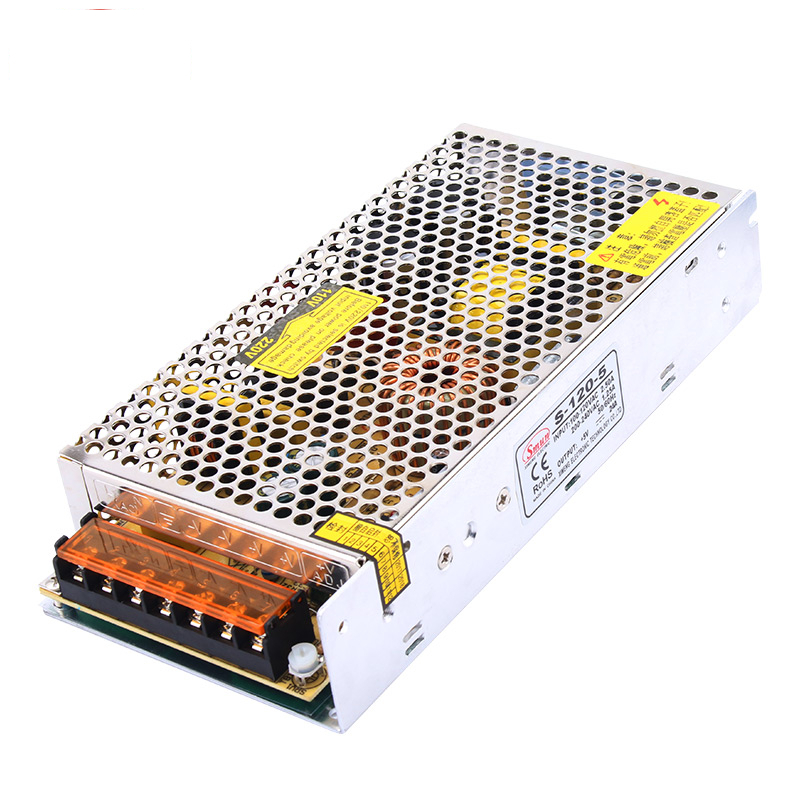
Open frame means no enclosure. The converter is a bare board, so cooling, isolation and touch protection move to the system integrator.
Convection replaces the fan. Exposed components shed heat into the cabinet air, and system airflow passes directly over the hottest parts.
Chassis conduction suits sealed builds. Bolting the board to a metal plate turns the host enclosure into the heatsink where fans are not allowed.
Height is the usual reason to choose it. Removing the shell and terminal blocks cuts the Z-axis, which fits 1U racks and slim panels.
BOM savings come with assembly work. Fewer parts lower unit cost, but standoffs, insulation and clearance checks move into your build.
Clearance is designed, not assumed. Creepage from primary to chassis must be engineered into the mounting stack and verified on the sample.
Introduction
An open frame power supply is a bare-board AC-DC or DC-DC converter built without a protective metal or plastic enclosure. This minimalist, component-level design offers maximum thermal dissipation and footprint efficiency, making it the preferred choice for engineers integrating power solutions directly into custom industrial, medical, or telecommunications chassis.
In the highly competitive field of industrial electronics design, minimizing the physical footprint of control systems while maximizing power density is a constant engineering objective. Power supplies are often the bulkiest and most thermally challenging components within an equipment enclosure. By stripping away the outer casing, open frame designs allow systems integrators to tightly pack the power conversion stage alongside other critical electronics. This approach demands a rigorous understanding of system-level thermal management and safety clearances, but when executed correctly, it yields vastly superior spatial and financial efficiency compared to traditional enclosed units.
What is an Open Frame Power Supply? (Thermal Advantages)
Maximizing Natural Convection and Airflow
The most significant engineering advantage of omitting the external casing is the drastic improvement in thermal dynamics. In a traditional enclosed unit, the metal shell acts as a thermal barrier, trapping heat generated by switching transistors, transformers, and rectifiers. This often necessitates internal cooling fans or heavily derated performance specifications.
In stark contrast, open frame power supplies expose these heat-generating components directly to the ambient air within the host equipment's main enclosure. This unobstructed exposure maximizes natural convection cooling. Furthermore, if the host system utilizes forced-air cooling (system fans), the airflow can pass directly over the hottest components on the bare printed circuit board (PCB), resulting in vastly more efficient heat dissipation. This enhanced thermal efficiency allows open frame units to sustain higher continuous power outputs in smaller footprints without exceeding critical component temperature thresholds.
Leveraging Chassis Conduction Cooling
Beyond convection, the mechanical design of bare-board power supplies facilitates highly efficient conduction cooling strategies. Engineers can design the host equipment's metal chassis to act as a massive, integral heatsink. By strategically mounting the open frame PCB onto the equipment's metal backplate using thermally conductive standoffs—or by using thermal pads to couple hot components directly to the chassis wall—the heat is rapidly drawn away from the power supply and dissipated across the entire surface area of the host machine.
This conduction-cooling technique is particularly vital in sealed, fanless environments, such as IP67-rated outdoor enclosures or sterile medical equipment where forced air cooling is prohibited. The ability to directly couple the thermal load to the external chassis is a unique and powerful capability of the open frame form factor.
Table 1: Cooling Paths Available to a Bare-Board Supply
Cooling path
Mechanism
Depends on
Fits
Natural convection
Air rises across exposed components
Cabinet volume and vent area
Sealed panels at moderate load
Forced air
System fan moves air over the board
Fan position and intake filter
Rack and machine enclosures
Chassis conduction
Heat flows into a metal plate
Contact area and plate mass
Fanless and sealed enclosures
Mixed
Conduction plus internal air movement
Mounting design
Dense multi-board assemblies
Open Frame vs Enclosed PSU: Cost and Size Comparison
Analyzing the Volume-to-Power Ratio
When volumetric efficiency is a primary design constraint, the open frame form factor is unmatched. By eliminating the bulky metal housing, cooling fan assemblies, and external terminal blocks, the overall dimensions of an open frame acdc power supply are significantly reduced compared to an enclosed counterpart of identical wattage. This reduction in the Z-axis (height) is often the most critical factor, allowing the power supply to be integrated into low-profile 1U rackmount chassis, slimline industrial displays, and compact DIN-rail control enclosures.
Engineers can achieve power densities (Watts per cubic inch) that are physically impossible with enclosed units. This spatial efficiency allows designers to either shrink the overall size of the final product or allocate the saved volume to additional functional circuitry, thereby increasing the feature set of the end device without increasing its physical footprint.
Bill of Materials (BOM) Cost Reduction
The financial benefits of the open frame architecture are equally compelling for large-scale manufacturing. The removal of the sheet metal enclosure, structural chassis screws, internal wire harnesses for external connectors, and the associated assembly labor translates to a direct and measurable reduction in the Bill of Materials (BOM) cost. For high-volume OEM production runs, these per-unit savings scale dramatically, significantly improving the profit margins of the final product.
Furthermore, because the open frame unit relies on the host system for cooling and physical protection, redundant components are eliminated. The system integrator is not paying for a fan or a metal case that is ultimately unnecessary when the power supply is buried deep inside a larger, well-ventilated, and structurally robust industrial control cabinet.
Table 2: Open Frame Against Enclosed, Item by Item
Safety and Mounting Considerations for Open Frame Designs
Navigating Creepage and Clearance Requirements
While open frame units offer immense benefits, they transfer the burden of electrical safety directly onto the system integration engineer. Because the high-voltage AC mains circuitry is exposed on the PCB, strict adherence to international safety standards (such as IEC 62368-1 for industrial/ITE or IEC 60601-1 for medical) regarding creepage and clearance distances is mandatory. When mounting the bare board, engineers must ensure that adequate physical distance is maintained between the high-voltage primary side of the power supply and any grounded metal part of the host chassis to prevent arcing.
This often requires the use of precisely dimensioned, non-conductive standoffs (typically nylon or ceramic) and the installation of Mylar or Kapton insulating sheets between the solder side of the PCB and the metal mounting plate, ensuring absolute dielectric isolation under all operating conditions.
Customization and OEM Integration Challenges
Integrating a bare board into a complex machine often requires a tailored approach to mechanical and electrical interfaces. Off-the-shelf open frame units use standardized PCB footprints and pin-header connectors, which may not align perfectly with highly specialized host board layouts or custom wiring harnesses. This is where partnering with a skilled open frame power supply odm (Original Design Manufacturer) becomes critical.
An ODM can modify the standard design—adjusting connector types, altering the PCB dimensions, moving specific heat-generating components to optimize chassis cooling, or tweaking the output voltage regulation curves—to perfectly match the unique mechanical and electrical constraints of the specific application. This collaborative customization ensures that the power supply ceases to be a generic component and becomes a seamlessly integrated, optimized subsystem of the final product.
Conclusion
For engineers tasked with optimizing the spatial, thermal, and financial metrics of complex industrial equipment, the open frame power supply offers a distinct competitive advantage over traditional enclosed units. By removing the physical barriers to cooling and eliminating redundant packaging materials, these bare-board designs maximize power density and minimize BOM costs.
However, capitalizing on these benefits requires a sophisticated approach to system-level thermal management and rigorous adherence to electrical safety clearances during chassis integration. When properly implemented, the open frame architecture empowers designers to build smaller, cooler, and more cost-effective industrial solutions. Where the thermal budget is still open, the open frame power supply range lists the bare-board form factors that sit alongside the enclosed units above.
Q: What is the difference between open frame and enclosed supplies?
A: An open frame unit ships as a bare board without a housing, while an enclosed unit adds a metal or plastic case, terminal blocks and often a fan. The conversion circuit can be similar; the difference sits in cooling, touch protection and who holds the safety approval.
Q: Can an open frame supply run without a fan?
A: Yes, if the heat path is designed. Convection through the cabinet or conduction into a metal plate can carry the loss, but the ambient around the board and the mounting surface temperature both have to be checked against the derating curve.
Q: Does open frame really reduce cost?
A: The unit price is usually lower because the housing, fan and terminal blocks are gone. The saving is partly offset by standoffs, insulating sheets and the engineering time needed to verify clearances, so the net effect grows with production volume.
Q: How much clearance is needed to the chassis?
A: Enough to satisfy the creepage and clearance table of the safety standard applied to the end product, measured from the primary side to any earthed metal. The exact figure depends on pollution degree, working voltage and the insulation level you claim.
Q: How do I compare an open frame design with an enclosed equivalent?
A: Match the conversion topology and wattage first, then compare the thermal derating and the height. A 500W single-output PFC supply is a useful benchmark because its datasheet states the derating curve an open frame unit would have to match.