Selecting the wrong power supply compromises system reliability. It creates frustrating compliance bottlenecks. It also increases long-term maintenance costs. Industrial automation demands absolute precision. Every component plays a vital role in your overall design. You need robust hardware to keep machinery running smoothly.
This guide focuses on evaluating essential criteria. We look specifically at sourcing an enclosed power supply for commercial and industrial applications. We provide design engineers and procurement teams a pragmatic framework. You will learn to evaluate specifications thoroughly. We compare different form factors objectively. We also outline how to evaluate manufacturing partners effectively.
Armed with this evidence-based approach, you avoid costly design mistakes. You ensure your end product performs safely in harsh environments. We cover everything from thermal management to stringent safety compliance. By following our framework, you mitigate risks. You achieve faster time-to-market and guarantee robust field performance.
Key Takeaways
- Form Factor Matters: Choosing between standard and low-profile designs dictates your system's thermal management and spatial layout.
- Spec Beyond the Label: Evaluating continuous power versus peak loads, and understanding thermal derating curves, prevents premature field failures.
- Compliance is Non-Negotiable: Pre-certified units reduce time-to-market and mitigate regulatory risks for global product launches.
- Supplier Viability: A reliable enclosed power supply supplier is evaluated on supply chain resilience, testing transparency, and lifecycle support, not just unit cost.
Enclosed Type Power Supply vs. Open Frame: Framing the Decision
Engineers often debate between open-frame and enclosed architectures. System architecture constraints heavily dictate this choice. You must assess whether your main enclosure provides sufficient inherent protection. Open-frame units require the host system to do the heavy lifting. The host must manage physical safety and EMI shielding. Conversely, an enclosed type power supply offers a self-contained solution. It simplifies integration significantly.
Thermal management realities also differ vastly. Open-frame models rely heavily on system-level airflow. They need ambient convection or external fans blowing across their components. Enclosed units handle heat differently. They feature a metal chassis. This chassis acts as an integrated heat sink. Higher wattage enclosed models often include built-in active cooling. Built-in fans ensure components stay within safe operating margins.
Safety and handling represent another critical divide. Enclosed units protect operators from high-voltage components. They eliminate accidental shock hazards during routine maintenance. The metal casing also shields sensitive circuitry from environmental debris. Falling screws or dust cannot easily short the internal board. These protective traits make enclosed models the standard choice. They dominate industrial automation and user-accessible equipment.
Common Open-Frame Integration Mistakes
- Failing to provide adequate clearance around the bare PCB.
- Ignoring ambient airflow directions inside the main cabinet.
- Relying solely on external chassis grounding without verifying EMI performance.
Core Enclosed Power Supply Specifications to Evaluate
Reading a datasheet requires reading between the lines. You must master the enclosed power supply specifications to guarantee reliability. We start by analyzing load requirements and output capacity. You need to calculate continuous draw carefully. Then, compare it against transient peak loads. Avoid over-specifying your wattage. Massive over-specification hurts energy efficiency. It also wastes physical space. Conversely, under-specifying triggers over-current protection. This causes unexpected system reboots.
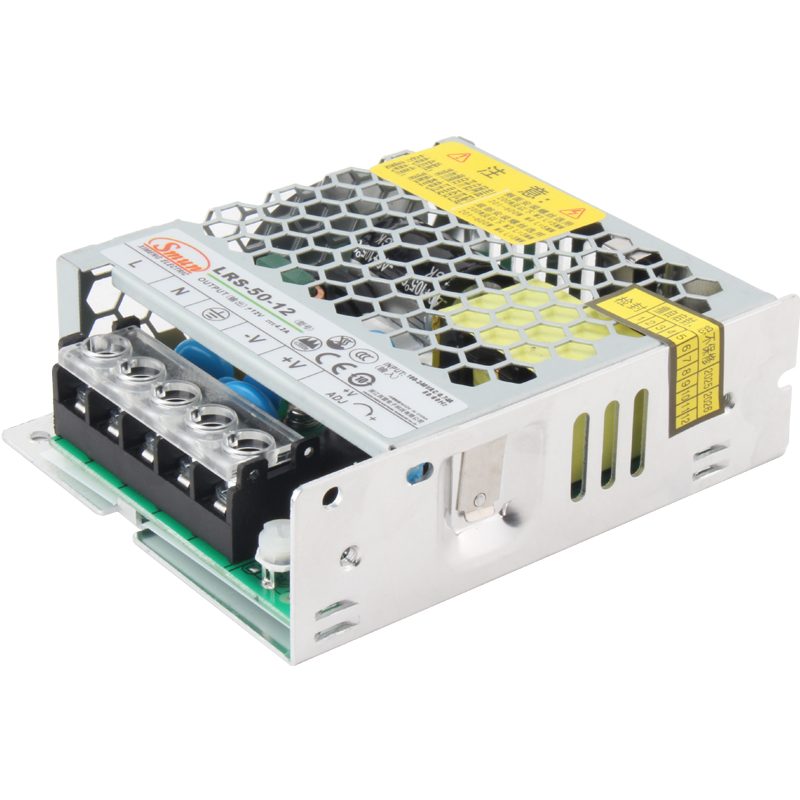
Footprint and spatial efficiency dictate mechanical design. You must evaluate standard versus low-profile form factors. Vertical space constraints often drive these decisions in modern racks. We recommend benchmarking against modern low-profile architectures. For example, look at the enclosed power supply,lrs series 35w to 600w thin models. They provide exceptional high power density. They fit perfectly within standard 1U-compatible heights.
Electrical noise and stability impact sensitive downstream components. Ripple and noise require close attention. You must verify acceptable millivolt (mV) thresholds. Sensitive DC loads, like analog sensors, fail under high ripple. Transient response matters equally. You must know how quickly the unit recovers from sudden load changes. Fast recovery prevents damaging voltage dips during motor startups.
Efficiency and standby power round out the core specs. Look for 85% or higher active efficiency. Low no-load power consumption is also crucial. These metrics help you meet modern energy standards. Compliance frameworks like ErP and DoE demand strict efficiency baselines.
Table 1: Power Supply Parameter Evaluation Guide
| Specification Parameter | Common Pitfall | Engineering Best Practice |
| Continuous Power | Sizing exactly to peak load | Size to 80% of rated capacity for longevity |
| Ripple & Noise | Ignoring high-frequency spikes | Add external LC filters for sensitive analog sensors |
| Transient Response | Accepting slow recovery times | Verify recovery under 500µs for step loads |
| Active Efficiency | Ignoring low-load efficiency | Check efficiency curves at 25%, 50%, and 100% loads |
Environmental Resilience and Thermal Derating
Industrial environments push electronics to their absolute limits. Operating temperature ranges require deep scrutiny. You cannot just read the maximum temperature rating. You must scrutinize the manufacturer's thermal derating curve. A unit rated for 500W might only deliver 300W at 50°C ambient. If you ignore this curve, the unit overheats. It will hit thermal shutdown and halt your production line.
We recommend a systematic approach to thermal evaluation:
- Identify the absolute peak ambient temperature inside your main enclosure.
- Consult the specific power supply derating curve datasheet.
- Calculate the maximum available continuous output power at that peak temperature.
- Factor in airflow limitations or stagnant air pockets within your cabinet.
- Add a 15% safety margin to your final wattage calculation.
Vibration and shock resistance form another critical pillar. Industrial automation involves constant movement. Robotics and heavy machinery generate significant mechanical stress. Standard commercial units crack under this physical abuse. You must look for explicit IEC 60068-2-6 compliance. This standard proves the unit survives continuous industrial vibration profiles.
Conformal coating and ingress protection address chemical and particulate threats. A metal casing blocks large debris. It does not stop microscopic dust or condensation. High-humidity environments breed corrosion. Dusty factory floors invite conductive shorts. You must evaluate if the internal PCB requires conformal coating. Coating protects sensitive surface-mount components. It ensures long-term reliability despite a breathable metal enclosure.
Safety Standards, EMI/EMC, and Compliance
Navigating global compliance can delay product launches for months. Pre-approved certifications act as a massive shortcut. Ensure your chosen unit holds relevant regional approvals. Look for UL/cUL for North America. Verify TUV and CE for European markets. Check for UKCA for the United Kingdom. Utilizing pre-certified units streamlines your end-product certification. The testing labs accept the power supply module automatically.
Application-specific standards dictate precise isolation and safety rules. You must match the standard to your industry. For Industrial and Information Technology Equipment (ITE), demand IEC/EN/UL 62368-1 compliance. Medical applications carry far stricter consequences. You must verify IEC 60601-1 certification. Medical units require specific isolation barriers. You must evaluate MOOP (Means of Operator Protection) versus MOPP (Means of Patient Protection). MOPP units feature higher dielectric strength and lower leakage currents.
Electromagnetic Compatibility (EMC) dictates how well your system plays with others. The metal casing inherently aids in EMI shielding. It acts as a Faraday cage. However, the enclosure alone does not guarantee compliance. You must verify exact emissions standards. Look for CISPR or EN55032 compliance on the datasheet. Immunity standards also matter greatly. Check EN61000-4 ratings. This ensures external electrical noise will not disrupt your power delivery. You must match these baselines to your specific operational environment.
How to Shortlist an Enclosed Power Supply Supplier
Hardware specifications only tell half the story. The company manufacturing the hardware matters just as much. You need a reliable enclosed power supply supplier to ensure long-term success. Evaluate manufacturing and QA transparency first. Does the vendor provide comprehensive MTBF data? Mean Time Between Failures proves engineering rigor. Look for calculations based on accepted frameworks. MIL-HDBK-217F or Telcordia standards offer the most trustworthy MTBF numbers.
Lifecycle management defines your future engineering workload. Consumer electronics phase out every two years. Industrial systems run for decades. Will the supplier guarantee product availability? You need units available for the entire lifecycle of your host equipment. Sudden part obsolescence forces expensive system redesigns. Demand clear end-of-life (EOL) notification policies.
Customization versus COTS (Commercial Off-The-Shelf) represents another supplier test. Most projects start with standard SKUs. Sometimes, you need slight modifications. Assess if the vendor can provide modified standards. Can they add specific conformal coatings? Can they offer customized output voltage trims? A flexible vendor saves you from designing a custom power architecture from scratch.
Global support and lead times round out vendor evaluation. Supply chains break unexpectedly. You must evaluate the vendor's local stocking networks. Can they deliver units to your contract manufacturer on time? Review their warranty terms carefully. High-quality industrial units typically carry 3-to-5-year warranties. Finally, audit their RMA (Return Merchandise Authorization) processes. A smooth return process indicates a mature, customer-focused organization.
Conclusion
Choosing the right power hardware requires careful balancing. You must balance mechanical fit, thermal realities, and global compliance readiness. Ignoring any single factor leads to compromised systems. Treat power components as the foundation of your hardware design.
To finalize your decision, rely on a structured decision matrix. Prioritize derated power capacity and safety certifications first. These prevent catastrophic field failures. Next, evaluate the physical form factor and spatial integration. Finally, consider the unit cost. Following this exact hierarchy maximizes your long-term value. It ensures your industrial equipment operates flawlessly under the harshest conditions.
FAQ
Q: Can I mount an enclosed power supply in any orientation?
A: Mounting orientation directly affects thermal convection and derating. Heat rises, so vertical versus horizontal mounting changes internal airflow. Always refer to the manufacturer's specification sheet. They provide approved mounting angles and derating penalties for non-standard orientations. Following these guidelines ensures optimal cooling and prevents thermal shutdowns.
Q: Do enclosed power supplies require external cooling?
A: It depends on the wattage. Convection-cooled units, usually under 200W, rely purely on ambient air. Fan-cooled units include built-in active cooling. However, even convection units require adequate physical clearance inside your main system cabinet. Without proper breathing room, ambient temperatures spike and trigger thermal failure.
Q: Can I connect multiple enclosed power supplies in parallel for more power?
A: Yes, but only if the specific models feature built-in active current sharing. This is often called a parallel function. Wiring standard, non-sharing units together causes severe load imbalance. One unit will shoulder the entire load, overwork itself, and fail rapidly.
Q: What is the difference between a chassis mount and a DIN rail enclosed power supply?
A: The difference lies in the form factor and installation speed. A chassis mount requires physically screwing the unit into a metal backplate. A DIN rail power supply snaps directly onto standardized industrial rails. DIN rail models drastically speed up installation inside complex control cabinets.