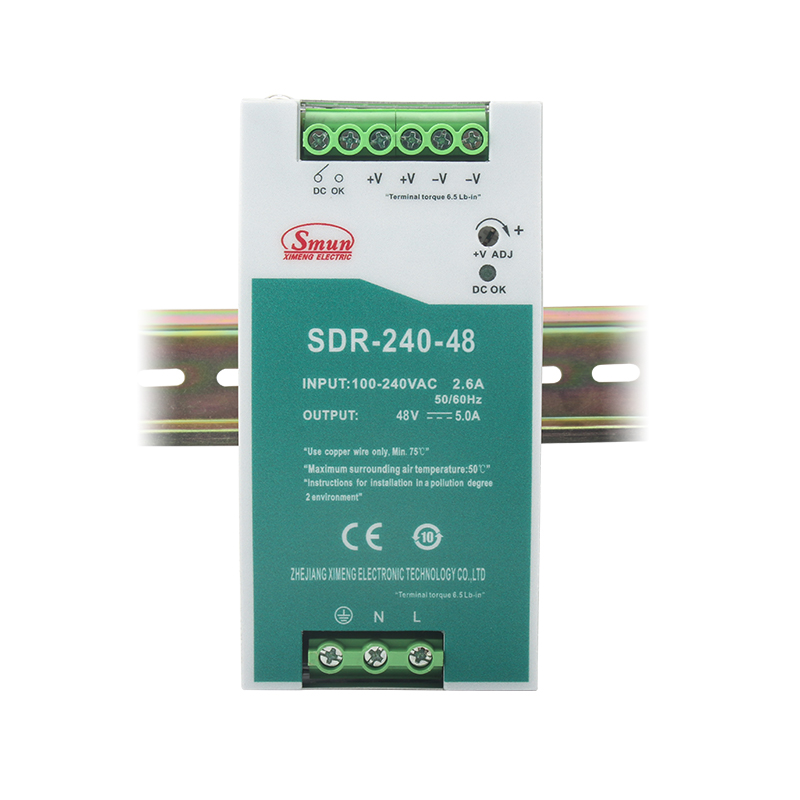
Engineers often face a frustrating dilemma when sizing power components. Undersizing leads to abrupt system faults and costly downtime. Conversely, oversizing wastes valuable cabinet space and inflates project budgets unnecessarily. Selecting a DIN rail power supply is no longer just about matching nominal voltage and wattage. It requires carefully analyzing operating environments, peak loads, and strict compliance requirements. Modern automation systems demand high precision. You must evaluate how thermal conditions and dynamic loads affect real-world output. Ignoring these variables compromises long-term system reliability. This guide introduces a proven engineering-first framework. We will help you evaluate true capacity needs and finalize your component selection accurately. You can then confidently specify the exact power unit your system actually requires.
Key Takeaways
Nameplate capacity rarely equals operational capacity; environmental derating is a mandatory calculation.
Dynamic loads (inrush currents, inductive loads) dictate whether you need a standard unit or one with power boost capabilities.
Matching DIN rail power supply specifications to exact vertical compliance (e.g., NEC Class 2 for building automation) prevents costly regulatory bottlenecks.
Evaluating a DIN rail power supply supplier is as critical as the hardware, requiring proof of MTBF data, EMC compliance, and supply chain stability.
Calculating True Load Profile: Beyond the Nameplate Wattage
Many engineers fall into the trap of simply adding up nominal wattages. You read the datasheets for your sensors, controllers, and relays. You tally the numbers. You pick a power unit matching that exact total. This approach frequently causes system instability.
Steady-state loads remain constant during normal operation. A basic PLC or a string of LED indicators draws a highly predictable current. Dynamic loads operate differently. They introduce severe fluctuations into your power network.
Inductive loads demand massive short-term current spikes. When you energize these components, they pull significantly more power than their nameplate suggests. Common culprits include:
DC motors starting up under mechanical load.
Electromechanical contactors pulling in their coils.
Solenoid valves opening against high fluid pressure.
Large capacitive loads charging upon initial power-up.
These inrush currents often exceed nominal ratings by three to five times. If your power unit lacks sufficient headroom, the voltage will drop. This voltage dip causes PLCs to reset or sensors to drop offline.
You do not necessarily need a permanently larger capacity unit. Many modern units feature power boost capabilities. A 100W unit might offer a 150% peak power boost. It delivers 150W for three to five seconds. This handles the transient spike perfectly. You save cabinet space and avoid paying for unused continuous capacity.
Industry veterans follow the 80% rule. You should run power supplies at 70% to 80% of their maximum rated continuous load. If your calculated steady-state load is 80W, specify a 100W unit. This heuristic maximizes component lifespan. It reduces internal thermal stress on electrolytic capacitors. The unit runs cooler, lasts longer, and provides a buffer for future system expansions.
Environmental Derating: The Real-World Capacity Killer
Nameplate wattage assumes ideal laboratory conditions. Real-world control cabinets rarely offer ideal environments. Ambient temperature inside closed panels drastically degrades actual output capacity. This phenomenon is known as thermal derating.
Manufacturers base 100% capacity ratings on specific ambient temperatures. This is typically 40°C or 50°C. Once the internal cabinet temperature exceeds this threshold, the power output drops. Typical derating curves show capacity falling by 2.5% for every degree above 50°C. If your cabinet reaches 60°C, a 100W unit might only safely deliver 75W.
Airflow heavily influences this temperature dynamic. These units rely primarily on natural convection cooling. Hot air rises. Cool air flows through the bottom vents. Poor cabinet layout destroys this convection cycle. You must maintain strict clearance distances. Standard practice dictates 50mm of clearance above and below the unit. You also need side-by-side clearance. Cramming devices together traps heat and artificially lowers your available capacity.
Altitude also forces derating calculations. Installations above 2,000 meters face thinner air. Less dense air absorbs and transfers heat less efficiently. Convection cooling degrades significantly. Standard guidelines recommend derating capacity by 5% per 1,000 meters above the 2,000-meter mark. Failing to account for altitude will cause premature thermal shutdowns in high-elevation mining or telecom applications.
Typical Environmental Derating Impact
Environmental Factor
Threshold Trigger
Typical Capacity Reduction
Ambient Temperature
Above 50°C (or 60°C)
2% to 3% per degree Celsius
Altitude
Above 2,000 meters
5% per 1,000 meters
Input Voltage
Below 100V AC
10% to 20% depending on model
Aligning DIN Rail Power Supply Specifications with Application Environments
Capacity requirements change drastically based on your specific vertical market. Industrial automation presents harsh operating environments. Control cabinets sit near heavy machinery. They endure constant mechanical shock and severe vibrations. You must specify units rated for IEC 60068-2-27 shock standards.
Electrical transients also plague factory floors. Large drives starting and stopping inject noise into the line. You need robust transient protection. For compact mid-tier control panels, engineers frequently rely on an industrial din rail power supply 75. A 75W capacity perfectly balances footprint and power. It easily handles an HMI screen, a micro-PLC, and a few localized sensors without wasting space.
Building automation demands entirely different parameters. Smart infrastructure requires strict fire and electrical safety compliance. Engineers must carefully match DIN rail power supply specifications to local electrical codes. NEC Class 2 compliance is non-negotiable for many commercial HVAC and lighting controls. This standard legally limits output to 100VA. It prevents excessive energy from initiating electrical fires. A Class 2 rating allows technicians to run wiring without heavy conduit. This drastically reduces installation time and labor.
Overload protection behaviors also dictate proper application matching. When a fault occurs, power units react in specific ways. You must choose the right behavior for your load.
Hiccup Mode shuts down the output completely upon detecting an overload. It waits a few seconds, then attempts to restart. If the short persists, it shuts down again. This protects wiring during hard short circuits.
Constant Current mode behaves differently. It sustains the current output while allowing the voltage to drop. The unit does not shut down immediately. This is highly desirable for starting heavy DC motors. The motor gets the sustained current it needs to spin up, even as the voltage sags briefly.
Evaluating EMC, Efficiency, and Reliability Metrics
Capacity means nothing if the unit trips due to external interference. Electromagnetic Compatibility (EMC) is critical. Factory environments generate massive electrical noise. Heavy industrial EMC immunity standards, like EN 61000-6-2, are mandatory. They ensure your unit ignores voltage dips, surges, and radio frequency interference. A unit lacking proper EMC shielding will falsely trigger its internal protections. This causes unexplainable system reboots.
Operating efficiency directly impacts thermal management. Efficiency measures how much AC input converts to usable DC output. The remainder turns into heat. A din rail power supply operating at 94% efficiency dissipates far less heat than an 85% efficient model. Lower heat generation means higher capacity utilization. You can fit high-efficiency units into smaller, tightly packed enclosures without triggering thermal derating. High efficiency effectively buys you more usable capacity in hot environments.
Mean Time Between Failures (MTBF) requires careful scrutiny. Marketing brochures often boast millions of hours of MTBF. You must not take generic MTBF numbers at face value. Different manufacturers use wildly different calculation methods. To find true reliability, you need a standardized approach.
Verify the standard used. Look for established frameworks like MIL-HDBK-217F or the telecommunications standard SN 29500.
Check the test temperature. An MTBF calculated at 25°C is useless for a factory panel. Demand MTBF figures calculated at realistic temperatures, typically 40°C or 50°C.
Analyze actual lifetime ratings. MTBF is a statistical failure rate, not a guaranteed lifespan. Look for explicit electrolytic capacitor lifetime ratings. Capacitors usually dictate the true end-of-life for the unit.
How to Shortlist a DIN Rail Power Supply Supplier
Hardware quality is only half the equation. The manufacturer behind the product guarantees its long-term viability. A trustworthy DIN rail power supply supplier provides comprehensive, transparent documentation. You should instantly reject companies offering only marketing bullet points. True engineering suppliers publish detailed datasheets. These must include precise derating curves, efficiency graphs, and exact dimensional drawings. You need this data to run thermal simulations.
Compliance and certifications validate the supplier's engineering claims. The supplier must provide readily available certificates. Look for UL 61010 or UL 508 for industrial control equipment. Verify CE, CB, and TUV marks. Ensure these certifications apply specifically to your target region and target industry.
Evaluate their supply chain and lifecycle support. Industrial machines often run for decades. A sudden component obsolescence forces costly redesigns. You must evaluate the supplier's ability to guarantee long-term product availability. Ask about their localized technical support footprint. When a factory line goes down, you need regional field engineers who can troubleshoot immediately. Reliable suppliers buffer their inventory and provide strict end-of-life notification policies.
Conclusion
Selecting the correct capacity requires looking far beyond the nominal wattage printed on the box. The right capacity lives at the intersection of your specific load profile, thermal environment, and application behaviors. You must account for dynamic inrush currents to avoid nuisance tripping. You must calculate thermal derating to ensure your unit survives closed-cabinet temperatures. Finally, you must align the unit's protection mechanisms with your specific inductive or resistive loads.
Your next action is clear. Audit your control cabinet immediately. Map out the thermal constraints, calculate maximum ambient temperatures, and define your peak dynamic loads. Only after establishing these hard engineering metrics should you request a sample or a quote from your shortlisted manufacturer.
FAQ
Q: Can I connect two DIN rail power supplies in parallel to increase capacity?
A: Yes, but only if the specific units have a built-in parallel function (current sharing) and redundancy diodes. Otherwise, they will fight each other and fail.
Q: What happens if I use a 75W industrial DIN rail power supply for a 70W continuous load?
A: Operating at ~93% capacity leaves very little headroom for inrush currents or temperature derating. In a hot cabinet, this unit may trip. Upgrading to a 100W or 120W unit is the safer engineering choice.
Q: Why does my DIN rail power supply keep restarting (hiccuping) on startup?
A: This usually indicates capacitive loads or DC motors are drawing a startup current that exceeds the power supply's peak capacity, triggering short-circuit/overload protection.
Q: How do I know if I need a Class 2 rated DIN rail power supply?
A: Required primarily in building automation, HVAC, and lighting controls where local electrical codes mandate limited energy circuits to reduce fire and shock risks without requiring conduit wiring.