If you have ever tried running electronics on a boat or an off-grid outdoor rig, you know that water, salt fog, and dust are absolute killers for electrical circuits. Standard voltage regulators quickly corrode or short out when exposed to the harsh elements. To keep your GPS, LED lights, or radio running smoothly, you need a power solution that can take a splash—or even a full dunking—and keep on working.
This guide reviews 10 leading waterproof dc dc converter options for 2026, focusing on their step-up, step-down, and voltage stabilization capabilities. Whether you need to drop a high-voltage battery bank down to run standard 5V accessories using a specialized unit like the 12V/24V to 5V 60A IP68 buck converter, or boost a 12V system to 24V, we have you covered. We will break down the essential specs you need to look for, covering power needs that range from recreational marine electronics to heavy-duty commercial and government applications.
Essential Specifications of a Marine-Grade Waterproof DC DC Converter
When you are looking for a power converter for your boat, kayak, or off-road vehicle, you cannot just grab any standard plastic box off the shelf. A true marine-grade unit has to survive salt spray, heavy vibrations, and actual water submersion. To make sure your gear does not fry the first time a wave splashes over the bow, you must look for three non-negotiable specifications: a clearly stated Ingress Protection (IP) rating, a fanless thermal cooling system, and built-in electrical safety protections.
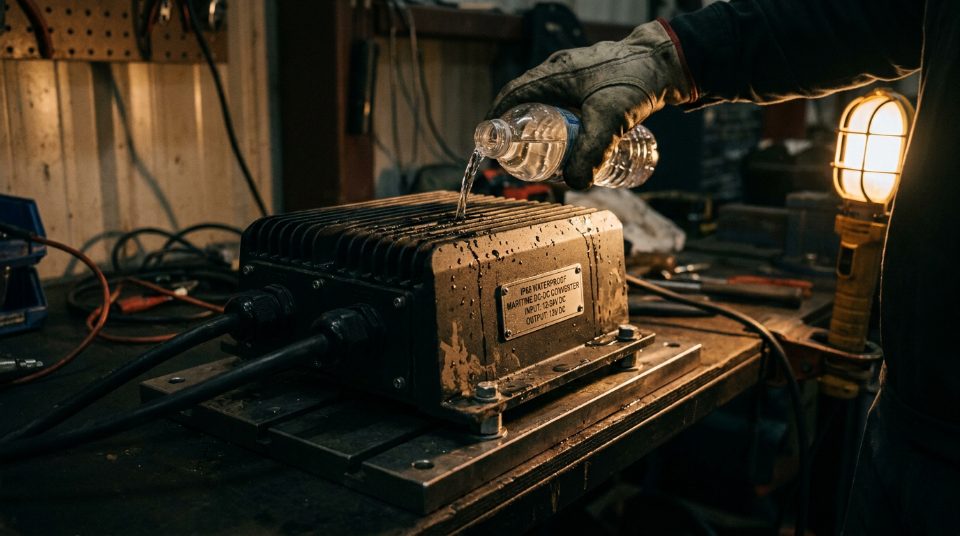
First, let's talk about how we measure waterproofness. You will see numbers like IP67 or IP68 stamped on these devices. These are Ingress Protection ratings. The first digit (6) means the unit is completely dust-tight. The second digit tells you how well it handles water. An IP67 rating means the converter can survive being dunked in water up to 1 meter (about 3 feet) deep for 30 minutes. An IP68 rating takes it a step further, allowing the device to handle continuous submersion under deeper, pressurized water. If you plan to hose down your deck with a high-pressure nozzle, or if your bilge pump compartment occasionally floods, choosing an IP68-rated waterproof dc dc converter is your best insurance policy against water damage.
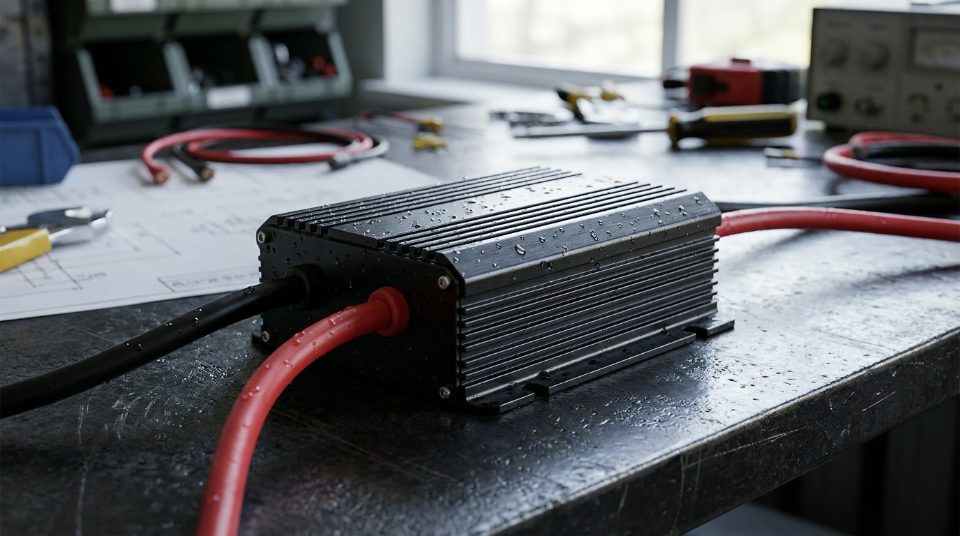
But keeping water out is only half the battle; you also have to keep the heat from building up inside. Standard electronics use tiny spinning fans to blow hot air away, but moving parts fail quickly when exposed to salty marine air. Instead, marine-grade converters rely on passive cooling. Manufacturers pack the internal electronics in a solid block of protective epoxy or silicone—a process called potting—and house them in a heavy-duty die-cast aluminum casing. This metal casing features integrated cooling fins that naturally pull heat away from the internal circuits and release it into the surrounding air. This smart design prevents thermal runaway (where a device gets hotter and hotter until it destroys itself) without relying on fragile, open-air fans.
Finally, you need to decide on the internal electrical layout, known as topology. You will choose between isolated and non-isolated designs. Non-isolated converters share a common ground wire between the input and output. They are smaller, highly efficient, and perfect for simple setups, like using a 12V/24V to 5V waterproof buck converter to charge your phone or power basic USB accessories from your boat's main battery. However, if you are running highly sensitive marine electronics like fishfinders or radar systems, you should opt for an isolated converter. Isolated models physically separate the input and output grounds, which blocks electrical noise and prevents ground loops from damaging your expensive equipment. Whichever layout you choose, make sure it includes built-in safety features like over-temperature shutdown, over-voltage protection, and short-circuit safeguards to keep your entire electrical system safe.
Key Takeaways
Ingress protection (IP) ratings like IP67 or IP68 are mandatory to guarantee survival against temporary submersion and high-pressure washdowns.
Thermal dissipation mechanisms, such as die-cast aluminum housings with integrated cooling fins, prevent thermal runaway without relying on vulnerable open fans.
Electrical safety features must include non-isolated or isolated topologies with built-in over-temperature, over-voltage, and short-circuit protections.
Premium Waterproof DC DC Converter Options for Step-Up Applications
Have you ever tried to run a powerful 24-volt marine trolling motor or a bright LED light bar on your boat, only to realize your main battery system only outputs 12 volts? Instead of buying and squeezing another heavy battery into your tight storage space, you can use a high-power step-up voltage regulator module. These smart devices act like a turbocharger for your electrical system, efficiently boosting lower voltages—like your standard 12V battery power—up to a stable, reliable 24V output.
While some setups require stepping down high voltage—such as using a 60V to 12V waterproof step-down to power 12V accessories from a large battery pack—other outdoor projects demand the exact opposite: boosting voltage up.
For demanding outdoor loads, you cannot rely on weak, low-power adapters. You need premium, heavy-duty options that support up to 20A of continuous current and 480W of total power. These rugged step-up configurations are highly suitable for golf carts, club cars, and fishing boats that need to power specialized 24V trolling motors or large LED arrays. Because high-quality step-up modules are completely sealed in epoxy, they easily shrug off the heavy vibrations of a bumpy cart ride or the constant splashing of saltwater.
However, there is an important trade-off you must keep in mind when stepping up your voltage. In the world of electrical engineering, you cannot get something for nothing. When you double the voltage from 12V to 24V, you also double the amount of current your input battery has to supply. If your 24V motor draws 20A (480W), your 12V battery actually has to push more than 40A of current to feed the converter, because no conversion is 100% efficient. This means you must use much thicker input wires to prevent voltage drops and ensure your main battery can handle the heavy discharge without overheating.
Key Takeaways
High-power step-up voltage regulator modules efficiently boost lower voltages, such as 12V battery power up to a stable 24V output.
Heavy-duty options support up to 20A of continuous current and 480W of power, ideal for demanding outdoor loads.
These step-up configurations are highly suitable for golf carts, club cars, and boats powering specialized 24V trolling motors or LED arrays.
Commercial and Government-Grade Converters for Heavy-Duty Outdoor Use
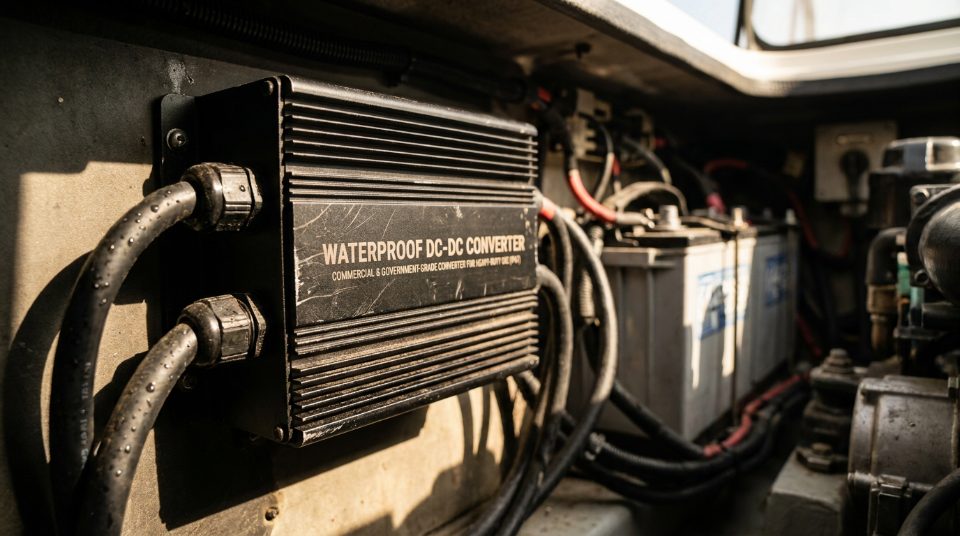
Have you ever wondered how coast guards, research vessels, and heavy-duty industrial crews keep their sensitive electronics running in the middle of a storm? They do not use fragile, consumer-grade adapters. Instead, they rely on commercial-off-the-shelf (COTS) waterproof converters. These heavy-duty units are widely available to meet the rigid procurement standards of government agencies and contractors. Because these organizations need gear that is already tested, documented and ready to deploy, they turn to standardized, rugged solutions. You can find these highly reliable options through specialized marine distributors, such as the PKYS DC DC Converter page, which showcases commercial-grade power hardware built to survive the most punishing environments.
On modern vessels and heavy outdoor equipment, propulsion systems are moving toward higher voltages—like 36V or 48V—to run electric motors more efficiently. However, standard marine electronics like your GPS, fish finder, radar, and VHF radio still require a steady 12V supply. High-efficiency step-down models (such as 48V to 12V or 36V to 12V) allow safe operation of these standard electronics directly from your high-voltage propulsion batteries. By using a buck converter with a high efficiency rating, you avoid wasting battery energy as heat, keeping your sealed equipment enclosures cool and preventing premature component failure.
Even with the right voltage step-down, heavy-duty outdoor operations face another major electrical headache: voltage sags. When you crank a large diesel engine or run a heavy electric winch, the sudden massive draw of current causes your battery voltage to plummet temporarily. In a basic setup, this sudden drop can cause your navigation screens to flicker, lose data, or completely reboot right when you need them most.
To prevent this, commercial systems integrate voltage stabilizers. These specialized devices act like electrical shock absorbers. They maintain a flat, clean output voltage even during engine cranking or severe battery voltage sags. By installing a dedicated waterproof dc dc converter designed for stabilization, you ensure that your critical communication and navigation systems receive uninterrupted, clean power no matter how hard your primary batteries are working.
Key Takeaways
Commercial-off-the-shelf (COTS) waterproof converters are widely available to meet the rigid procurement standards of government agencies and contractors.
High-efficiency step-down models (such as 48V to 12V or 36V to 12V) allow safe operation of standard marine electronics from high-voltage propulsion batteries.
Voltage stabilizers maintain a flat, clean output voltage even during engine cranking or severe battery voltage sags.
Step-by-Step Guide to Installing Waterproof Power Modules
So, you have picked out the perfect power module for your boat or off-road rig. Now comes the most important part: putting it in. Even the toughest marine-grade gear will fail if it is wired incorrectly or mounted in the wrong spot. To get the longest life and best performance out of your equipment, you need to follow a careful, step-by-step installation plan.
Preparation and Prerequisites
Before you cut any wires, you have to do some quick homework. First, you need to calculate the exact wire gauge—measured in American Wire Gauge (AWG)—for your target current draw and the physical length of your wire run. If your wires are too thin, they will resist the flow of electricity, heat up, and cause a major drop in voltage before the power even reaches your devices. Always consult a marine-grade wire chart to select the correct gauge for your specific current load.
Next, choose your mounting location carefully. While these modules are built to survive water and dust, they still hate extreme heat. You must select a mounting location that is shielded from direct engine heat and exhaust manifolds. Ideally, find a spot with decent passive airflow so the metal housing can do its job of pulling heat away from the internal electronics.
The Installation Process
Once you have your plan and materials ready, you can begin the physical installation. Follow these steps to ensure a secure, long-lasting connection:
Securely Mount the Unit: Bolt the module down to a flat, solid surface using stainless steel hardware to prevent rust. Make sure the unit is mounted firmly so that vibrations from rough waters or bumpy trails won't shake it loose over time.
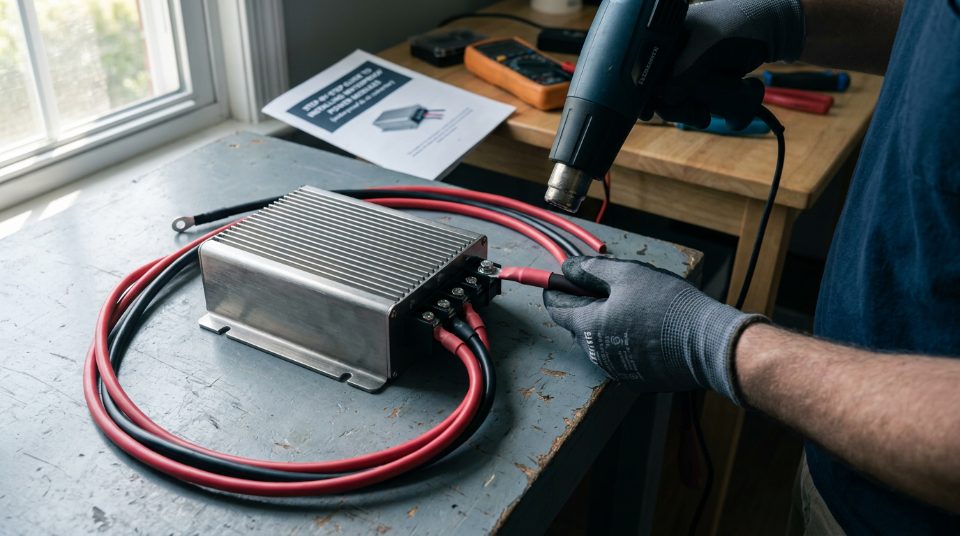
Prep and Crimp the Wires: Strip the wire ends carefully without nicking the copper strands. Slide a piece of adhesive-lined heat shrink tubing onto the wire first. Then, crimp marine-grade, tinned-copper ring terminals onto the wire ends using a proper ratcheting crimping tool. Tinned copper is essential because it resists the green corrosion caused by salty, humid air.
Make the Connections: Connect the terminals to your power source and your load, tightening the nuts to the manufacturer's specified torque.
Seal the Connections: Slide the adhesive-lined heat shrink tubing over the crimped barrel of the terminal and the wire insulation. Use a heat gun to shrink the tubing until you see a tiny bead of adhesive squeeze out of the ends. This glue creates a completely watertight seal that keeps moisture from creeping inside the wire strands.
Critical Failure Conditions to Avoid
To protect your investment, keep these three common installation mistakes on your radar:
Reverse-Polarity Wiring: Double-check your positive and negative connections before turning the power on. Swapping these wires, even for a split second, can instantly destroy a waterproof dc dc converter and potentially damage any expensive electronics connected to it.
Incorrect Fin Orientation: Always mount the unit with its cooling fins running vertically (up and down), not horizontally (side to side). Hot air naturally rises. Vertical fins allow heat to escape upward through natural convection. If the fins are horizontal, the heat gets trapped between them, and the unit will run much hotter.
Exceeding Rated Current Capacity: Never force your module to pull more current than its continuous rating. If you run a 10-amp converter at 12 amps, it will overheat, trigger its thermal shutdown, or burn out prematurely. Always leave a safety margin of about 20% to keep things running cool and reliably.
Key Takeaways
Prerequisites include calculating the exact wire gauge (AWG) for the target current draw and selecting a mounting location shielded from direct engine heat.
The installation process requires secure mechanical mounting, crimping marine-grade ring terminals, and sealing connections with adhesive-lined heat shrink tubing.
Failure conditions to avoid include reverse-polarity wiring, mounting the unit with cooling fins oriented horizontally, and exceeding the rated current capacity.
Conclusion
Selecting the right waterproof dc dc converter depends entirely on matching your specific voltage transformation needs with a verified, IP-rated enclosure. Whether you are upgrading a recreational club car for weekend drives or deploying commercial marine systems in harsh offshore environments, robust power conversion is your best defense against expensive equipment failures down the line. Sensitive outdoor electronics simply cannot survive voltage drops or water damage.
As a next step, calculate the total current draw of your target devices and choose a converter that provides a 20% safety buffer. If your installation spot is prone to direct splashes or heavy rain, look for a fully potted IP67 or IP68 unit to guarantee complete protection. Taking these simple steps now ensures your power system remains safe, stable, and ready for any weather.
FAQ
What is the difference between silicone and epoxy potting in a waterproof dc dc converter?
Epoxy potting provides superior mechanical strength and protection against harsh chemicals, which is ideal for high-vibration industrial machinery. However, silicone potting is much more flexible, allowing it to absorb thermal expansion and handle extreme temperature swings without cracking or pulling away from the internal electronics. If your outdoor equipment faces rapid temperature changes, silicone-potted units generally offer better long-term reliability.
When do you actually need an isolated converter versus a cheaper non-isolated one?
You should choose an isolated model if you need to protect sensitive communication gear, like marine sonar, radio, or GPS, from electrical noise generated by heavy trolling motors or alternators. Isolation completely separates the input and output ground circuits, which blocks electrical interference and prevents destructive ground loops. For simple loads like LED light bars or basic bilge pumps, a standard non-isolated converter is perfectly sufficient and more efficient.
How does high ambient temperature affect the maximum current output of a sealed buck converter?
Because sealed, fanless units rely entirely on passive cooling, they cannot dump heat easily when the surrounding air gets hot. Most converters will begin to "de-rate," meaning they automatically lower their safe continuous current output once ambient temperatures climb past 40°C (104°F). To avoid unexpected shutdowns in hot engine compartments, you should oversize your unit by 30% to 50% or bolt it directly to a flat metal frame to help draw heat away.