If you are rigging up your boat or off-road vehicle, you will eventually run into a frustrating power mismatch. High-performance accessories like trolling motors, high-intensity LED light bars, and specialized navigation gear almost always require a 24V power supply. Unfortunately, your starting battery and alternator only provide a standard 12V. In the past, the only way to solve this was to wire a second heavy battery in series. This brute-force method adds massive weight, eats up valuable compartment space, and complicates your onboard charging setup.
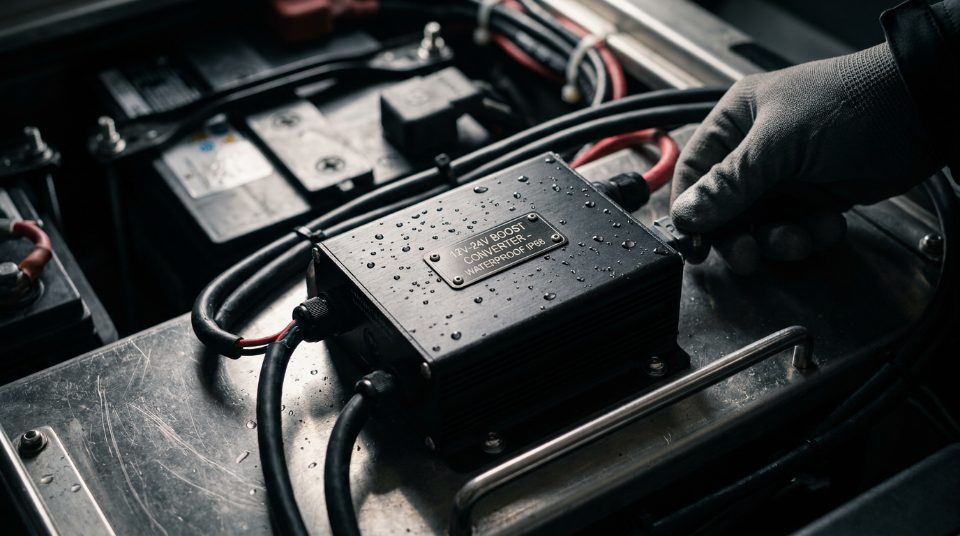
Fortunately, a modern 12v to 24v waterproof boost converter offers a lightweight, cost-effective alternative. These compact solid-state devices step up your existing 12V battery power to a stable 24V output on demand, completely eliminating the need for a secondary battery bank. For instance, when you look at high-capacity units like the 1-50A IP68 waterproof boost converter, you can see how advanced power electronics deliver high current without the bulk. They are perfect for tight spaces under the dash of a truck, inside a golf cart battery bay, or within a boat’s console where every inch and ounce counts.
However, choosing the right voltage regulator for wet, vibration-heavy environments requires looking past basic specs. If you pick a converter that cannot handle the heat or moisture of an off-road trail or saltwater spray, it will quickly fail due to thermal overload or water damage. To ensure reliable performance, you must carefully evaluate environmental protection ratings, continuous power requirements, and physical space constraints. Understanding these factors will help you avoid severe voltage drops and keep your high-power accessories running smoothly in the harshest conditions.
Why Your Vessel or Rig Needs a 12v to 24v Waterproof Boost Converter
You need a step-up converter because your boat or off-road rig runs on a standard 12V electrical system, but your most demanding gear requires 24V to operate efficiently. Instead of forcing you to rewire your entire vehicle, a 12v to 24v waterproof boost converter acts as a smart step-up voltage regulator. It takes the highly unstable, fluctuating 12V input from your alternator or starting battery—which can bounce anywhere from 11V during engine cranking to 14.4V while charging—and boosts it to a rock-solid, clean 24V output. This stable voltage prevents your sensitive electronics from flickering, rebooting, or shutting down when your engine loads change.
Traditionally, getting 24V meant buying two heavy 12V batteries and wiring them in series. While this works, it adds up to 60 pounds of dead weight and hogs precious storage space in your bilge or utility compartment. Using a solid-state boost converter completely eliminates the need for these secondary batteries. You save physical space, reduce your vehicle's overall weight, and simplify your charging setup since you only have to maintain a single 12V bank. However, there is a trade-off: because of the laws of physics, drawing 10 amps at 24V on the output side means the converter will pull at least 20 amps from your 12V battery. Your alternator and primary wiring must be beefy enough to handle this doubled input current without causing a massive voltage drop.
This power conversion is essential for running high-draw accessories that perform poorly—or not at all—on standard 12V power. Common 24V applications in marine and off-road environments include heavy-duty recovery winches, high-intensity LED light bars, and specialized marine audio systems that need higher voltage to push clean sound without clipping. Similar power-stepping challenges exist in other utility vehicles, which is why technicians often look at robust designs like the 24V to 48V waterproof step-up model when stepping up voltages even higher for heavy-duty electric motors. Whether you are powering a high-end marine stereo or a trail-clearing winch, stepping up your voltage ensures your equipment gets the exact power it needs to run at peak performance.
Key Takeaways
The converter acts as a step-up voltage regulator, taking fluctuating 12V input from your alternator or starting battery and boosting it to a stable 24V output.
Using a converter eliminates the need for secondary 12V batteries in series, saving valuable physical space and reducing overall vehicle weight.
Common 24V applications in marine and off-road environments include heavy-duty winches, specialized marine audio systems, and high-intensity LED light bars.
Deconstructing IP67: Waterproofing and Shock Resistance in Harsh Environments
When you are shopping for a 12v to 24v waterproof boost converter, you will constantly see the term "IP67" stamped on the spec sheet. But what does that code actually mean for your boat or off-road rig?
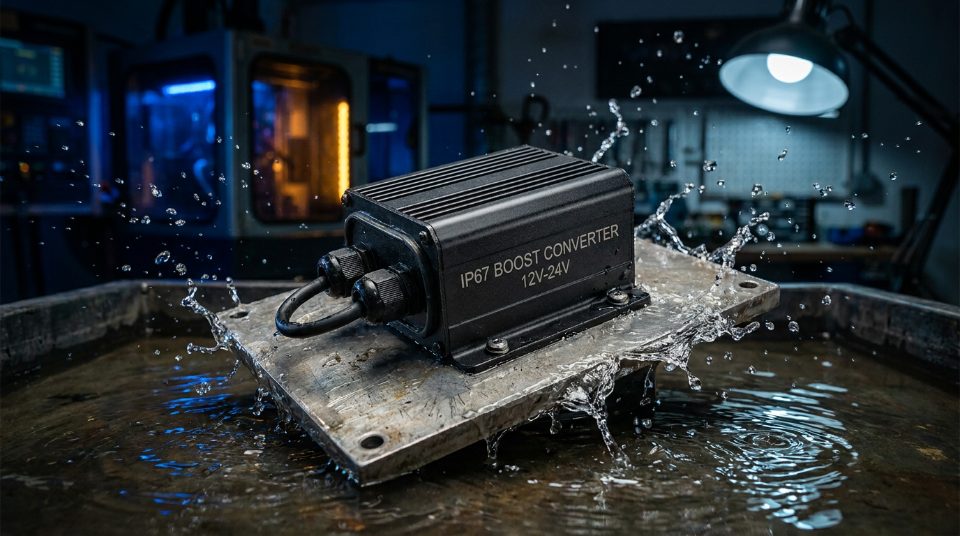
The "IP" stands for Ingress Protection, which is a standard rating system for how well an electrical enclosure keeps out unwanted elements. The first digit, "6", is the highest possible rating for solids, meaning the device is 100% dust-tight. No trail dust, sand, or fine grit can slip inside. The second digit, "7", guarantees that the device can survive complete immersion in water up to 1 meter (about 3.2 feet) deep for up to 30 minutes. If your boat's bilge compartment temporarily floods or your truck splashes through a deep creek crossing, your power supply will keep running without shorting out.
To achieve this level of protection, manufacturers do not just rely on tight plastic cases or simple rubber gaskets. Instead, high-quality converters use a process called potting. Engineers fill the entire metal housing with liquid epoxy or silicone resin. Once this material cures, it hardens into a solid block that completely seals the internal circuit board. This potting technology creates a permanent barrier against moisture, high humidity, and saltwater corrosion—which is crucial because salt air can eat away unprotected copper circuits in a matter of weeks. This level of extreme environmental protection is similar to what you find in heavy-duty automotive power steps, such as the 12V to 48V boost converter, which relies on these robust sealing principles to survive under-hood environments.
Potting also solves another major challenge: vibration. When your boat pounds against heavy waves or your truck rattles over washboard dirt roads, the delicate internal circuitry is subjected to intense, repetitive forces. Over time, constant shaking can snap solder joints, crack circuit boards, or wiggle heavy components loose. The solid epoxy or silicone potting acts like a built-in shock absorber, holding every capacitor, resistor, and wire firmly in place. This anti-shock protection ensures that your electrical system remains stable no matter how rough the terrain gets.
Key Takeaways
An IP67 waterproof rating guarantees that the device is 100% dust-tight and can survive complete immersion in water up to 1 meter deep for 30 minutes.
High-quality converters utilize epoxy or silicone potting technology to seal internal components, providing moisture-proof protection against saltwater corrosion and high humidity.
Anti-shock and vibration resistance are critical for protecting delicate internal circuitry from the constant pounding of waves on boats or rough terrain encountered by off-road trucks.
How to Choose the Right 12v to 24v Waterproof Boost Converter Based on Specs
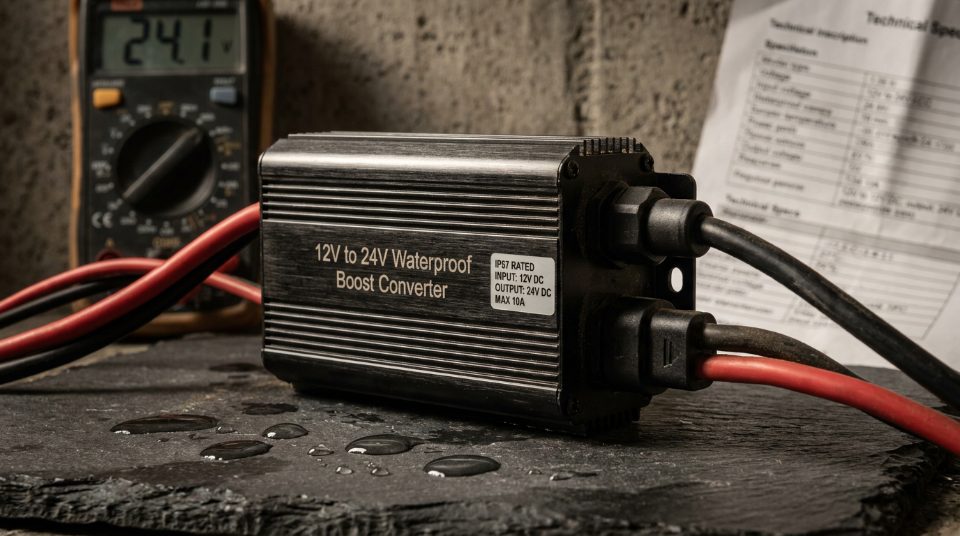
How do you pick the perfect converter without melting your wires or draining your battery? It all comes down to reading the spec sheet like a pro. When you are shopping for a 12v to 24v waterproof boost converter, matching the device's technical specifications to your specific setup is the only way to ensure your gear runs smoothly. Let's break down the exact specs you need to look for.
Output Current and Power Rating Requirements
How do you make sure your new converter can actually handle the load of your marine or off-road gear? If you hook up a device that asks for more power than your converter can give, you are going to run into serious performance issues. Finding the right size requires a simple math formula and a bit of breathing room for your electronics.
To calculate your exact power needs, follow these steps:
Find the Amps: Look at the user manual or the spec sticker on your 24V device (such as a trolling motor or LED light bar) to find its continuous current draw in amps (A).
Calculate the Wattage: Multiply that current by 24 (the output voltage). This gives you the required power in watts (W). For example, if your device draws 5 amps, your calculation is watts.
Add a Safety Margin: Never run a converter at 100% capacity. You should select a converter with a 20% to 30% safety margin. For a 120-watt demand, multiplying by 1.25 (a 25% margin) means you should look for a converter rated for at least 150 watts (or 6.25 amps at 24V).
Why is this safety buffer so important? If you under-size your 12v to 24v waterproof boost converter, you will quickly run into three major problems:
Voltage Drops: Under heavy loads, an overloaded converter cannot maintain a stable 24V output. The voltage will sag, which can cause marine fishfinders to glitch and reboot, LED lights to flicker, or motors to lose torque.
Excessive Heat: Pushing a converter to its absolute limit forces its internal components to work overtime. Because the conversion process is not perfectly efficient, this extra struggle generates massive amounts of heat.
Thermal Shutdown: To prevent itself from permanently melting, a quality converter will trigger its automatic thermal protection and shut down completely. This leaves your equipment dead in the water—literally—until the unit cools down.
By choosing a converter that easily handles your peak power needs with room to spare, you keep the operating temperature low and ensure your electronics get a clean, steady stream of power.
Compact Form Factor for Tight Vehicle Spaces
You might be wondering: "Where on earth am I going to mount this device?" If you are working on a golf cart, a club car, or stuffing electronics behind a crowded under-dash panel, physical space is at a premium. Fortunately, you do not need a massive, heavy box to get the job done.
Modern step-up modules are engineered to be incredibly compact and lightweight. Thanks to high-frequency switching technology, manufacturers can shrink the internal electrical components. This allows you to easily tuck a 12v to 24v waterproof boost converter into tight corners where space is measured in inches.
However, shrinking the device presents a major trade-off: smaller devices have less surface area to dissipate heat. To overcome this, look for models featuring integrated die-cast aluminum outer shells. Instead of using a separate, bulky heatsink, these units use the outer metal shell itself to radiate heat away from the internal circuits. This design keeps the footprint small without sacrificing thermal performance.
To get the best performance in cramped spaces, follow these mounting practices:
Metal-to-Metal Contact: Mount the flat back of the aluminum shell directly against a metal frame member of your vehicle. This allows the vehicle frame to act as an extra heat sink, drawing warmth away from the unit.
Orientation: Position the unit with the cooling fins running vertically if possible, which helps natural air currents carry heat upward and away.
Avoid Sealed Pockets: Do not bury the converter deep inside completely sealed plastic enclosures with zero airflow, as trapped heat will eventually build up and trigger a thermal shutdown.
Safety Protections and Thermal Efficiency
When installing a 12v to 24v waterproof boost converter in a tight boat compartment or under an ATV dash, you must ensure it can handle electrical hiccups without causing a fire.
To keep your vehicle and gear safe, choose a unit with these built-in electronic guards:
Over-voltage and Under-voltage: Protects the unit from voltage spikes and prevents it from draining your starting battery dead.
Overload and Short-circuit: Instantly cuts power if a wire pinches or a device draws too much current.
Overheating: Shuts the system down safely if internal temperatures spike.
Beyond these active guards, look for high conversion efficiency—ideally 95% or higher. High efficiency means the converter wastes very little energy. Since wasted electrical energy turns directly into heat, a highly efficient unit keeps power loss to a minimum. This ensures your converter stays cool, even when tucked away inside an enclosed, unventilated compartment.
Installation Steps, Fail-safes, and Troubleshooting
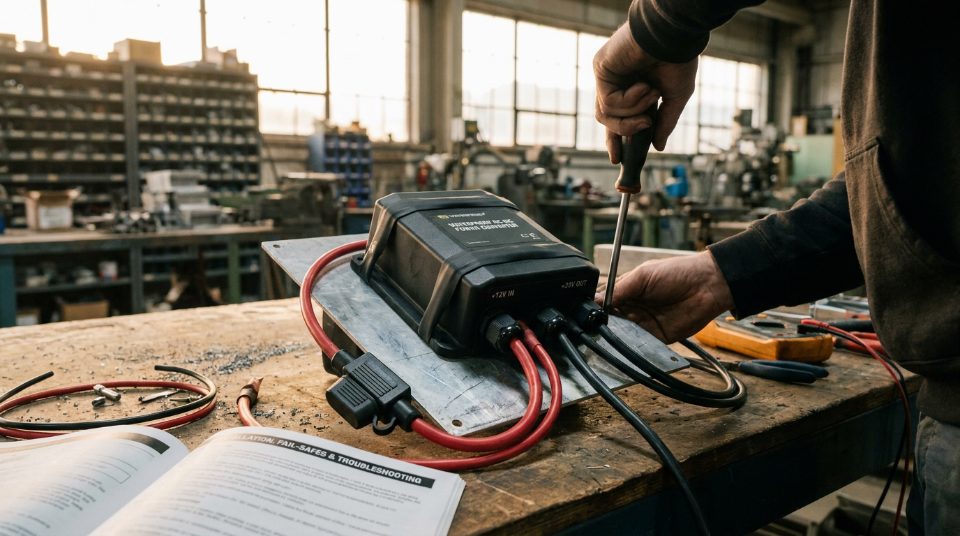
How do you actually hook up your new converter without sparking a fire or ruining your gear? Installing a 12v to 24v waterproof boost converter requires a careful, step-by-step approach to ensure your electrical system stays safe and runs cool.
Step-by-Step Installation Guide
Before you strip any insulation or crimp any connectors, make sure you have the right tools and materials. Here is how to get the job done right:
Cut the Power: Always disconnect the negative terminal of your main 12V battery before touching any wiring. This simple step prevents accidental short circuits while you work.
Mount for Heat Dissipation: Find a flat, solid metal surface on your boat or vehicle frame. Bolt the converter's flat aluminum back directly to this surface. The metal acts as a secondary heat sink, drawing heat away from the unit during heavy use.
Wire with Marine-Grade Conductors: Run tinned copper marine-grade wire for both the input (12V) and output (24V) sides. This wire resists saltwater corrosion and vibration. Make sure you use the correct wire gauge (AWG) based on your current load and run length to prevent voltage drop.
Add the Critical Inline Fuse: Install an inline fuse on the positive (+) 12V input wire as close to the battery source as possible. If a short occurs along the wire run, this fuse blows instantly, saving your vehicle's main electrical harness from catching fire.
Understanding Fail-safes and Troubleshooting
Even with a perfect installation, off-road and marine environments can throw unexpected curveballs at your electrical system. Knowing how your converter reacts to common failure conditions will help you troubleshoot issues quickly.
Low Input Voltage (The 9V Threshold): If your starting battery drains or your alternator struggles, the input voltage might drop below 9V. To protect itself and prevent draining your battery to absolute zero, the converter will automatically shut down. If your 24V accessories suddenly stop working, check your 12V battery's state of charge first.
Output Short Circuits (Auto-Recovery Mode): If a branch rubs against the frame and pinches your 24V output wires, it creates a short circuit. Instead of blowing its internal circuitry, the converter enters "hiccup" or auto-recovery mode. It will cut power, wait a moment, and attempt to cycle power back on. It will repeat this safe cycle until you find and clear the physical short circuit, after which it will resume normal operation automatically.
Key Takeaways
Disconnect the main 12V battery, mount the converter to a flat metal surface that aids heat dissipation, and wire the input and output terminals using appropriate gauge marine-grade wire.
Always install an inline fuse on the positive 12V input wire close to the battery source to protect the vehicle's electrical system from catastrophic shorts.
Failure conditions include input voltage drops below 9V (causing the converter to shut down) and output short circuits (which trigger the auto-recovery mode to cycle power until the fault is cleared).
Conclusion
To get your dual-voltage system up and running, your immediate next step is to match your vehicle's physical layout with your gear's electrical load. If you are retrofitting a cramped under-seat compartment in a golf cart or mounting under a truck dashboard, physical space and thermal management are your primary constraints. In these tight conditions, choosing an ultra-compact, high-efficiency design with an integrated aluminum heatsink is non-negotiable. It keeps temperature rise minimal even when the converter is tucked away without direct airflow. On the other hand, if you are rigging a saltwater fishing boat or an open-cab off-road vehicle, your main focus must shift toward surviving heavy vibration and direct water exposure.
Choosing the right unit always comes down to balancing these environmental realities with your gear's peak wattage demands. Never compromise on an IP67 waterproof rating or robust potting material; these are what keep saltwater and trail dust from frying your circuit board. When sizing your system, always factor in a 20% to 30% headroom buffer over your continuous load to handle startup surges and prevent voltage drops.
Before you mount your new 12v to 24v waterproof boost converter, map out your wiring path and secure the proper inline fuses. Safeguarding your input line with a dedicated fuse close to the battery is the single best way to protect your vehicle's main electrical harness from unexpected shorts. By choosing a unit with built-in over-temperature and short-circuit protections, and taking the time to install it on a flat, heat-dissipating metal surface, you ensure your 24V accessories will run reliably out on the water or deep on the trail.
FAQ
Why does the 24V output drop when my heavy accessory starts up? This drop is usually caused by undersized 12V input wiring. Because the boost process requires drawing double the current on the 12V side, any thin wire or loose connection will choke the converter. Upgrading to a thicker wire gauge on your input line will instantly stabilize your output voltage.
How hot will a 12v to 24v waterproof boost converter get under full load? You can expect a temperature rise of 30°C to 40°C above the surrounding air when running at maximum capacity. Since these sealed units rely entirely on passive cooling to stay waterproof, mounting them directly to a flat metal surface is crucial. Avoid placing them in unventilated, high-heat areas like sealed engine compartments.
Can I power multiple 24V accessories off a single unit? Yes, you can run multiple devices in parallel as long as their total combined wattage stays below the converter's continuous rating. For best results, use a fused distribution block on the 24V output to protect each accessory. Just keep in mind that high-surge devices might cause brief voltage dips that could reboot sensitive electronics sharing the circuit.