If you love off-grid adventures in your RV or boat, you probably know how unpredictable battery power can be. While your battery bank is supposed to deliver a steady flow of electricity, the reality is much messier. Heavy alternator charging, sudden solar surges, or the heavy draw of starting an engine can cause your system's voltage to swing wildly. These constant fluctuations can easily fry or shorten the lifespan of your sensitive onboard electronics, like LED TVs, Wi-Fi routers, and delicate marine sensors.
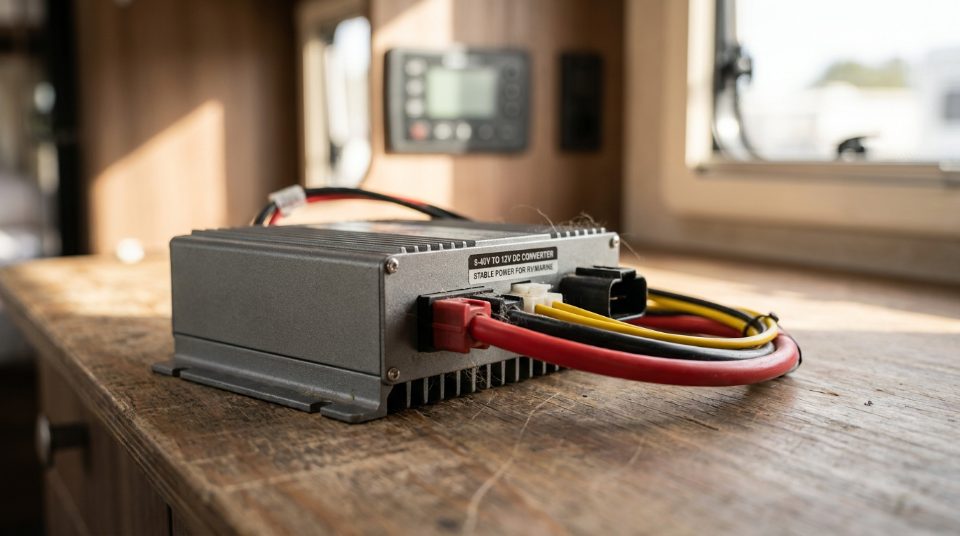
That is where an active stabilizer comes to the rescue. By installing an 8-40v to 12v boost buck converter, you can dynamically smooth out these chaotic power shifts. Whether your battery drops to a low 8V or spikes up to 40V, this device automatically steps the voltage up or down to maintain a clean, continuous 12V DC output. For those dealing with heavy-duty setups, options like the 8-40V to 12V boost buck converter show how versatile these regulators can be at managing wide input ranges to keep your gear safe.
We will look at the best converter options available to protect your valuable appliances from unexpected voltage sags and spikes. Whether you need a small, highly efficient stabilizer for a single router or a heavy-duty regulator for your entire cabin, you will find the right strategies to keep your off-grid power reliable and safe.
Why Your RV and Marine Setup Needs an 8-40v to 12v boost buck converter
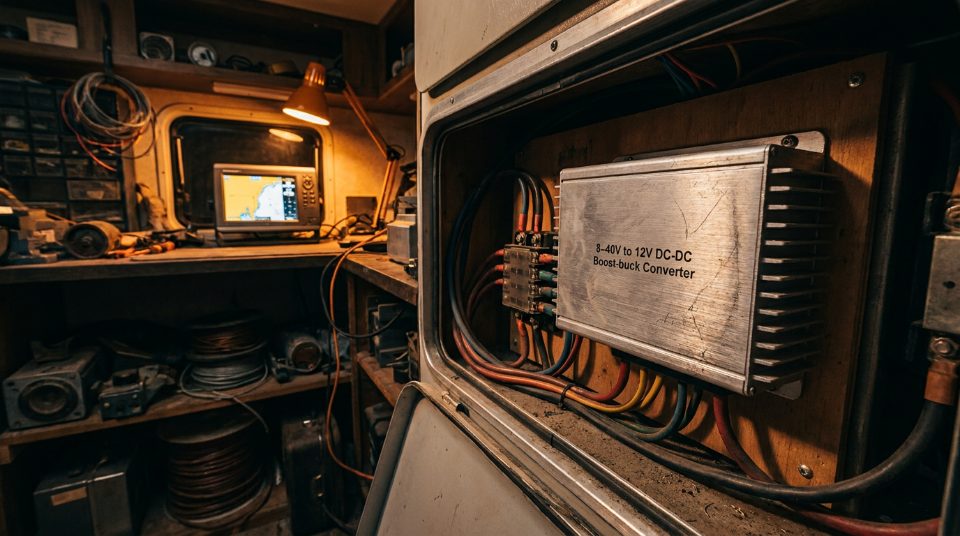
Have you ever noticed your marine GPS rebooting right when you start your boat's engine, or your RV’s LED lights flickering when your solar panels kick into high gear? This happens because your vehicle's "12-volt" battery bank is rarely sitting at exactly 12 volts. In reality, mobile electrical systems are highly unstable. When you crank a heavy engine, the massive starter motor draws so much current that your system voltage can instantly plunge to a low 8V. On the flip side, when your alternator surges or your solar charge controller pumps in maximum power on a bright afternoon, that voltage can spike up to 40V.
This is where a buck-boost topology comes in to save your gear. Unlike simple regulators that can only lower voltage, this smart design automatically switches modes on the fly. When your battery voltage rises above 12V, the converter goes into "buck" (step-down) mode to trim the excess power. The moment the voltage dips below 12V, it seamlessly transitions into "boost" (step-up) mode to pull the voltage back up. While you might see similar heavy-duty regulators like a 9-40V to 24V boost buck module used to run 24V appliances on heavy machinery, a dedicated 12V stabilizer is what keeps your standard onboard gear running safely.
By using an active 8-40v to 12v boost buck converter, you protect your sensitive marine navigation equipment and RV electronics from these chaotic power swings. Without it, constant voltage drops can trigger annoying microprocessor resets, cause screen flickering, and lead to the premature failure of your expensive electronics. Keeping the power steady ensures your fishfinders, routers, and stereos live a long, trouble-free life.
Key Takeaways
Battery voltage in mobile systems frequently drops to 8V during heavy engine cranking and rises up to 40V during rapid solar charging or alternator surges.
The buck-boost topology automatically transitions between step-down (buck) mode when input is above 12V and step-up (boost) mode when input drops below 12V.
Using a dedicated stabilizer prevents microprocessor resets, screen flickering, and premature failure of sensitive marine navigation equipment.
Key Selection Criteria for Marine and RV Power Converters
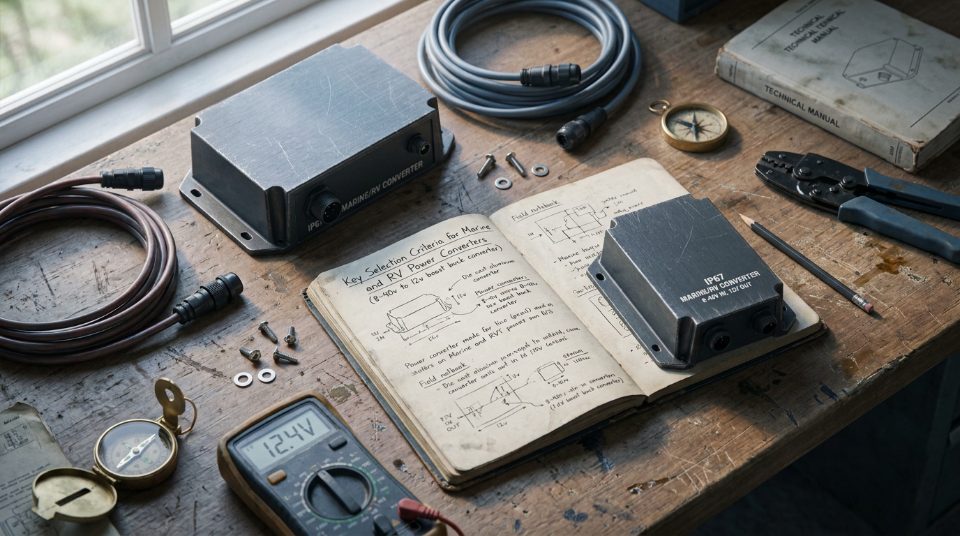
How do you pick the perfect voltage regulator when there are hundreds of options online? It is easy to get lost in the technical jargon, but choosing the right 8-40v to 12v boost buck converter comes down to three main things: how well it handles the environment, how much current it can safely push, and what safety features are built into its brain.
1. Rugged Housing for Harsh Environments
Your boat or RV is a tough place for electronics. Between salt spray, high humidity, and the constant vibration of driving down bumpy roads or crashing through waves, a standard plastic box will not last.
Look for IP67-rated die-cast aluminum housing: The "IP67" rating means the unit is completely dust-tight and can survive being dropped in a meter of water for up to 30 minutes.
Why aluminum matters: Die-cast aluminum does double duty. It seals out moisture and salt air, and it acts as a physical heat sink. Because these converters work hard to change voltages, they generate heat. An aluminum shell pulls that heat away from the internal components and releases it into the surrounding air, keeping the unit running cool without needing a noisy, breakable cooling fan.
2. The Right Current Rating for Your Load
You must match the converter's output capacity with the devices you plan to run. If you try to pull too much current, the converter will overheat, drop its voltage, or shut down entirely.
For small electronics: If you are only powering a marine GPS, a small Wi-Fi router, or a couple of LED lights, a compact converter is ideal. Industrial-grade converters offering up to 3A constant current (36W output power) are perfect for small electronics because they are highly efficient, run cool, and take up very little space.
For heavy appliances: If you need to run bilge pumps, diesel heaters, or large stereo amplifiers, you will need a heavy-duty unit rated for 10A (120W) or higher.
Understanding the circuitry: Many of these units, like the non-isolated boost buck range, use a non-isolated design. This means the input and output share a common negative ground. Non-isolated converters are incredibly efficient—often over 90%—making them perfect for conserving your battery power, though you should make sure your sensitive radio gear does not suffer from ground-loop electrical noise.
3. Built-In Safety Protections
When you are off the grid, a simple wiring mistake or a short circuit should not result in a fire. You need a converter that can protect itself and your expensive appliances from electrical faults.
Over-temperature protection: If the engine bay gets too hot, the converter will automatically throttle back or shut down to prevent thermal runaway—a dangerous cycle where overheating causes the device to draw more power until it melts or catches fire.
Over-voltage and short-circuit protection: If a wire rubs against a metal frame and shorts out, or if your alternator sends a massive voltage spike, the converter's internal switches will instantly cut the connection. This keeps the high-voltage transient from reaching and frying your sensitive 12V electronics.
Key Takeaways
Look for IP67-rated die-cast aluminum housing to seal out moisture, salt spray, and vibration in harsh marine environments.
Select the right current rating; industrial-grade converters offering up to 3A constant current (36W output power) are perfect for small electronics, while heavy appliances require 10A or higher.
Ensure the unit features built-in safety mechanisms including over-temperature, over-voltage, and short-circuit protection to prevent thermal runaway.
The 5 Best 8-40v to 12v boost buck converter Models on the Market
Choosing the right converter model depends on balancing your total appliance wattage with the unit's thermal dissipation capabilities. If you try to pull more power than the device can cool, it will overheat and shut down to protect itself.
As detailed in the industry resource DC DC Converter Input Range and Isolation Explained, managing this thermal load is just as important as matching the voltage. A smaller, sealed unit might work great for low-draw gear, but heavy-duty appliances need larger metal bodies with cooling fins to shed heat.
The table below compares the five best converter styles based on their power limits and how they handle heat.
Model Type
Max Current
Max Power
Best Application
Cooling Design
Industrial-Grade
3A
36W
GPS, routers, small sensors
Sealed epoxy potting
Waterproof Stabilizer
5A
60W
Small audio, single LED runs
Metal housing
Heavy-Duty
10A
120W
Bilge pumps, diesel heaters
Aluminum chassis
High-Power Regulator
15A
180W
Multiple light strips, fans
External heat-sink fins
Commercial-Grade
20A
240W
Multi-device navigation suites
Heavy-duty heat sink
Below, we look at the best options on the market, starting with compact units and moving up to high-output powerhouses.
Key Takeaways
Choosing the right converter model depends on balancing your total appliance wattage with the unit's thermal dissipation capabilities.
Best Compact & Low-Draw Options (Up to 3A/36W)
If you only need to keep a few small gadgets running, you do not need a massive, heavy converter taking up precious space in your electrical panel. For 12V/24V to 5V buck converter, compact options that pull up to 3A or 5A are your best bet. They are highly efficient, generate very little heat, and tuck away easily behind a dashboard or inside a small control box.
The Industrial-Grade 3A Buck-Boost Regulator
This tiny powerhouse delivers a constant 3A (36W) output, making it the perfect 8-40v to 12v boost buck converter choice for DC-DC converter range. What makes it stand out is its use of synchronous rectification technology.
In traditional converters, diodes are used to control the direction of the electrical current. However, diodes act like a bottleneck, creating friction that wastes power and turns it into heat. Synchronous rectification replaces these old diodes with advanced electronic switches (MOSFETs) that open and close with microsecond precision. This change dramatically cuts down on energy waste, keeping the unit running cool even when your battery bank is fluctuating wildly. It is ideal for running sensitive microprocessors, small Wi-Fi routers, and GPS trackers that need a clean, steady 12V supply without draining your house batteries.
The 5A Waterproof Voltage Stabilizer
If you want a little more breathing room for your gear, the 5A Waterproof Voltage Stabilizer gives you a moderate 60W power buffer. This model is specifically engineered for harsher environments, featuring complete epoxy potting.
During manufacturing, the entire internal circuit board is drowned in a liquid epoxy resin that hardens into a solid, protective block. This block completely seals out water, salt spray, dust, and heavy vibrations. It is the perfect match for small marine audio systems, fishfinders, and small LED light runs on open-cockpit boats or off-road vehicles.
System Trade-offs and Considerations
While these compact units are highly reliable, they do require some compromises:
No Room for Expansion: A 3A or 5A limit is strict. If you decide to add more electronics to the circuit later—like a portable 12V fridge or a diesel heater—you will instantly overload the converter and trigger its safety shutdown.
Passive Cooling Limits: Because these units are small and sealed, they do not have large cooling fins or fans. They rely on their flat metal backing to transfer heat. To keep them running efficiently, you must mount them flat against a cool, flat surface (like a metal frame or a well-ventilated wood panel) to help draw heat away.
Best High-Output Options for Heavy RV & Marine Loads
If you are running power-hungry equipment on your boat or RV, small stabilizers will not cut it. Heavy DC loads require robust hardware that can handle high current demands without dropping voltage or overheating.
The Heavy-Duty 24V to 12V step-down converter: This unit is your go-to workhorse for mid-range demands. It is specifically designed to run multiple LED light strips, bilge pumps, and cabin ventilation fans simultaneously. By maintaining a steady 12V output, it prevents your lights from dimming or flickering when a heavy pump suddenly kicks on.
The High-Power 15A (180W) Buck-Boost Regulator: When you need to mount your power stabilizer in a hot engine bay or a tight utility compartment, this model is the ideal choice. It features deep, external aluminum heat-sink fins that rapidly dissipate thermal buildup, allowing for continuous high-load operations in ambient temperatures that would cause standard converters to shut down.
The Commercial-Grade 20A (240W) Stabilizer: This is the ultimate choice for complex marine navigation suites, radar systems, and multi-device fast-charging hubs. It is engineered with a high surge capacity, meaning it can easily handle the brief, intense spikes of electrical current that occur when multiple heavy devices are switched on at the exact same time.
Using a high-output 8-40v to 12v boost buck converter ensures your critical systems stay online, but keep in mind the trade-offs. These larger units take up more physical space and require thicker gauge wiring to prevent voltage drop before the power even reaches your appliances.
Installation Tips and Preventing Common Buck-Boost Failures
Getting your hands on a high-quality converter is only half the battle. If you install it incorrectly, you risk damaging your expensive marine electronics or even starting an electrical fire. To get the most out of your setup, you need to follow a few critical installation strategies.
Step 1: Install Dual Inline Fuses
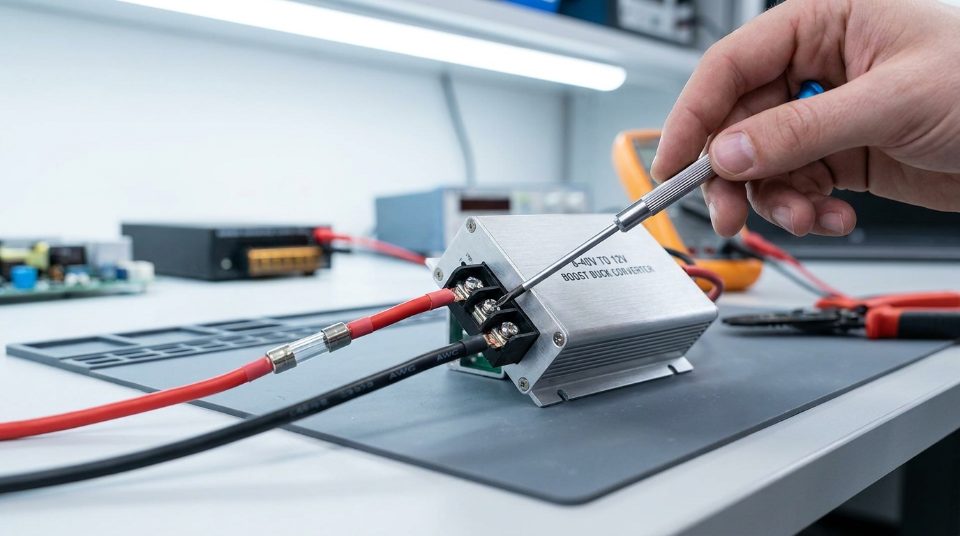
Do not skip this step! You must install inline fuses on both the input and output sides of your converter.
The Input Fuse: This protects your battery bank and the main wiring if the converter itself suffers an internal short circuit.
The Output Fuse: This protects your downstream appliances and thinner wires from drawing too much current (overcurrent damage) if a device malfunctions.
Match the fuse ratings to the continuous current limits of your specific converter model.
Step 2: Choose the Right Wire Gauge (AWG)
Voltage drop is a silent performance killer in 12V systems. If your power wires are too thin or too long, the electrical resistance will drop the voltage before it even reaches the converter's input terminals. To prevent this, use a wire gauge calculator to select the correct American Wire Gauge (AWG) based on the total length of your wire run. Thicker wires ensure your converter receives a strong, stable input signal to work with.
Step 3: Keep It Cool and Ventilated
Even highly efficient models generate heat. Avoid mounting your 8-40v to 12v boost buck converter in tight, unventilated spaces like sealed plastic glove boxes or unvented engine compartments. If the ambient temperature around the unit exceeds 80°C (176°F), the converter will either trigger its automatic thermal shutdown or suffer permanent component degradation. Always mount it on a flat, heat-conductive surface in a space with decent airflow.
Step 4: Double-Check Your Polarity
Before you flip the power switch, double-check your connections with a multimeter. Connecting the positive and negative wires backward (reverse polarity) will instantly destroy non-protected diode circuits inside the unit. A simple five-second check of your red and black wires can save you from a costly mistake.
Key Takeaways
Always install inline fuses on both the input and output sides to protect the converter and downstream wiring from overcurrent damage.
Use correct wire gauges (AWG) based on the run length to minimize voltage drop before the current reaches the converter's input terminals.
Avoid mounting the converter in unventilated, enclosed spaces where ambient temperatures exceed 80°C, which triggers thermal shutdown or causes permanent component degradation.
Verify input polarity before powering on; connecting positive and negative wires backward will instantly destroy non-protected diode circuits.
Conclusion
If your off-grid setup regularly deals with alternator surges or deep battery drains, adding an 8-40v to 12v boost buck converter is the single best way to protect your gear. This wide-input topology handles harsh input transients—like a sudden 40V spike from solar charging or an 8V drop during engine cranking—by seamlessly switching between step-up (boost) and step-down (buck) modes. It is highly recommended if you run sensitive microprocessors, marine fishfinders, or cellular routers that cannot tolerate even a split-second voltage sag.
Your next step is to size your system correctly. Do not guess your load. Calculate the peak wattage demand of all your connected devices, then add a 20% safety margin. This buffer keeps the unit running cool and prevents it from tripping its over-current protection during start-up surges. If your total load is under 36 watts, a compact 3A stabilizer will do the trick. For larger loads, like bilge pumps or LED lighting networks, look at heavy-duty 10A or higher models. Also, consider whether you need an isolated converter to eliminate ground-loop interference in sensitive audio or radio gear, or if a standard non-isolated unit is fine for your general DC distribution.
Finally, secure your investment with a solid installation. Keep the converter in a well-ventilated space to assist its thermal dissipation, use heavy-gauge wires to avoid pre-converter voltage drops, and always install inline fuses on both sides. Taking these steps ensures your off-grid power system remains rock-solid, protecting your expensive electronics no matter where your adventures take you.
FAQ
What is the difference between an isolated and a non-isolated converter, and which one do I need?
Non-isolated converters share a common ground between the input and output, which works perfectly for most standard RV lights and bilge pumps. Isolated models completely separate the input and output circuits using an internal transformer to block electrical noise. You only need an isolated unit if you are trying to eliminate ground-loop interference in sensitive marine radios, fishfinders, or high-end audio systems.
Why does the converter generate more heat when my battery voltage drops close to 8V?
When your battery voltage drops, the regulator has to work much harder in boost mode to pull the voltage back up to a stable 12V. To maintain your output power, the unit must draw more current from the battery, which increases electrical resistance inside the circuitry. This extra workload generates more heat, which is why keeping the unit in a well-ventilated spot is so important during deep battery drains.
Does an 8-40v to 12v boost buck converter drain my battery when my electronics are turned off?
Yes, these devices have a tiny parasitic power draw, often called quiescent current, even when your connected electronics are not running. While this idle draw is usually very small—often just a few milliamps—it can slowly drain your battery bank over weeks of storage. To prevent this, you should install a physical master switch or a relay on the input wire to completely disconnect the stabilizer when your RV or boat is parked.