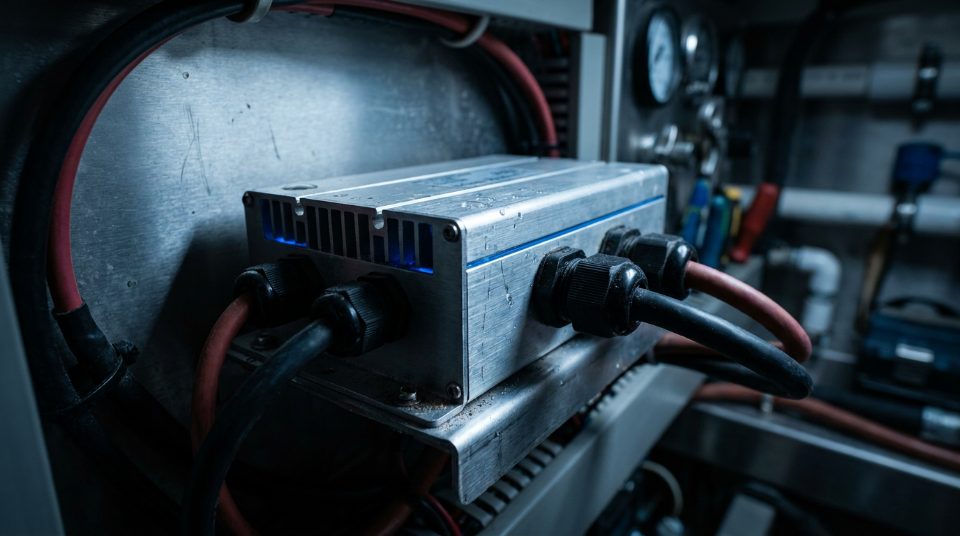
When you take your boat out onto open water or push your off-road rig through muddy trails, your onboard electronics face a brutal environment. Constant moisture, corrosive salt spray, fine dust, and violent mechanical vibrations are always working to ruin your electrical connections. Standard 12V/24V to 5V waterproof buck converter simply won't last under these conditions; you need hardware engineered to survive the elements.
This is where the IP68 ingress protection rating becomes your shield. An IP68 rating guarantees that the internal electronics are completely sealed against dust and can withstand continuous submersion in water. For instance, when stepping down power for onboard USB ports or low-voltage sensors, reliable units like the 12V/24V to 5V IP68 buck converter show how heavy-duty sealing keeps sensitive components bone-dry even under direct exposure to wet conditions.
However, finding the right ip68 dc dc converter for your specific setup goes beyond just checking the waterproof label. To ensure your onboard systems stay reliable, you must evaluate how the device handles heat, manages voltage spikes, and stands up to physical abuse. Choosing the wrong unit can lead to overheated compartments or fried electronics, so knowing what features to prioritize is key to keeping your gear running smoothly.
1. High Conversion Efficiency in an IP68 DC DC Converter
When you install a power converter inside a sealed, unventilated boat compartment, you are putting it in a thermal trap. Because an IP68-rated device must be completely dust-tight and waterproof to survive continuous submersion, it cannot have cooling fans or open air vents. If your converter is inefficient, it turns wasted energy into heat, which builds up inside the sealed unit until it burns itself out. That is why high conversion efficiency is your first line of defense against thermal failure when choosing an ip68 dc dc converter.
To keep heat to an absolute minimum, you should look for a converter that uses synchronous rectification technology. Traditional converters use standard diodes to regulate voltage, but these diodes have a natural voltage drop that wastes power and creates heat. Synchronous rectification replaces these diodes with advanced control chips and low-resistance MOSFETs (Metal-Oxide-Semiconductor Field-Effect Transistors). This upgrade slashes internal resistance, allowing the unit to reach up to 95% energy efficiency during the voltage step-down process.
Let's look at the math to see why this efficiency gap matters:
At 95% efficiency: A high-efficiency model converting an 8-36V wide input down to a stable 12V/25A output (delivering 300W of continuous power) only loses about 15 watts of power as waste heat. The die-cast metal housing can easily dissipate this small amount of heat into the surrounding air.
At 80% efficiency: That same 300W output would generate a massive 75 watts of waste heat. Inside a tight, unventilated engine bay or battery locker, 75 watts of trapped heat will quickly trigger a thermal shutdown or permanently damage your gear.
This thermal challenge is just as critical when you need to step voltage up instead of down. For example, using a highly efficient 1-50A IP68 boost converter ensures that your dual-battery setups or 24V trolling motors get stable, high-current power without turning your storage locker into an oven.
Because these units are completely filled with a solid, protective potting compound to achieve their waterproof rating, they rely entirely on conduction to cool down. The heat must travel from the internal transistors, through the potting glue, and out to the metal ribs of the outer shell. By choosing a model with 95% efficiency, you make sure there is very little heat to move in the first place, keeping your marine electronics running cool and safe in the tightest corners of your boat.
Key Takeaways
Look for synchronous rectification technology that achieves up to 95% energy efficiency, minimizing power loss during voltage step-down.
High-efficiency models, such as those converting 8-36V input to a stable 12V/25A/300W output, generate significantly less waste heat.
Reduced heat generation allows the converter to operate safely inside sealed, unventilated marine compartments without overheating.
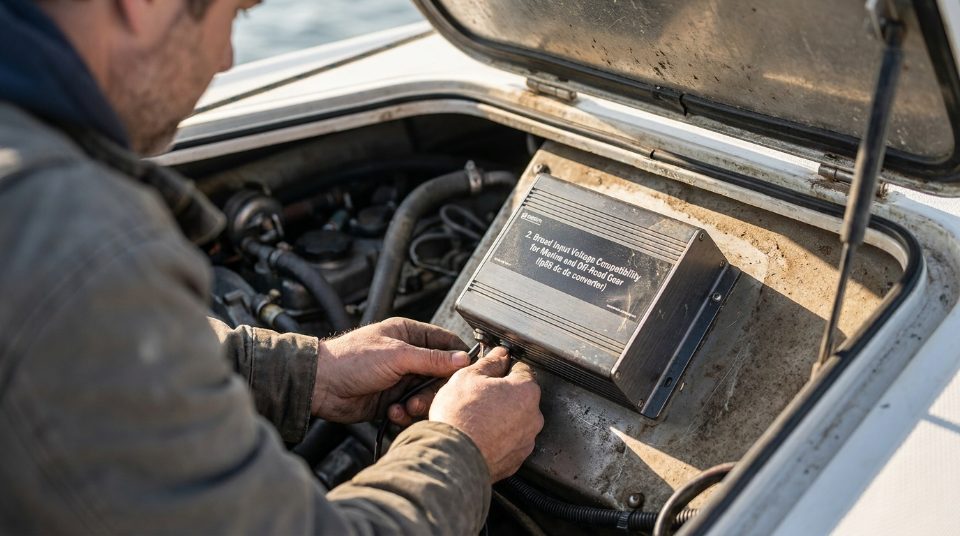
2. Broad Input Voltage Compatibility for Marine and Off-Road Gear
Have you ever noticed your boat's cabin lights flicker when you start the engine, or heard a strange buzzing noise in your stereo speakers? That happens because marine and off-road electrical systems are noisy environments. Your alternator does not output a perfectly flat voltage; instead, it spikes and dips as the engine revs or as heavy loads turn on and off. Plus, depending on your vehicle's setup, you might be dealing with a 24V, 36V, 48V, or even a 72V battery bank.
To handle these massive swings, you need a converter with broad input voltage compatibility. For example, a quality converter that can step down a wide range, such as 72V down to a stable 12V, gives you a massive safety cushion. It can swallow huge voltage spikes from a charging alternator without passing that stress down to your gear. This flexibility is especially useful if you run mixed-voltage systems. For instance, if you are managing a solar-powered rig, utilizing a specialized unit like the 48V to 24V IP68 step-down converter allows you to bridge high-voltage battery banks with standard equipment safely.
Onboard gear generally falls into two very different categories, and your converter must support both:
Gear Type
Examples
Power Requirement
What Happens with Poor Power?
Heavy-Duty Loads
Bilge pumps, electric cooling fans, anchor winches, motorized outdoor toys
High startup current, tolerates minor voltage fluctuations
Slow operation, motor stalling, or blown fuses
Sensitive Electronics
GPS navigators, marine audio, LED displays, hard drive players, media devices
Extremely clean, ripple-free DC power
Screen flickering, audio hums, system crashes, or data loss
How to Ensure Stable Power for All Onboard Gear
To keep both your heavy-duty motors and your sensitive GPS running smoothly at the same time, use these system design practices:
Isolate your circuits: Run your sensitive electronics on a separate output branch from your heavy-duty motors. This prevents the high startup current of a motor from dropping the voltage and resetting your GPS or media player.
Check the output ripple specification: Choose an ip68 dc dc converter that specifies a low peak-to-peak ripple voltage (ideally under 100mV). Clean, ripple-free power keeps your marine speakers free of static and prevents digital displays from flickering.
Size the converter for startup surges: Electric fans and motors can draw up to three times their normal running current when they first spin up. Always match your converter’s peak output rating to these initial startup surges, not just the continuous running wattage.
Key Takeaways
A wide input voltage range (such as step-down capability from 72V to 12V) is necessary to handle fluctuating alternator outputs and varying battery bank configurations.
The converter must support diverse onboard applications, delivering stable power to heavy-duty loads like motors, electric fans, and outdoor toys.
Clean, ripple-free DC output is critical for sensitive electronics, including marine audio, speakers, LED displays, GPS navigators, hard drive players, and media devices.
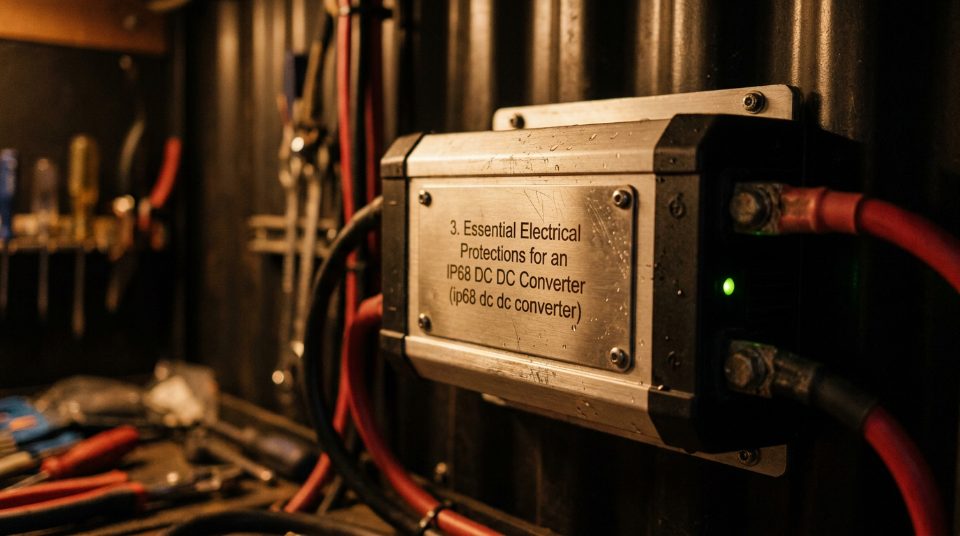
3. Essential Electrical Protections for an IP68 DC DC Converter
When you are out on the water, electrical issues can happen in a split second. A sudden battery surge, a pinched wire, or an overloaded bilge pump can easily destroy your expensive marine electronics. Because an ip68 dc dc converter is completely sealed in protective glue, you cannot simply open it up to replace a blown internal fuse. That is why built-in, smart electronic safety features are your system's first and only line of defense.
To keep your boat's electrical grid safe, you should look for a converter equipped with these five essential protections:
Short-Circuit Protection (SCP): If a positive wire accidentally touches a negative wire, this feature shuts down the output instantly to prevent sparks, melted wires, or electrical fires.
Over-Voltage (OVP) and Under-Voltage Protection (UVP): These guardrails monitor the incoming power. If your alternator spikes or your battery bank drains too low, the converter shuts down to protect your connected gear from frying or running on unstable voltage.
Overload Protection (OLP): If your marine gear tries to draw more current than the converter can safely handle, this feature limits the output current to prevent internal damage.
Over-Temperature Protection (OTP): If the unit gets too hot inside a closed engine bay, the thermal sensor will temporarily turn off the power until the unit cools down.
As detailed in the design manuals for the Non Isolated Buck DC DC Converter p, these safety circuits work together to shield both the converter and your sensitive navigation screens from unexpected electrical spikes.
Why Auto-Recovery is a Must-Have Feature
In the past, when a power converter experienced a fault, you had to manually flip a switch or cycle the main power to get it working again. On a boat, your converter might be tucked away in a tight, hard-to-reach compartment behind the dashboard.
That is why you need a converter with an auto-recovery function. When a short circuit or a voltage spike occurs, the converter safely shuts itself down. Once the underlying issue is resolved—such as clearing a pinched wire or letting the unit cool down—the converter automatically restarts and restores power to your devices. You do not have to crawl into tight spaces with a flashlight just to reset your system.
Look for CE and RoHS Certifications
Before you buy any electrical gear for your boat, check the label for international certifications.
CE Mark: This certification proves that the manufacturer tested the converter and met strict European safety, health, and environmental protection requirements.
RoHS Compliance: This guarantees that the product is free from hazardous materials like lead, mercury, and cadmium. Since marine gear eventually gets recycled or disposed of, RoHS-compliant devices keep toxic chemicals out of our waterways.
Key Takeaways
Integrated safety mechanisms must include over-voltage, under-voltage, overload, over-temperature, and short-circuit protections to safeguard connected marine gear.
Look for an auto-recovery function that automatically restores power delivery once the underlying electrical fault or voltage spike is resolved.
Verify CE and RoHS certifications to ensure the device complies with international safety standards and environmental regulations for hazardous substances.
4. Rugged Physical Construction and Installation Design
When you are slamming through ocean waves or bouncing down a rocky trail, your onboard electronics take a brutal beating. If your voltage converter has a flimsy plastic shell or loose internal parts, the constant rattling will shake it to pieces in no time. To survive these rough conditions, a high-quality ip68 dc dc converter must be built like a tank, both inside and out.
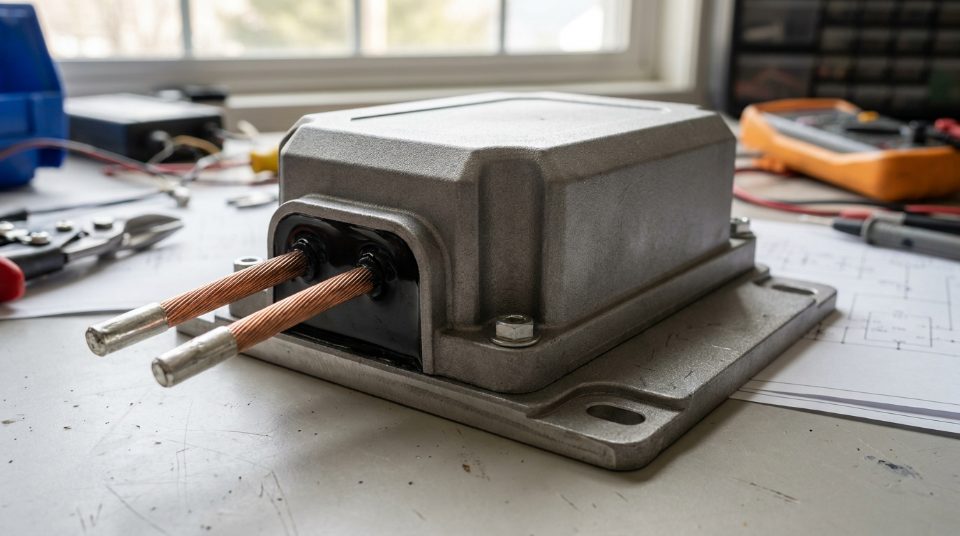
The first line of defense is the outer shell. You want a unit housed in a heavy-duty die-cast aluminum housing. Aluminum is tough enough to withstand accidental impacts, and it doubles as a highly efficient heat sink to draw warmth away from the internal components. Inside that metal shell, the entire circuit board should be completely encased in high-thermal-conductivity organic silica potting. This potting is a specialized, rubbery compound that fills every empty space inside the housing. It does two critical jobs: it seals out every drop of water to maintain its submersible rating, and it acts as a shock absorber. By locking every capacitor, chip, and inductor firmly in place, the potting prevents heavy vibrations from snapping the delicate solder joints on the circuit board.
Next, look at the wires coming out of the device. In humid, salt-air environments, standard copper wires will oxidize quickly. They turn green, become brittle, and lose their ability to conduct electricity, which can cause your marine gear to flicker or shut down. To prevent this, the converter should feature corrosion-resistant pre-tinned copper wire leads. Tinning involves coating each copper strand in a micro-thin layer of tin. This tin barrier stops oxygen and moisture from reaching the copper, preventing oxidation at your connection points and ensuring a clean, stable flow of power for years.
Finally, you need a reliable way to keep the unit in place. A loose converter bouncing around your engine bay or battery compartment is an accident waiting to happen. It can pull on its own wires, spark, or damage surrounding equipment. To prevent this, choose a converter designed with integrated mounting tabs molded directly into the metal housing. These tabs allow you to securely bolt the unit to a flat, solid surface on your boat or vehicle. Once bolted down, the converter will stay perfectly still, protecting your wiring from tension and wear even during the roughest transit.
Key Takeaways
The outer shell should feature die-cast aluminum housing paired with high-thermal-conductivity organic silica potting to resist physical shock and vibration.
Corrosion-resistant pre-tinned copper wire leads are essential to prevent oxidation at connection points when exposed to humid salt-air environments.
Integrated mounting tabs are required to securely bolt the converter to flat surfaces, preventing movement during rough water transit or off-road navigation.
Conclusion
When you are out on the water or tackling a dusty trail, the last thing you want to worry about is a sudden power failure. A rugged ip68 dc dc converter is vital for maintaining stable power delivery to your critical navigation, entertainment, and mechanical systems. By prioritizing a model with 95% conversion efficiency, robust electrical protections, and verified CE/RoHS certifications, you can easily prevent premature equipment failure. From there, ensuring proper physical mounting and using corrosion-resistant wiring during your installation guarantees long-term durability in even the harshest marine conditions.
To get the most out of your new hardware, keep these practical next steps in mind:
Leave some breathing room: Always size your converter so that your continuous electrical load does not exceed 80% of the device's maximum rated capacity. This buffer keeps the unit running cool.
Seal your splices: Even with pre-tinned wires, always use marine-grade heat-shrink butt connectors or adhesive-lined heat shrink tubing to seal your wire splices against salty sea air.
Choose the right surface: Bolt the flat back of the aluminum housing directly to a metal frame or bulkhead if possible. The metal surface acts as an extra heat sink to draw warmth away from the unit.
Quick Troubleshooting FAQ
Do I still need an inline fuse if the converter has built-in short-circuit protection? Yes. Built-in protections safeguard the converter and your connected devices, but they cannot protect the input wiring coming from your battery bank. Always place an inline fuse on the positive input wire as close to the battery source as possible to protect against wire fires if the main cable gets pinched.
Can I mount the converter inside a completely sealed plastic box? While the unit's IP68 rating allows it to survive in dusty, wet, sealed spaces, placing it inside a small, sealed plastic box limits airflow. Over time, trapped heat can trigger the converter's thermal shutdown. It is always best to mount it in a location that allows at least some passive air circulation.
FAQ
What does the "8" in the IP68 rating actually mean for water depth and testing duration? The number "8" means the device can withstand continuous immersion in water under conditions specified by the manufacturer, which is tougher than the 1-meter limit of an IP67 rating. For industrial components, this test usually involves submersion at a depth of 1.5 to 3 meters for at least 30 minutes to 2 hours. However, you should always check the manufacturer's datasheet for the exact depth and time limits of their specific test.
How do manufacturers achieve waterproof seals around the incoming and outgoing power cables? To prevent water from wicking along the copper strands and entering the housing, manufacturers use high-grade epoxy potting that completely surrounds the wires inside the entry collar. Additionally, high-quality units use heavy-duty rubber strain-relief boots compressed around the cable jacket. Following recommended ip68 dc dc converter installation steps, you should always point your cable exits downward to prevent water from pooling at the entry point.
Can I use a standard step-down converter in a marine solar charging system? While a step-down converter can regulate voltage, it lacks the Maximum Power Point Tracking logic needed to efficiently manage fluctuating solar panel outputs. Using a simple buck converter instead of a dedicated solar charge controller will result in massive power loss and could damage your battery bank over time. For solar setups, you should only use a specialized solar regulator that features built-in IP68 weatherproofing.