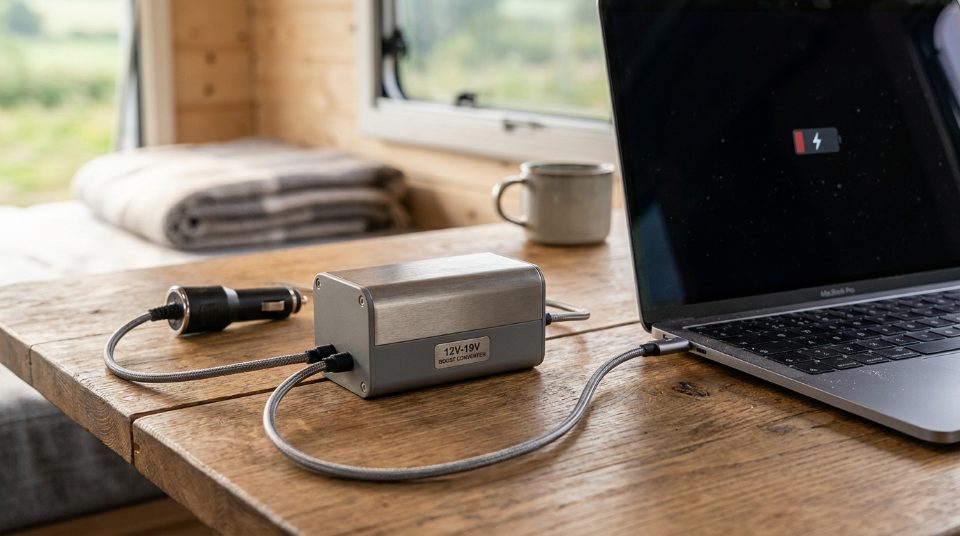
If you want to work from your car or RV, you will quickly find that your laptop won't charge directly from the dashboard. Laptops require a stable 19V DC DIN rail power supply range, making standard 12V vehicle outlets insufficient without a dedicated step-up mechanism to boost the voltage.
While you could use a noisy DC-to-AC inverter paired with your standard wall charger, a 12v to 19v boost converter is significantly more energy-efficient. Direct 24V to 12V buck converter avoids the massive double-conversion power loss of turning DC to AC and then back to DC, saving your vehicle's battery life.
However, selecting the right hardware, like a robust 12V to 19V boost converter for vehicles setup, requires balancing your laptop's wattage needs with the electrical safety limits of your vehicle's DC accessory circuits so you do not blow any fuses.
Why You Need a 12v to 19v Boost Converter for Laptop Charging
Have you ever tried plugging your laptop directly into a 12V cigarette lighter socket, only to find absolutely nothing happens? That is because your car or RV battery system typically outputs between 12V and 14V. However, most professional and gaming laptops require a steady 19V input just to initiate the charging process. Without a way to bridge this voltage gap, your laptop is essentially a paperweight on long road trips.
Your first instinct might be to grab a standard car inverter to power your laptop's regular wall charger. But this setup is incredibly wasteful. An inverter takes your car’s DC power, converts it to AC, and then your laptop charger converts it right back to DC. This double-conversion process loses a massive amount of energy as heat, quickly draining your vehicle's battery. Using a dedicated 12v to 19v boost converter solves this by performing a direct DC-to-DC conversion, keeping your energy setup highly efficient. For rugged environments, relying on specialized hardware like a 9-40V to 19V waterproof boost buck ensures you get reliable power without wasting precious battery capacity.
Beyond efficiency, safety is the biggest reason to use a dedicated step-up device. Your vehicle’s electrical system is a noisy environment. When you start the engine or turn on the AC, the alternator causes rapid voltage fluctuations. A quality boost converter acts as a protective shield. It regulates these chaotic input spikes into a clean, continuous 19V stream, safeguarding your laptop’s sensitive motherboard circuitry from fry-inducing power surges.
Key Takeaways
Direct DC-to-DC conversion eliminates the double-conversion energy loss (DC to AC, then back to DC) inherent in traditional car inverters.
Standard car and RV battery systems output 12V to 14V, whereas most professional and gaming laptops require a steady 19V input to initiate charging.
Quality boost converters regulate fluctuating vehicle alternator voltages into a clean, continuous 19V stream, protecting sensitive laptop motherboard circuitry.
7 Best 12v to 19v Boost Converter Options for Every Vehicle Setup
Choosing the right way to step up your vehicle's power depends entirely on your laptop's energy appetite and your installation environment. To help you find the perfect match, we have broken down the top options into three distinct categories: compact sealed units, heavy-duty waterproof powerhouses, and adjustable open-frame modules.
When selecting a 12v to 19v boost converter, you need to match its continuous current capability with your laptop's peak demand while keeping installation safety in mind.
Converter Category
Typical Output
Enclosure Type
Best For
Key Trade-off
Compact Sealed Modules
19V 5A (95W)
Plastic / Thin Alloy (IP67)
Standard ultrabooks, thin-and-light laptops
Low heat profile, but limited to under 100W
Heavy-Duty Cast-Aluminum
19V 10A (190W)
Thick Cast-Aluminum (IP68)
Gaming laptops, marine setups, golf carts
Highly durable and powerful, but draws high input current
Adjustable Open-Frame
Variable (e.g., 10-60V)
None (Bare PCB)
Custom DIY projects, non-standard devices
Maximum voltage flexibility, but lacks environmental protection
The 7 Best Configuration Options for Your Vehicle
1. The 95W (19V 5A) Compact Sealed Module
This is the ultimate sweet spot for daily commuters and remote business workers. It provides plenty of juice for standard ultrabooks, Chromebooks, and business-class laptops without generating excessive heat. Because it is fully sealed in epoxy resin (potted), it easily resists dust and vibration under the dashboard.
2. The 190W (19V 10A) Cast-Aluminum Waterproof Converter
If you are running a high-performance gaming laptop or a mobile workstation, this heavy-duty unit is your best bet. Frequently utilized in golf carts, utility vehicles, and marine environments, its thick cast-aluminum shell acts as a massive heat sink to keep internal temperatures low during intense gaming sessions.
3. The Adjustable Open-Frame Module with Onboard Potentiometers
For tech enthusiasts who need to power non-standard devices, these bare-board modules are incredibly handy. They feature tiny, adjustable screws (potentiometers) that let you manually fine-tune the output voltage. This allows you to set the output to exactly 19.5V or 18.5V depending on your device's specific manufacturer requirements.
4. The 60W (19V 3.15A) Micro-Potted Unit
This ultra-small option is perfect for space-constrained installations, like inside a motorcycle glove box or a tight center console. It is highly efficient and designed for lower-power laptops, ensuring you do not drain your starter battery during short stops.
5. The 150W (19V 7.89A) Mid-Range Aluminum Shell
Sitting comfortably between the standard 95W units and the massive 190W gaming models, this mid-range converter is ideal for video editors and creators who use entry-level dedicated graphics cards. It offers a great balance of power capacity and physical size.
6. Dual-Output Boost Boards (19V DC + 5V USB)
Some specialized open-frame modules feature auxiliary 12V/24V to 5V buck converter alongside the main boost circuit. This design allows you to run your 19V laptop while simultaneously fast-charging your phone or tablet from a single 12V input source.
7. High-Efficiency Synchronous Rectifier Modules
These advanced converters use active switches (like MOSFETs) instead of basic diodes to handle the power conversion. This design minimizes internal energy loss, making them the absolute best choice for off-grid RV setups where every single watt-hour of battery capacity counts.
Technical Deep Dive: What to Look For
When shopping for these units, keep these technical details in mind to ensure a safe installation:
Step-Up Ratio and Efficiency: Stepping up power from a nominal 12V vehicle battery to a stable 19V requires a boost ratio of roughly 1.6. Look for converters that guarantee at least 90% to 95% efficiency. Lower efficiency means more energy is lost as heat, which can shorten the lifespan of the converter.
Waterproof Packaging (Potting): For vehicles exposed to the elements, IP67 or IP68 ratings are essential. The internal circuitry of these units is completely encased in a hard epoxy compound. This potting protects the delicate electronics from moisture, road salt, and engine vibrations. While some heavy-duty industrial systems require massive step-ups like the 12V to 24V IP68 boost converter for specialized marine gear, a dedicated 12V to 19V converter is the perfect match for standard laptop charging.
Acceptance Checks: Before you plug your expensive laptop into a newly installed converter, always perform a quick safety check. Use a digital multimeter to measure the output voltage at the plug. A healthy converter should read between 19.0V and 19.5V under no-load conditions. If the reading fluctuates wildly or exceeds 20V, do not connect your device.
Key Takeaways
Compact 19V 5A (95W) sealed modules represent the ideal sweet spot for charging standard ultrabooks and business laptops on the go.
Heavy-duty waterproof 19V 10A (190W) cast-aluminum converters, frequently utilized in golf carts and marine vehicles, easily power high-performance gaming laptops.
Adjustable open-frame boost modules with onboard potentiometers provide the flexibility to fine-tune output voltages for non-standard device requirements.
The Amperage Trap: Why High-Power Converters Can Melt Car Sockets
Have you ever plugged a device into your car's accessory outlet, only to find the plug burning hot to the touch a few minutes later? This is the classic "amperage trap." When you use a high-power converter to charge a demanding gaming laptop, the simple math of electrical conversion can quickly overload your vehicle's stock wiring.
Here is how the numbers catch people off guard. Let's say you want to run a heavy-duty converter that outputs 19V at 10A, which equals 190W of power. Because energy cannot be created out of thin air, your 12V car system has to supply that same wattage. If we divide 190W by a nominal 12V input, you need about 15.8A of current. Once you factor in standard conversion efficiency losses—usually around 90%—your 12v to 19v boost converter actually has to draw over 16A from your car's battery.
This is a major problem because standard vehicle cigarette lighter sockets are typically rated and fused at only 10A. If you try to pull 16A through that dashboard socket, you will easily blow the fuse. Even worse, if the fuse fails to blow, the excessive current will overheat the thin stock wiring hidden behind your dash, potentially melting the plastic socket or starting an electrical fire.
According to the safety and installation guidelines in What Should You Inspect Before Accepting Boost DC Converter, inspecting the physical wire limits and current ratings is a non-negotiable step before powering up. If you need to safely run any converter rated above 95W, you must bypass the dashboard socket entirely.
Run Dedicated Wires: Route heavy-gauge copper wires (at least 12 AWG) directly from your auxiliary battery to your mounting location.
Install an Inline Fuse: Place an inline fuse holder on the positive wire as close to the battery terminal as possible to protect the circuit from shorts.
Connect the Converter: Wire the input side of your step-up converter directly to these new, dedicated lines, bypassing the factory dashboard circuitry completely.
Key Takeaways
Delivering 19V at 10A (190W) on the output side requires drawing over 16A from a 12V input source, factoring in standard conversion efficiency losses.
Standard vehicle cigarette lighter sockets are typically rated and fused at only 10A, meaning high-power converters will easily blow fuses or overheat stock wiring.
To safely run converters rated above 95W, users must bypass the dashboard socket and wire the step-up converter directly to the auxiliary battery with an inline fuse.
DIY Alternative: Designing a Custom Step-Up Circuit
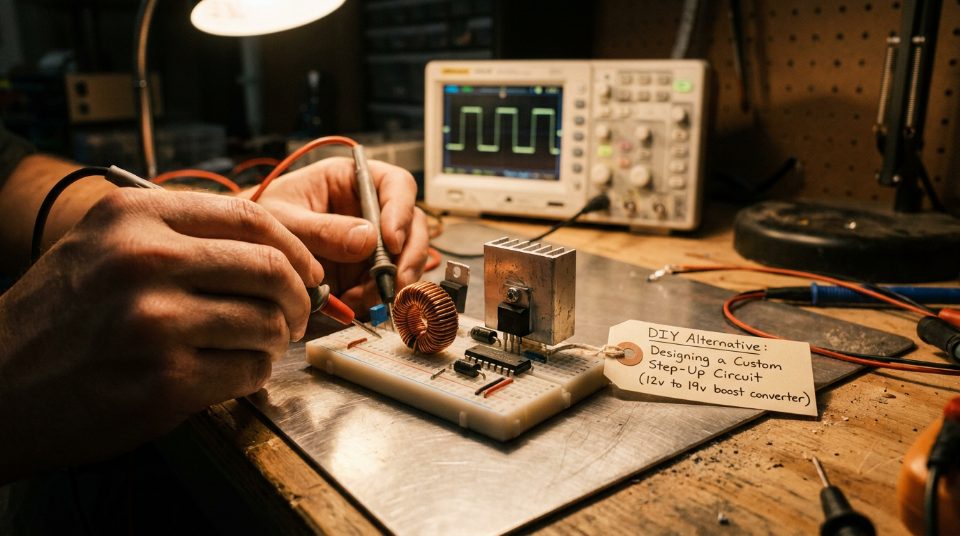
If you love electronics and want total control over your power setup, you do not have to buy a pre-made 12v to 19v boost converter. You can actually design and build your own custom step-up circuit from scratch. This hands-on approach is a great way to learn how power electronics work, and it lets you customize the hardware to fit your exact needs.
To build a basic boost circuit, you will need to source a few key discrete components:
Power MOSFET: This acts as a high-speed electronic switch that rapidly turns the input voltage on and off.
Inductor: A coil of wire wrapped around a magnetic core that stores energy in a magnetic field when the switch is closed and releases it when the switch opens.
Schottky Diode: A fast-switching diode that directs the stored energy to the output and prevents current from flowing backward.
PWM Controller: An integrated circuit (IC) that generates pulse-width modulation signals to control the switching speed of the MOSFET.
One of the biggest reasons enthusiasts choose to build a custom circuit is to control electromagnetic interference (EMI). Standard commercial converters often run at fixed frequencies that can create annoying static or noise on your RV's AM/FM radio, ham radio, or sensitive onboard electronics. By designing your own board, you can manually tune the switching frequency of the PWM controller to a "quiet" band, keeping your vehicle's communication and entertainment systems noise-free.
However, there is a major catch to going the DIY route. Commercial converters are usually "potted"—meaning they are filled with a solid, waterproof epoxy that protects them from vibration and moisture. More importantly, commercial units have built-in safety features like over-current protection and thermal runaway prevention. Trying to design these complex safety circuits yourself is highly difficult. If your DIY board overheats or experiences a short circuit, it could easily damage your expensive laptop or even start a fire, which is why commercial units remain the safer bet for most travelers.
Key Takeaways
Enthusiasts can construct a custom step-up circuit using discrete components such as a power MOSFET, an inductor, a Schottky diode, and a PWM controller.
A custom-built circuit allows manual optimization of the switching frequency to minimize electromagnetic interference (EMI) with sensitive onboard RV electronics.
The primary drawback of DIY builds compared to commercial potted units is the difficulty of integrating robust over-current and thermal runaway protections.
Conclusion
When setting up your mobile power system, choosing between a 95W sealed converter and a 190W industrial unit comes down to two things: your laptop’s peak power draw and your vehicle's wiring capacity. If you have a standard business laptop, a 95W unit is usually plenty. But if you run a high-performance gaming rig, you will need the extra muscle of a 190W converter.
Before you plug anything in, your next step should always be to calculate the 12V input current draw. Never plug a high-amperage 12v to 19v boost converter directly into a standard dashboard accessory port without checking the math first, or you risk blowing a fuse or damaging your stock wiring.
For most off-grid mobile offices and RV installations, commercial waterproof potted modules are your best bet. They offer a reliable, plug-and-play solution that protects against moisture, vibration, and thermal issues, keeping your devices charged and safe while you are on the road.
FAQ
How should I test a new step-up module before connecting my expensive laptop? You should perform a quick acceptance check using a digital multimeter to verify the output voltage under a dummy load before plugging in your computer. Connect a power resistor that mimics your laptop's average wattage and check if the voltage stays steady at 19V without dropping or spiking. This simple test ensures the device is stable and won't damage your motherboard due to a manufacturing defect.
Why is epoxy potting so important for converters used in off-road vehicles or RVs? Constant road vibrations can easily crack solder joints on an open circuit board, causing sudden power failures or dangerous short circuits. Fully potted converters are filled with a solid synthetic resin that locks every component firmly in place while sealing out moisture and dust. This rugged design is a key part of smart 12v to 19v boost converter strategies because it acts as both a physical shock absorber and a thermal conductor.
How does engine status affect the converter's boost ratio and current capability? When your engine is running, the alternator keeps the input voltage high at around 14.4V, which lowers the boost ratio and makes the conversion highly efficient. If the engine is off, the battery drops to 12.0V or lower, forcing the converter to work harder and draw more input current to maintain that 19V output. This extra workload generates more heat, so you must ensure your setup has adequate ventilation when charging off a resting battery.