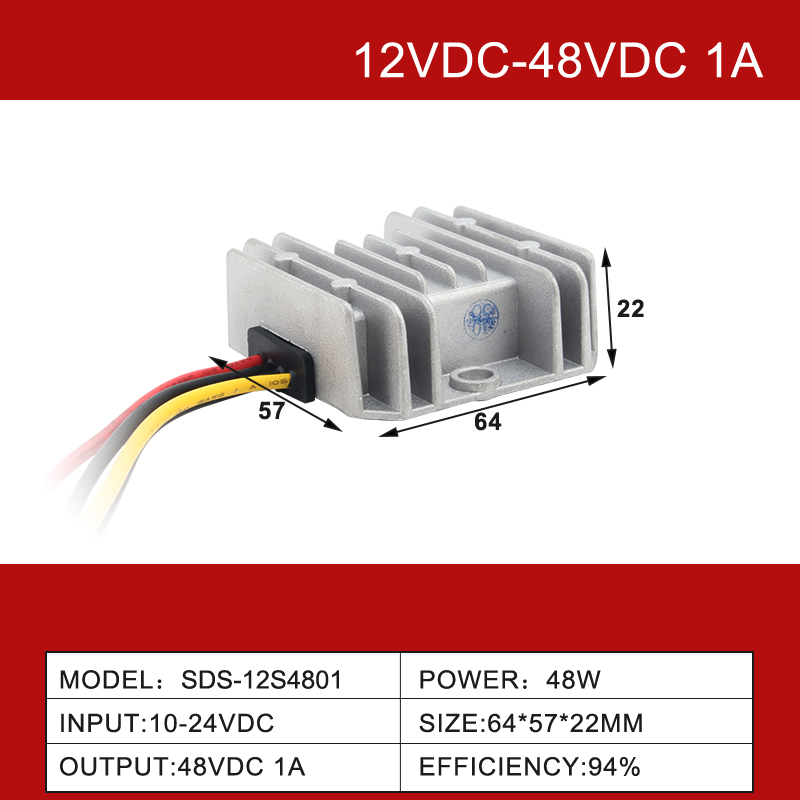
Trucks run 24V, accessories run 12V. A step-down module bridges the two without tapping one battery in the series pair.
EV auxiliaries still need a low-voltage rail. An isolated auxiliary power module replaces the alternator and holds 12V from the traction pack.
Load dump is the defining input event. Clamping a 40V to 100V surge decides whether downstream electronics survive.
Potting is a mechanical part, not a coating. It anchors components against vibration and carries heat to the housing.
Size for continuous load, then check inrush. Motors and relays draw three to five times their running current at startup.
Quiescent current drains parked vehicles. A tracker left on a converter with high standby draw will flatten the battery.
Introduction
An automotive dc dc converter is an essential power conditioning device engineered specifically to manage the volatile electrical environments found within vehicles. Whether bridging the gap between a high-voltage battery pack and low-voltage accessories in an electric vehicle (EV) or regulating power for telematics in heavy-duty commercial trucks, these converters ensure stable energy delivery. They must withstand severe voltage transients, aggressive thermal cycling, and constant physical vibration, making their design far more robust than standard commercial power supplies. A 12V to 28V waterproof converter for vehicle loads is a typical example of how that robustness is packaged.
Why 12V/24V Auxiliary Power is Critical in Commercial Vehicles
Integrating a rugged automotive dc-dc converter into commercial fleets and heavy machinery solves systemic power distribution challenges across multi-voltage networks.
The Role of 24V Systems in Heavy Trucks
Unlike passenger vehicles, commercial trucks, buses, and earth-moving equipment primarily utilize a 24V electrical architecture. This higher voltage reduces the current required to deliver power, allowing for thinner wiring harnesses and significant weight reduction over long chassis runs. However, modern fleets require the installation of GPS tracking, fleet management telematics, dashcams, and driver infotainment systems—most of which are designed natively for 12V inputs. A reliable step-down converter is mandatory to power these electronics without draining a single battery in a 24V series configuration, which would cause an imbalance and premature battery failure.
EV Auxiliary Power Modules (APM)
In electric vehicles, the traction battery operates at extremely high voltages, typically 400V or 800V. However, traditional vehicle components like lighting, windshield wipers, power steering ECUs, and the HVAC blower motor still operate on a 12V or 24V DC bus. An isolated DC-DC converter, acting as the Auxiliary Power Module (APM), steps down the high traction voltage to charge the low-voltage auxiliary battery and power these legacy systems, effectively replacing the mechanical alternator found in internal combustion engine (ICE) vehicles.
Load Dump and Voltage Transient Mitigation
The electrical environment on a vehicle's alternator-driven bus is notoriously dirty. Transients such as a "load dump"—which occurs when a discharged battery is suddenly disconnected while the alternator is generating charging current—can spike the 12V or 24V bus up to 40V or 100V for several hundred milliseconds. Automotive-grade converters are designed with heavily reinforced input stages to clamp these surges, ensuring the delicate downstream 12V electronics are shielded from catastrophic overvoltage destruction.
Table 1: 12V and 24V Auxiliary Architecture in Commercial Vehicles
Aspect
12V bus
24V bus
Battery arrangement
One 12V block
Two 12V blocks in series
Current for the same load
Roughly double
Roughly half
Harness over a long chassis
Heavier conductor needed
Lighter conductor, less weight
Accessory supply
Direct, or a step-up for 24V loads
Step-down to 12V for cameras and telematics
Battery balance risk
None from a single block
Tapping one block unbalances the pair
Handling Vibration and Temperature Extremes in Automotive
Deploying an automotive dc to dc converter requires addressing harsh environmental stressors that cause standard industrial power supplies to fail prematurely.
Resisting Mechanical Shock and Vibration
Vehicles, especially off-road machinery and heavy-duty trucks, subject electronic components to constant multi-axis vibration and sudden mechanical shocks. To combat this, automotive power modules utilize full-potting technology. The internal cavity of the converter is filled with a specialized thermally conductive epoxy or silicone compound. This potting securely anchors every surface-mount and through-hole component to the PCB, preventing solder joint fatigue and physical breakage caused by resonance frequencies generated during transit.
Thermal Cycling and Extreme Ambient Temperatures
Under-hood and chassis-mounted environments experience extreme temperature fluctuations. A converter may be exposed to -40°C during a winter night and rapidly heat up to +85°C or even +105°C during high-load engine operation in summer. Automotive-grade units are built using wide-temperature-range capacitors and heavy-duty MOSFETs. Furthermore, the potting compound facilitates superior thermal dissipation, drawing heat away from internal hot spots and transferring it to the aluminum chassis enclosure, which acts as an integrated heatsink.
Ingress Protection (IP Rating) for Harsh Environments
Converters mounted outside the cabin are exposed to water spray, road salt, dust, and corrosive chemicals. A high Ingress Protection rating, typically IP67 or IP68, is non-negotiable. The aluminum housing, sealed gaskets, and polyurethane potting ensure that the sensitive electronics are completely hermetically sealed. This prevents moisture ingress that would otherwise lead to dendritic growth, short circuits, and corrosion of the internal copper traces.
Table 2: Vehicle Stress Against Converter Design Response
Stress
What it does to a converter
What to verify in the specification
Load dump
Spikes the bus to 40V or 100V for hundreds of milliseconds
Input clamp behaviour and surge rating
Continuous vibration
Fatigues solder joints at resonance
Full potting and chassis anchorage
Thermal cycling
Swings from -40°C to +85°C or above
Wide-temperature parts and potted heat path
Water, salt and dust
Drives dendritic growth and trace corrosion
IP67 or IP68 sealing and gasket design
Ignition-off standby
Drains the battery over long parking periods
Quiescent current at 12V or 24V input
Where a 12V chassis has to feed a 24V lift or lighting circuit, an IP68 12V to 24V boost module is sealed for the same underbody environment as the step-down units.
How to Size the Converter for Truck and EV Auxiliary Loads
Selecting the correct car dc-dc converter capacity ensures system reliability without incurring the unnecessary costs of over-engineering the power supply.
Calculating Continuous Load Requirements
The first step is auditing the continuous power draw of all connected devices. Add up the nominal amperage of the telematics unit, communication radios, cab lighting, and any other aftermarket accessories. For example, if the combined continuous draw is 15 Amps at 12 Volts (180 Watts), a standard 20A converter provides a safe operational margin. It is industry best practice to size the converter so that the continuous load operates at roughly 70% to 80% of the module's maximum rated capacity, optimizing efficiency and thermal performance.
Accounting for Peak Inrush Currents
Many automotive loads are highly inductive or capacitive. Motors (like wipers or fans), relays, and incandescent bulbs require a massive surge of current upon startup—often 3 to 5 times their nominal running current. If the converter is not sized to handle this transient inrush, its internal Over-Current Protection (OCP) will trigger, causing the system to continuously reboot or fail to start. Always verify the converter’s peak surge capacity (e.g., 150% load for 5 seconds) aligns with the startup profile of the heaviest inductive load on the bus.
Managing Quiescent Current (Standby Draw)
When the vehicle's ignition is turned off, certain systems like alarm modules and GPS trackers remain active. The converter must remain operational but draw minimal parasitic power from the main vehicle battery to prevent draining it over long weekends. Reviewing the converter’s quiescent current—often called no-load input current—is crucial. A well-designed automotive converter will feature an ultra-low standby draw, typically measuring in the low milliamps.
Reliable power conversion is the backbone of modern vehicular electronics, from commercial truck telematics to the low-voltage auxiliary systems in electric vehicles. An appropriately specified automotive dc dc converter protects expensive electronics against brutal voltage transients, survives relentless physical vibration, and thrives in extreme temperatures. By accurately calculating load requirements and demanding robust potting and IP ratings, fleet engineers can drastically reduce vehicle downtime.
The next step is to build a load list before the first RFQ: continuous amps per device, the largest inrush, the ambient at the mounting position and the standby current the battery can tolerate over a parked week. That list, not the vehicle voltage alone, is what a supplier needs to propose the right module.
Q: Why do trucks use 24V while their accessories need 12V?
A: A 24V bus halves the current for the same load, which allows thinner harnesses over a long chassis. Most telematics, cameras and radios are built for 12V, so a step-down converter supplies them without tapping one battery in the series pair, which would unbalance the two blocks.
Q: What is an auxiliary power module in an electric vehicle?
A: It is an isolated converter that takes the high traction voltage and produces the 12V or 24V rail that lighting, wipers, steering ECUs and the blower motor still need. It also maintains the small auxiliary battery, replacing the alternator of a combustion vehicle.
Q: How much load dump can a converter survive?
A: That depends on the input stage, and the figure must come from the supplier's test data rather than from a general claim. Load dump transients on a 12V system are commonly described as reaching 40V and on 24V systems up to 100V, for a few hundred milliseconds, so ask for the clamp behaviour at those levels.
Q: Is IP67 enough for a chassis-mounted converter?
A: It is usually sufficient for splash and dust exposure, while IP68 adds protection for sustained immersion. The mounting position decides: behind a bumper or under a deck, water and road salt are constant, and the sealing method, gasket and potting should be stated in writing.
Q: How do I stop a tracker from draining the battery overnight?
A: Check the no-load input current, often called quiescent current, at the vehicle's nominal voltage. A converter that stays energised for a tracker should draw only low milliamps; ask the supplier to state that figure for a waterproof boost-buck car converter before it is approved for a parked vehicle.